格物
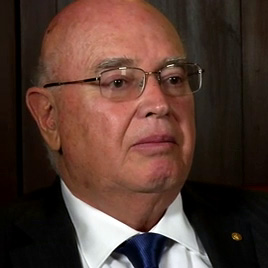
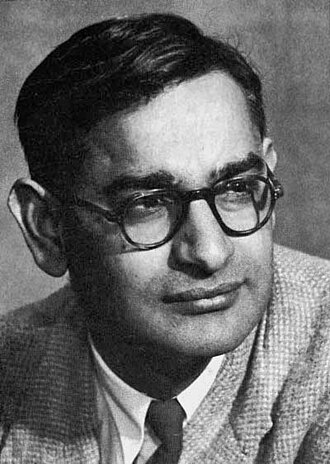
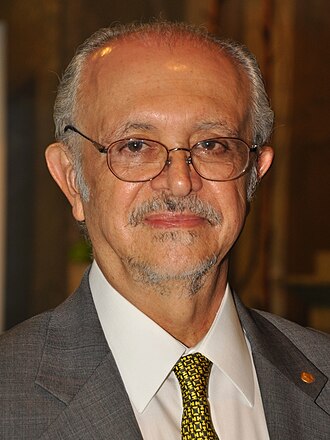
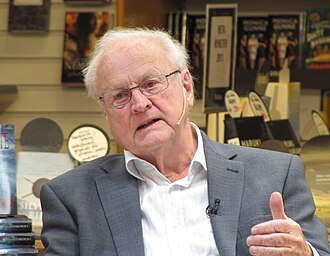
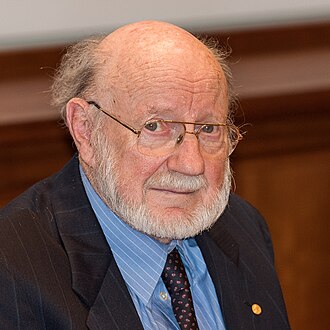
图:National Science Foundation · Public domain · Wikimedia Commons
加博尔·绍莫尔尧伊1935—2025
Gábor A. Somorjai
American chemist
加博尔·A·绍莫尔尧伊,出生于匈牙利布达佩斯,加州大学伯克利分校教授,同时任职于劳伦斯伯克利国家实验室,是表面化学和催化作用的重要研究者。1998年绍莫尔尧伊因在该领域的贡献获沃尔夫奖,2000年获鲍林奖,2002年获国家科学奖章,2008年获普利斯特里奖。
摘自维基百科「加博尔·绍莫尔尧伊」,CC BY-SA 4.0
- 出生
- 1935 年 5 月 4 日,布达佩斯
- 逝世
- 2025 年 7 月 7 日,帕洛阿尔托
- 国籍
- 美国、匈牙利
- 学科
- 化学
- 职业
- 化学家、大学教师
- 母语 / 工作语言
- 英语、匈牙利语
- 母校
- 布达佩斯技术与经济大学(1956 年)、加州大学伯克利分校(哲学博士,1960 年)
- 工作单位
- IBM、加州大学伯克利分校(1964—)、劳伦斯伯克利国家实验室
研究领域
师承
博士导师1
来自 Wikidata 的「博士导师」「师从」「博士生」「学生」记录,可能不全。
所获奖项(23)
- 1969古根海姆学者奖
- 1976美国物理学会会士
- 1981ACS Award in Colloid Chemistry
- 1982美国科学促进会会士
- 1983Centenary Prize
- 1989彼得·德拜奖
- 1990doctor honoris causa from the Pierre and Marie Curie University
- 1994ACS Award in Surface Chemistry
- 1995化学先驱奖
- 1997Von Hippel Award
- 1998沃尔夫化学奖
- 2000莱纳斯·鲍林奖
- 2000honorary doctor of Royal Institute of Technology
- 2001美国国家科学奖章
- 2003F. A. Cotton Medal
- 2006Remsen Award
- 2007朗缪尔奖
- 2008普里斯特利奖章
- 2010BBVA基金会前沿奖
- 2013美国国家科学院化工科学奖
- 2015威廉·H·尼克尔斯奖
- 2020Helmholtz Medal
- 2023恩里科·费米奖
学会与院士
百科正文
早年
1935年绍莫尔尧伊出生于匈牙利布达佩斯的一个犹太人家庭,因为拉乌尔·瓦伦贝格在1944年签发给他母亲的瑞典护照使得绍莫尔尧伊和他的妹妹逃过了被纳粹送入集中营的命运,而不幸被送入他的父亲纳粹集中营。尽管后来他的父亲幸存了下来,但绍莫尔尧伊的大多数亲属死在了纳粹的集中营中。
1956年,当时正在布达佩斯科技经济大学学习化学工程专业的绍莫尔尧伊参与了当年的匈牙利十月事件,因此在苏联军队入侵匈牙利后绍莫尔尧伊离开了匈牙利前往美国,1960年在加州大学伯克利分校获得博士学位。之后加入IBM位于纽约州的研发部门但在1964年再次回到伯克利担任助理教授。
化学研究
二十世纪50至60年代随着低能电子衍射(LEED)等新技术的引入引发了表面研究的革命,因为硅作为半导体具有重要电学性能,所以早期的表面研究局限在研究硅的表面性质。而绍莫尔尧伊对铂等具有重要化学性能的金属的表面性质更感兴趣。
绍莫尔尧伊发现催化剂表面的缺陷是催化反应发生的地方,这些缺陷位能促使化学键的断裂和形成从而合成复杂的有机化合物比如将石脑油重整成汽油。这些发现促使人们对物质的粘附性和润滑性、摩擦和吸附有了更深刻的理解。他的研究对纳米技术也有重要的影响。
二十世纪90年代绍莫尔尧伊开始与沈元壤合作开发和频光谱技术,这一技术可在无需真空腔的条件下研究表面反应。
以上内容摘自维基百科「加博尔·绍莫尔尧伊」,按 CC BY-SA 4.0 使用,去掉了参考文献、外部链接等尾部小节,公式改写成了纯文本。全文、配图和出处见原文。
英文维基百科补充中文条目比较短,下面是英文条目「Gábor A. Somorjai」的原文
Gabor Árpád Somorjai (May 4, 1935 – July 7, 2025) was a Hungarian-born American professor of chemistry at the University of California, Berkeley, and was a leading researcher in the field of surface chemistry and catalysis, especially the catalytic effects of metal surfaces on gas-phase reactions ("heterogeneous catalysis"). For his contributions to the field, Somorjai won the Wolf Prize in Chemistry in 1998, the Linus Pauling Award in 2000, the National Medal of Science in 2002, the Priestley Medal in 2008, the 2010 BBVA Foundation Frontiers of Knowledge Award in Basic Science and the NAS Award in Chemical Sciences in 2013. In April 2015, Somorjai was awarded the American Chemical Society's William H. Nichols Medal.
Early life
Somorjai was born in Budapest in 1935 to Jewish parents. He was saved from the Nazis when his mother sought the assistance of Raoul Wallenberg in 1944 who issued Swedish passports to Somorjai's mother, himself and his sister saving them from the Nazi death camps. While Somorjai's father ended up in the camp system, he was fortunate to survive but many of Somorjai's extended family were killed in the concentration camps.
He was studying chemical engineering at the Budapest University of Technology and Economics in 1956. As a participant in the 1956 Hungarian Revolution, Somorjai left Hungary to go to the US after the Soviet invasion. Along with other Hungarian immigrants, Somorjai enrolled in graduate study at Berkeley and obtained his doctorate in 1960. He joined IBM's Thomas J. Watson Research Center staff in Yorktown Heights, New York for a few years but returned to Berkeley as an assistant professor in 1964.
Chemical research
The introduction of new technology such as low-energy electron diffraction revolutionised the study of surfaces in the 1950s and 1960s. However, early studies were limited to surfaces such as silicon, important for its electrical properties. In contrast, Somorjai was interested in surfaces such as platinum known for its chemical properties.
Somorjai discovered that the defects on surfaces are where catalytic reactions take place. When these defects break, new bonds are formed between atoms leading to complex organic compounds such as naphtha to be converted into gasoline as an example. These findings led to greater understanding of subjects such as adhesion, lubrication, friction and adsorption. His research also has important implications such as nanotechnology.
In the 1990s, Somorjai started working with physicist Y. R. Shen on developing a technique known as Sum Frequency Generation Spectroscopy to study surface reactions without the need for a vacuum chamber.
Death
Somorjai died on July 7, 2025, at age 90.
Honors and awards
Somorjai was elected to the National Academy of Sciences in 1979 and the American Academy of Arts and Sciences in 1983. He was awarded the Wolf Foundation Prize in Chemistry in 1998 for his contribution to chemistry, sharing the honor with Professor Gerhard Ertl of the Fritz-Haber Institute in Berlin. Somorjai was awarded the National Medal of Science for his contribution as a chemist in 2002. The American Chemical Society also awarded him the Peter Debye Award in Physical Chemistry and the Adamson Award in Surface Chemistry. In 2002, he was awarded the status of University Professor across the University of California network, an honor he shares with two dozen other academics. In 2004, he won the F.A. Cotton Medal for Excellence in Chemical Research of the American Chemical Society. In 2008, he received the Priestley Medal, the highest award of the American Chemical Society, for his "extraordinarily creative and original contributions to surface science and catalysis".
The Somorjai Award
The Gabor A. Somorjai Award for Creative Research in Catalysis, consisting of US$5,000 and a certificate, is given annually to recognize outstanding research in the field of catalysis. The award is sponsored by the Gabor A. and Judith K. Somorjai Endowment Fund.
The Gabor A. and Judith K. Somorjai Visiting Miller Professorship Award
Established in 2011, the Gabor A. and Judith K. Somorjai Visiting Miller Professorship Award is one of the programs of the Miller Institute for Basic Research in Science at the University of California Berkeley. The Somorjais' wishes in the establishment of this award is to support visiting scientists in the broad field of chemical sciences for a one-month term in the Miller Institute. The first award was granted in 2013 to Angelos Michaelides.
以上节选摘自英文维基百科「Gábor A. Somorjai」,按 CC BY-SA 4.0 使用,去掉了参考文献、外部链接等尾部小节,公式改写成了纯文本。篇幅所限,较长的小节只摘了开头一部分,有的小节没有收;全文、配图和出处见原文。