格物
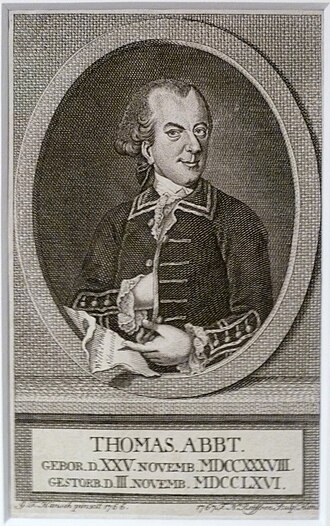
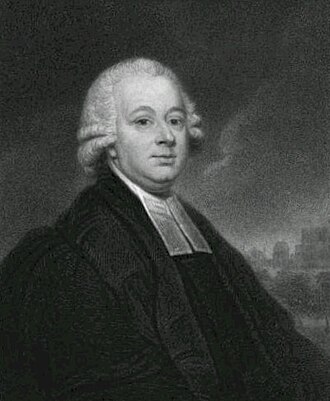
图:Castelargus · CC BY-SA 3.0 · Wikimedia Commons
- 出生
- 1738 年 11 月 25 日,乌尔姆
- 逝世
- 1766 年 11 月 3 日,比克堡
- 国籍
- 德国
- 学科
- 数学、博物与综合
- 职业
- 数学家、作家、哲学家、大学教师
- 母语 / 工作语言
- 德语
- 母校
- 哈雷-维滕贝格大学
- 工作单位
- 柏林洪堡大学、奥德河畔法兰克福欧洲大学
研究领域
百科正文
本条目暂无中文维基百科条目,下面是英文维基百科原文。
Education
Born in Ulm as the son of a wig-maker, Abbt visited a secondary school in Ulm, then moved in 1756 to study theology, philosophy and mathematics at the University of Halle, receiving a Magister degree in 1758. Abbt was a student of Georg Friedrich Meier and Johann Andreas Segner. Abbt was taught English by Segner. One year after submitting his doctoral dissertation Abbt received the formal permission to teach.
Career
In 1760 Abbt was appointed as an associate professor of philosophy at the University of Frankfurt (Oder), where he wrote his most well-known work Vom Tode für's Vaterland (1761).
This highly patriotic tract thematises Frederick II's defeat at Kunersdorf. It also drew the attention of the editors of the famous Literaturbriefe (Literary Letters), started by Gotthold Ephraim Lessing. He contributed a large number of historical, political, esthetical and philosophical essays. Abbt was a fervent admirer of Lessing and seconded his educational, prosaic style of writing.
In autumn 1761 he was appointed as full professor of mathematics in Rinteln. In 1763, he entered a competition that was sponsored by the Berlin Academy for an essay on the application of mathematical proofs to metaphysics. Among the competitors were Moses Mendelssohn, who won, and Immanuel Kant.
Abbt on sabbatical
Thomas Abbt wanted to grapple the exigencies of German social and intellectual life in a novel fashion. His work was an early attempt to create a space in which it became possible for individuals to think, talk, and act in reference to a larger socio-political whole. As Abbt finished up his studies, he took his professorship at the University of Frankfurt in 1760, where he began to work on "Dying for the Fatherland" in 1761. In early 1763 Abbt obtained the permission from his employer for a one year sabbatical. On his travels to Switzerland he visited Justus Möser, Johann Wilhelm von Archenholz, Friedrich Karl von Moser, Johann Daniel Schöpflin, and Isaak Iselin.
A lot of Abbt's work was an attempt to get the public life in the German society to act more for the good of the country, where he tries to motivate the people that anyone can be great.
Abbt's beliefs
In his writings he likes to express that there is an enlightened judgement for moral behavior and discussion. Within moral behavior, comes equality and Abbt emphasizes how the great women of the world are made of the same stuff as the great men. He believes that women should be relevant members of the informal public sphere, as it will bring good-heartedness and good-will. This is where here pushes for equality as he believes all help is needed, no matter what gender. Abbt also emphasizes that true religion is very strong, not a weakness, which will help transition things into a common good. As he believes that greatness is generally "in-born", it makes him less interested in reducing everyone to the same level, and would rather show how everyone can contribute.
Understanding Abbt's writing
Abbt was a different type of writer in his time, his primary audience was the middle and higher orders in Germany. After his death in 1770, he was honored for his writing on "Problem of Publikum", where he described and taught pure virtue along with innocence. This writing of his began to evolve as it was looked at as a vision which seemed to hold unlimited promise. In understanding Abbts writing, it is important to realize that there was a relationship between the German public sphere and the Enlightenment discourse within it. His vision of the informal public sphere existing more or less independently of government based on natural, human impulses, resonates with Shaftesbury in this regard.
In Abbt's book "On Dying for the Fatherland", he attempts to show a sense of public-spiritedness among his fellowship in every order.
Who influenced or was influenced by Abbt
Aufklärer like Abbt were concerned with nurturing a healthy social organism with their own individual development and emancipation. Other writers and philosophers such as Prussian philosopher Immanuel Kant tried tying "Enlightenment" directly to "Problem of Publikum", but found difficulty in the isolated individual. This project was begun by Abbt, which was carried on by Immanuel Kant and Johann Gottfried Herder who had different thoughts on it. Herder differed from Kant's more rationalist project, but the statues of the "Problem of Publikum" was a problem of the Aufklärer and of modern German history.
In the early 1760s Abbt and Moses Mendelssohn had been engaged in a translation of Shaftesbury, as they express their interest in the "public" as the measure of all "true" virtue.
Main message sent to his readers
Between Abbt's two famous works of "On Dying for the Fatherland (1761) and "On Merit" (1765), he tries to "overcome the basic German problem of a fragmented public sphere with enlightened argument designed to lead readers to locate themselves and their well-being in an enlarged societal frame." As he tried to fix this German problem within the public, his enlightened argument is pointed at people in leadership positions or people that have the opportunity to make a difference, in doing something positive for their community around them.
Abbt wrote that Germans lack a common interest, as he asks about the "volk" even though you are not supposed to ask about the "volk" as you are supposed to let it be as it has to pay for its dues. But, he wanted to show his readers what not to do by mentioning them.
Abbt receiving recognition
Abbt was honored for being the writer of "The Publikum" and a teacher of virtue and innocence, where people understood his points and listened to them. He took Professorship in Philosophy in 1760, which is when he wrote famous novel, "On Dying for the Fatherland", brought Abbt a lot of instant recognition. After writing it, he came into contact with Aufklärer and Moses Mendelssohn, who asked him to become a regular contributor to the "letters concerning the newest literature". In accepting this offer, Abbt's work became more public and often more present to readers eyes, where he could have easier access in influencing people. This novel also gave him the title of a full professorship in mathematics at the University of Rinteln.
References and sources
- References
- Sources
- Allgemeine Deutsche Biographie - online version at Wikisource
Eva Piirimäe, "Dying for the fatherland: Thomas Abbt's theory of aesthetic patriotism," History of European Ideas, 35,2 (2009), 194–208.
以上节选摘自英文维基百科「Thomas Abbt」,按 CC BY-SA 4.0 使用,去掉了参考文献、外部链接等尾部小节,公式改写成了纯文本。篇幅所限,较长的小节只摘了开头一部分,有的小节没有收;全文、配图和出处见原文。
同一学科、同时代的科学家


同一学科的科学家
更多 ›