格物
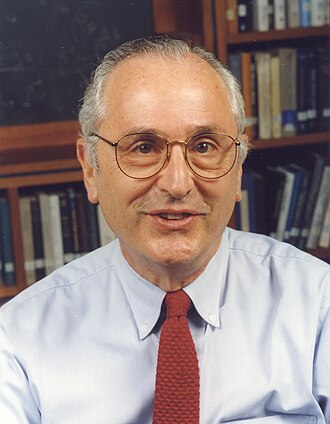
图:Dan Bahcall · CC BY-SA 3.0 · Wikimedia Commons
约翰·诺利斯·巴寇1934—2005
John N. Bahcall
American physicist (1934–2005)
约翰·诺里斯·巴考尔,美国天体物理学家,最知名于对太阳中微子问题的贡献,对哈勃空间望远镜的开发和对普林斯顿高级研究院的领导,曾与埃利·沃克斯曼共同提出沃克斯曼-巴考尔界限。
摘自维基百科「约翰·巴考尔」,CC BY-SA 4.0
- 出生
- 1934 年 12 月 30 日,什里夫波特
- 逝世
- 2005 年 8 月 17 日,纽约
- 国籍
- 美国
- 学科
- 物理学、天文学、博物与综合
- 职业
- 天文学家、天体物理学家、物理学家、大学教师
- 母语 / 工作语言
- 英语
- 母校
- 哈佛大学(哲学博士,1961 年)、芝加哥大学、加州大学伯克利分校、路易斯安那州立大学、C. E. Byrd High School
- 工作单位
- 加州理工学院、印第安纳大学
研究领域
师承
博士生1
来自 Wikidata 的「博士导师」「师从」「博士生」「学生」记录,可能不全。
所获奖项(13)
- 1970海伦·B·华纳天文奖
- 1994德尼·海内门天文物理奖
- 1994内华达奖章
- 1998汉斯·A·贝特奖
- 1998美国国家科学奖章
- 1999亨利·诺利斯·罗素讲座
- 2003富兰克林研究所奖项
- 2003英国皇家天文学会金质奖章
- 2003丹大卫奖
- 2003恩里科·费米奖
- 2004科姆斯托克物理学奖
- —美国物理学会会士
- —美国文理科学院院士
学会与院士
百科正文
奖项和荣誉
- 海伦·B·华纳天文学奖 (1970年)
- 美国文理科学院院士 (1976年)
- 美国航天局杰出公共服务奖章 (1992年)
- 丹尼·海涅曼天体物理学奖 (1994年)
- 汉斯·A·贝特奖 (1998年)
- 美国国家科学奖章 (1998年)
- 亨利·诺里斯·罗素讲座 (1999年)
- 丹·戴维奖 (2003年)
- 皇家天文学会金质奖章 (2003年)
- 费米奖 (2003年)
- 本杰明·富兰克林奖章 (2003年)
- 成就学院金板奖(2004年)
- 美国国家科学院康斯托克物理学奖 (2004年)
以上内容摘自维基百科「约翰·巴考尔」,按 CC BY-SA 4.0 使用,去掉了参考文献、外部链接等尾部小节,公式改写成了纯文本。全文、配图和出处见原文。
英文维基百科补充中文条目比较短,下面是英文条目「John N. Bahcall」的原文
John Norris Bahcall (December 30, 1934 – August 17, 2005) was an American astrophysicist and the Richard Black Professor for Astrophysics at the Institute for Advanced Study. He was known for a wide range of contributions to solar, galactic and extragalactic astrophysics, including the solar neutrino problem, the development of the Hubble Space Telescope, and his leadership and development of the Institute for Advanced Study in Princeton.
Early life and education
Bahcall was born into a Jewish family in Shreveport, Louisiana on December 30, 1934, and would later describe an early aspiration to become a Reform rabbi. He did not take science classes at high school. In high school he was a state tennis champion and a national debate champion (1952).
Bahcall began his university studies at Louisiana State University as a philosophy student on a tennis scholarship, where he considered pursuing the rabbinate. At the end of his freshman year, he transferred to the University of California, Berkeley, still studying philosophy. He took his first physics class to fulfill a graduation science requirement, later saying:
"It was the hardest thing I have ever done in my life, but I fell in love with science. I was thrilled by the fact that by knowing physics you could figure out how real things worked, like sunsets and airplanes, and that after a while everyone agreed on what was the right answer to a question."
Bahcall switched majors to physics, and graduated with an AB in Physics from Berkeley in 1956. He obtained his MS in physics in 1957 from the University of Chicago and his PhD in physics from Harvard University in 1961.
He spent a year as a research fellow in physics with Emil Konopinski at Indiana University.
Academic career
Bahcall joined the Institute for Advanced Study in Princeton, New Jersey in 1968 becoming a professor of natural sciences in 1971 and the Richard Black Professor of Natural Sciences in 1997.
Bahcall became a member of the National Academy of Sciences in 1976.
He was president of the American Astronomical Society from 1990 to 1992, and was president-elect of the American Physical Society at the date of his death.
Research
Bahcall published over six hundred scientific papers and wrote or edited nine books on astrophysics.
He is most notable for his work in establishing the standard solar model. He spent much of his life pursuing the solar neutrino problem with physical chemist Raymond Davis, Jr. Together, Davis and Bahcall collaborated on the Homestake Experiment. To test Bahcall's theoretical predictions, Davis created an underground detector for neutrinos in a South Dakota gold mine, essentially a large tank filled with cleaning fluid. The flux of neutrinos found by the detector was one-third the amount theoretically predicted by Bahcall, a discrepancy that took over thirty years to resolve. Bahcall's ongoing research in this area resulted in publication of his book Neutrino Astrophysics (1989), considered a standard reference on solar neutrinos.
The 2002 Nobel Prize in physics was awarded to Davis and Masatoshi Koshiba for their pioneering work in observing the neutrinos predicted from Bahcall's solar model, thereby vindicating Bahcall's prediction.
In addition to his work on solar neutrinos, Bahcall collaborated with Eli Waxman on the Waxman-Bahcall bound for high energy neutrinos. This bound sets a limit on high energy neutrino flux based on the observed flux of high energy cosmic rays.
Personal life and death
Bahcall married Princeton University astrophysics professor Neta Bahcall, whom he met as a graduate student at the Weizmann Institute in the 1960s. They had a daughter and two sons (including Safi Bahcall).
He died in New York on 17 August 2005, from a rare blood disorder.
Honors
- 2006, Exceptional Scientific Achievement Medal (posthumous), NASA
- 2004, Academy of Achievement, Golden Plate Award
- 2004, Comstock Prize in Physics from the National Academy of Sciences
- 2003, Gold Medal of the Royal Astronomical Society
- 2003, Benjamin Franklin Medal (with Raymond Davis, Jr. and Masatoshi Koshiba)
- 2003, Dan David Prize
- 2003, Fermi Award (with Raymond Davis, Jr)
- 2001, Member of the American Philosophical Society
- 1999, Henry Norris Russell Lectureship
- 1998, National Medal of Science
- 1998, Hans Bethe Prize
- 1994, Heineman Prize
- 1992, NASA Distinguished Public Service Medal, NASA
- 1976, Fellow of the American Academy of Arts and Sciences
- 1970, Helen B. Warner Prize
以上节选摘自英文维基百科「John N. Bahcall」,按 CC BY-SA 4.0 使用,去掉了参考文献、外部链接等尾部小节,公式改写成了纯文本。篇幅所限,较长的小节只摘了开头一部分,有的小节没有收;全文、配图和出处见原文。
同年获同一奖项
同一学科、同时代的科学家




同一学科的科学家
更多 ›