格物

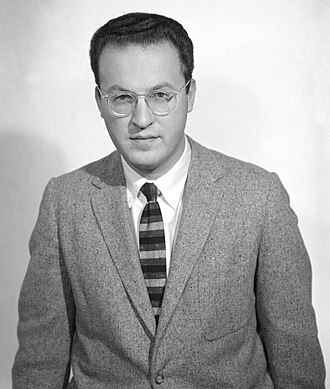
图:CERN · CC BY-SA 4.0 · Wikimedia Commons
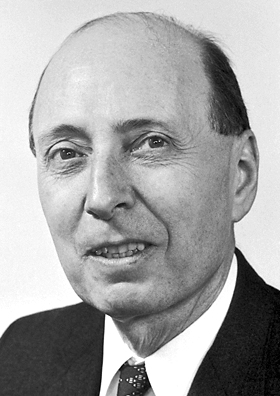
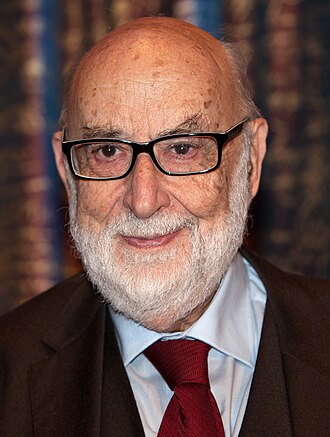
莱昂·范霍夫1924—1990
Léon van Hove
Belgian physicist, Director General of CERN (1924–1990)
Léon Charles Prudent Van Hove was a Belgian physicist and a Director General of CERN. He developed a scientific career spanning mathematics, solid state physics, elementary particle and nuclear physics to cosmology.
摘自英文维基百科「Léon Van Hove」(英文维基百科,暂无中文条目),CC BY-SA 4.0
- 出生
- 1924 年 2 月 10 日,布鲁塞尔城市圈
- 逝世
- 1990 年 9 月 2 日,日内瓦
- 国籍
- 比利时
- 学科
- 物理学、博物与综合
- 职业
- 物理学家、大学教师、核物理学家
- 母语 / 工作语言
- 法语
- 母校
- 法语布鲁塞尔自由大学
- 工作单位
- 乌得勒支大学(1954—1964)、莱顿大学(1981—1982)、奈梅亨拉德伯德大学(1982—1988)
研究领域
师承
博士导师1
博士生5
来自 Wikidata 的「博士导师」「师从」「博士生」「学生」记录,可能不全。
所获奖项(5)
- 1958法朗基奖
- 1962希纳曼数学物理奖
- 1974马克斯·普朗克奖章
- —doctor honoris causa of the University of Helsinki
- —honorary doctor of the University of Warsaw
学会与院士
百科正文
本条目暂无中文维基百科条目,下面是英文维基百科原文。
Biography
Van Hove studied mathematics and physics at the Université libre de Bruxelles (ULB). In 1946 he received his PhD in mathematics at the ULB. From 1949 to 1954 he worked at the Institute for Advanced Study in Princeton, New Jersey by virtue of his meeting with Robert Oppenheimer. Later he worked at the Brookhaven National Laboratory and was a professor and Director of the Theoretical Physics Institute at the University of Utrecht in the Netherlands. In the 1950s he laid the theoretical foundations for the analysis of inelastic neutron scattering in terms of the dynamic structure factor. In 1958, he was awarded the Francqui Prize in Exact Sciences. In 1959, he received an invitation to become the head of the Theory Division at CERN in Geneva. In 1975 Prof. Van Hove was appointed CERN Director-General, with John Adams, responsible for the research activities of the Organization. The LEP project was proposed during Van Hove's tenure as Director General.
Controversies
In 1963–64, George Zweig developed a particle physics model in which hadrons comprise fundamental constituents called "aces," independently of Murray Gell-Mann's quark model. As head of CERN's Theory Division, Van Hove opposed the work, reportedly refusing permission for journal submission, instructing staff not to type the manuscript, and cancelling a seminar where Zweig planned to present it. Zweig instead circulated the work as CERN preprints, which became influential despite not being formally published. Van Hove's actions substantially reduced the visibility of Zweig's work at a critical moment and are widely regarded as having contributed to Zweig's failure to receive the recognition that ultimately culminated in Gell-Mann alone receiving the 1969 Nobel Prize. Van Hove cited publication policy, though scientific skepticism toward fractionally charged constituents likely also played a role. Today, both Zweig and Gell-Mann are recognized as independent originators of the quark model.
Awards
- Francqui Prize, 1958
- Dannie Heineman Prize for Mathematical Physics, 1962
- Member, American Academy of Arts and Sciences, 1964
- Max Planck Medal, 1974
- Member, United States National Academy of Sciences, 1980
- Member, American Philosophical Society, 1980
There is a square, Square Van Hove, named after Van Hove at CERN, Geneva, Switzerland.
以上内容摘自英文维基百科「Léon Van Hove」,按 CC BY-SA 4.0 使用,去掉了参考文献、外部链接等尾部小节,公式改写成了纯文本。全文、配图和出处见原文。
同一学科、同时代的科学家


同一学科的科学家
更多 ›