格物
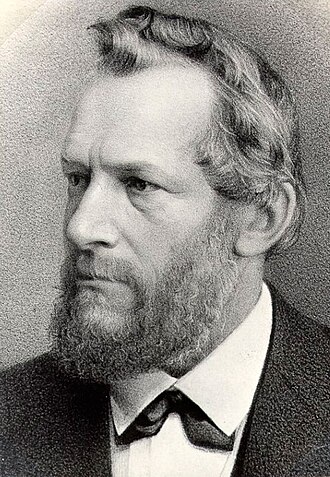
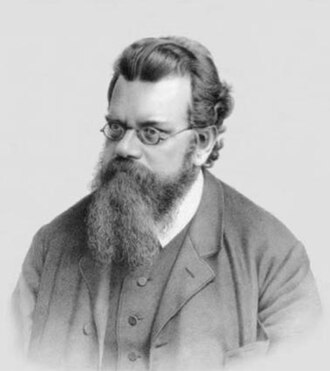
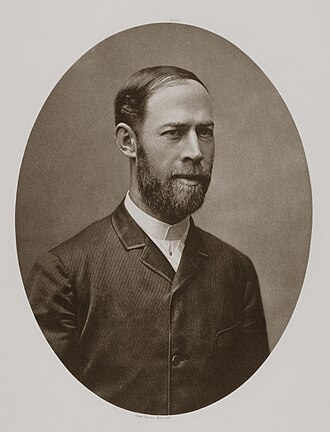
图:作者不详 · Public domain · Wikimedia Commons
- 出生
- 1818 年 11 月 7 日,柏林
- 逝世
- 1896 年 12 月 26 日,柏林
- 国籍
- 普鲁士王国
- 学科
- 物理学、生物学、医学、博物与综合
- 职业
- 医生、生理学家、大学教师、物理学家
- 母语 / 工作语言
- 德语、法语
- 母校
- 波恩大学、柏林洪堡大学、柏林法国文理中学(1837 年)
- 工作单位
- 弗里德里希·威廉大学(1855—)、柏林艺术学院(1849—)
研究领域
师承
博士导师1
来自 Wikidata 的「博士导师」「师从」「博士生」「学生」记录,可能不全。
所获奖项(5)
- 1873巴伐利亚马克西米兰科学与艺术勋章
- 1877Pour le Mérite for Sciences and Arts order
- 1877英国皇家学会外籍会员
- 1892Helmholtz Medal
- —维也纳大学荣誉博士
学会与院士
百科正文
生平
1818年出生于普鲁士王国柏林,1838年进入柏林大学,博士导师为约翰内斯·彼得·缪勒,两次担任柏林大学校长,他的名言有“我们现在不知道,将来也不知道”。1870年,杜布瓦-雷蒙以柏林大学校长的身份发表演讲,称“柏林大学,坐落于王宫对面,从根本上来说,是霍亨索伦王朝的知识保镖(或智力保镖,geistige Leibregiment des Hauses Hohenzollern)”。
知名学生有威廉·詹姆士、尤里乌斯·伯恩施坦。
以上内容摘自维基百科「埃米爾·杜布瓦-雷蒙」,按 CC BY-SA 4.0 使用,去掉了参考文献、外部链接等尾部小节,公式改写成了纯文本。全文、配图和出处见原文。
英文维基百科补充中文条目比较短,下面是英文条目「Emil du Bois-Reymond」的原文
Emil Heinrich du Bois-Reymond (7 November 1818 – 26 December 1896) was a German physiologist, the co-discoverer of nerve action potential, and the developer of experimental electrophysiology. His lectures on science and culture earned him great esteem during the latter half of the 19th century.
Life
Du Bois-Reymond was born in Berlin and spent his life there. His father was a poor immigrant from Neuchâtel, and his mother was a Berliner of prominent Huguenot origin. Emil had two sisters and two brothers, of whom one, Paul (2 December 1831 – 7 April 1889), became a distinguished mathematician.
Educated first at the French College in Berlin, du Bois-Reymond enrolled in the University of Berlin in 1838. He seems to have been uncertain at first as to the topic of his studies, for he was a student of the renowned ecclesiastical historian August Neander, and dallied with Naturphilosophie, geology, and physics, but eventually began to study medicine with such zeal and success as to attract the notice of Johannes Peter Müller (1801–1858), a well-known professor of anatomy and physiology.
Müller's earlier studies had been distinctly physiological, but his preferences caused him later to study comparative anatomy. He had, about the time when the young du Bois-Reymond came to his lectures, published his Elements of Physiology, which contains the following statement:
Though there appears to be something in the phenomena of living beings which cannot be explained by ordinary mechanical, physical or chemical laws, much may be so explained, and we may without fear push these explanations as far as we can, so long as we keep to the solid ground of observation and experiment.
In 1840 Müller made du Bois-Reymond his assistant in physiology, and as the beginning of an inquiry gave him a copy of the essay which the Italian physicist Carlo Matteucci had just published on the electric phenomena of animals. This determined the work of du Bois-Reymond's life. He chose as the subject of his graduation thesis Electric fishes, and so commenced a long series of investigations on bioelectricity. The results of these inquiries were made known partly in papers communicated to scientific journals, but also and chiefly by his work Investigations of Animal Electricity, the first part of which was published in 1848, the last in 1884.
Oratory
On nationalism
Following France's declaration of war on Prussia on 3 August 1870, du Bois-Reymond proclaimed that "the University of Berlin, quartered opposite the King's palace, is, by the deed of its foundation, the intellectual bodyguard (das geistige Leibregiment) of the House of Hohenzollern." But by the time of France's surrender on 26 January 1871 du Bois-Reymond had come to regret his words, lamenting the "national hatred of two embittered peoples." His 1878 lecture "On National Feeling" expanded on this topic, offering one of the earliest analyses of nationalism after those of Lord Acton and Fustel de Coulanges.
On history
In 1877 du Bois-Reymond presented a view of the past that highlighted science as the sole endeavor that demonstrated any improvement. "Science is the chief instrument of civilization," he wrote, "and the history of science the essential history of humanity.” In 1936 his argument was repeated by George Sarton in a lecture inaugurating a seminary in the history of science at Harvard University:Definition. Science is systematized positive knowledge, or what has been taken as such at different ages and in different places.
Theorem. The acquisition and systematization of positive knowledge are the only human activities which are truly cumulative and progressive.
Corollary. The history of science is the only history which can illustrate the progress of mankind. In fact, progress has no definite and unquestionable meaning in other fields than the field of science.One historiographer described du Bois-Reymond's attention to the history of science as "the first and indeed the most decisive attack on established historical scholarship" in the 19th century.
On Darwinism
Du Bois-Reymond was the first German professor to convert to Darwinism. He expounded the theory in popular classes at the University of Berlin, in itinerant lectures in the Ruhr and the Rhineland, and in formal addresses translated and reprinted across Europe and North America. Unlike his rival Ernst Haeckel, du Bois-Reymond espoused a mechanistic interpretation of natural selection that anticipated modern views.
以上节选摘自英文维基百科「Emil du Bois-Reymond」,按 CC BY-SA 4.0 使用,去掉了参考文献、外部链接等尾部小节,公式改写成了纯文本。篇幅所限,较长的小节只摘了开头一部分,有的小节没有收;全文、配图和出处见原文。
同一学科、同时代的科学家



同一学科的科学家
更多 ›