格物
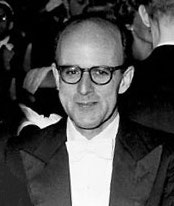
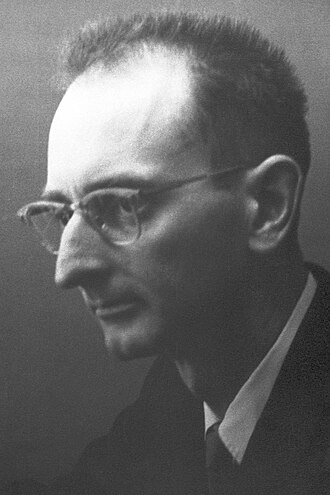
图:Unknown, SVENSKT PRESSFOTO · Public domain · Wikimedia Commons
马克斯·佩鲁茨1914—2002
Max Perutz
生物学家, 英国
马克斯·费迪南德·佩鲁茨,OM,奥地利-英国分子生物学家,1962年因“对球状蛋白质结构的研究”获诺贝尔化学奖。
摘自维基百科「马克斯·佩鲁茨」,CC BY-SA 4.0
- 出生
- 1914 年 5 月 19 日,维也纳
- 逝世
- 2002 年 2 月 6 日,剑桥
- 国籍
- 英国、奥地利、大不列颠及爱尔兰联合王国
- 学科
- 物理学、化学、生物学、地球科学
- 职业
- 分子生物学家、化学家、大学教师、晶体学家
- 母语 / 工作语言
- 英语、德语
- 母校
- 剑桥大学彼得学院、维也纳大学、剑桥大学、特蕾西亚学校
- 工作单位
- 剑桥大学、约克大学
研究领域
主要贡献
代表成就
师承
博士生4
来自 Wikidata 的「博士导师」「师从」「博士生」「学生」记录,可能不全。
所获奖项(15)
- 1962诺贝尔化学奖
- 1967威廉·埃斯内奖章
- 1967奥地利共和国科学与艺术荣誉十字勋章
- 1968汉斯·克雷布斯爵士奖
- 1968克鲁内演讲
- 1971皇家奖章
- 1979科普利奖章
- 1993奥托·瓦尔堡奖章
- 1993honorary doctorate from University of Paris-XI
- —大英帝国司令勋章
- —Pour le Mérite for Sciences and Arts order
- —维也纳大学荣誉博士
- —honorary doctorate of Salzburg University
- —美国文理科学院院士
- —Honorary member of the British Biophysical Society
学会与院士
百科正文
英文维基百科补充中文条目比较短,下面是英文条目「Max Perutz」的原文
Max Ferdinand Perutz (19 May 1914 – 6 February 2002) was an Austrian-born British molecular biologist, who shared the 1962 Nobel Prize for Chemistry with John Kendrew, for their studies of the structures of haemoglobin and myoglobin. He went on to win the Royal Medal of the Royal Society in 1971 and the Copley Medal in 1979. At Cambridge he founded and chaired (1962–79) The MRC Laboratory of Molecular Biology (LMB), fourteen of whose scientists have won Nobel Prizes.
Early life and education
Perutz was born in Vienna, the son of Adele "Dely" (Goldschmidt) and Hugo Perutz, a textile manufacturer. His parents were Jewish by ancestry, but had baptised Perutz in the Catholic religion. Although Perutz rejected religion and was an atheist in his later years, he was against offending others for their religious beliefs.
His parents hoped that he would become a lawyer, but he became interested in chemistry while at school. Overcoming his parents' objections he enrolled as a chemistry undergraduate at the University of Vienna and completed his degree in 1936. Made aware by lecturer Fritz von Wessely of the advances being undertaken at the University of Cambridge into biochemistry by a team led by Gowland Hopkins, he asked Professor Mark, who was soon to visit Cambridge, to make inquiries of Hopkins about whether there would be a place for him. Mark forgot, but had visited J.D. Bernal, who was looking for a research student to assist him with studies into X-ray crystallography. Perutz was dismayed as he knew nothing about the subject. Mark countered by saying that he would soon learn. Bernal accepted him as a research student in his crystallography research group at the Cavendish Laboratory. His father had deposited £500 with his London agent to support him. He learnt quickly. Bernal encouraged him to use the X-ray diffraction method to study the structure of proteins. As protein crystals were difficult to obtain, he used horse haemoglobin crystals, and began his doctoral thesis on its structure. Haemoglobin was a subject which was to occupy him for most of his professional career. He completed his Ph.D. under Lawrence Bragg in 1940.
He applied to Kings and St. John's colleges, and became a member of Peterhouse, on the basis that it served the best food. He was elected an Honorary Fellow of Peterhouse in 1962. He took a keen interest in the Junior Members, and was a regular and popular speaker at the Kelvin Club, the college's scientific society.
World War II
When Hitler took over Austria in 1938, Perutz's parents managed to escape to Switzerland, but they had lost all of their money. As a result, Perutz lost their financial support. With his ability to ski, experience in mountaineering since childhood and his knowledge of crystals, Perutz was accepted as a member of a three-man team to study the conversion of snow into ice in Swiss glaciers in the summer of 1938. His resulting article for the Proceedings of the Royal Society made him known as an expert on glaciers.
Lawrence Bragg, who was Professor of Experimental Physics at the Cavendish, thought that Perutz's research into haemoglobin had promise and encouraged him to apply for a grant from the Rockefeller Foundation to continue his research. The application was accepted in January 1939 and with the money Perutz was able to bring his parents from Switzerland to England in March 1939.
On the outbreak of World War II, Perutz was rounded up along with other persons of German or Austrian background, and sent to Newfoundland (on orders from Winston Churchill). After being interned for several months he returned to Cambridge.
Because of his pre-War research into the changes in the arrangement of the crystals in the layers of a glacier, he was asked for advice on whether if a battalion of commandos were landed in Norway, could they be hidden in shelters under glaciers. His knowledge on the subject of ice then led to him being recruited for Project Habakkuk in 1942.
Personal life
In 1942, Perutz married Gisela Clara Mathilde Peiser (1915–2005), a medical photographer. They had two children, Vivien (b. 1944), an art historian; and Robin (b. 1949), a professor of chemistry at the University of York. Gisela was a refugee from Germany (she was a Protestant whose own father had been born Jewish).
He died on 6 February 2002 and his ashes were interred with his parents Hugo Perutz and Dely Perutz in the Parish of the Ascension Burial Ground in Cambridge. Gisela died on 17 December 2005 and her ashes were interred in the same grave.
以上节选摘自英文维基百科「Max Perutz」,按 CC BY-SA 4.0 使用,去掉了参考文献、外部链接等尾部小节,公式改写成了纯文本。篇幅所限,较长的小节只摘了开头一部分,有的小节没有收;全文、配图和出处见原文。
同年获同一奖项
同一学科、同时代的科学家


同一学科的科学家
更多 ›