格物
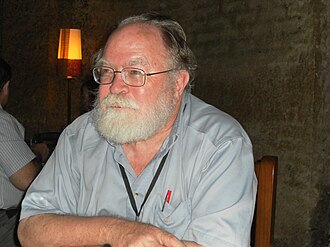
图:Sijothankam · CC BY-SA 3.0 · Wikimedia Commons
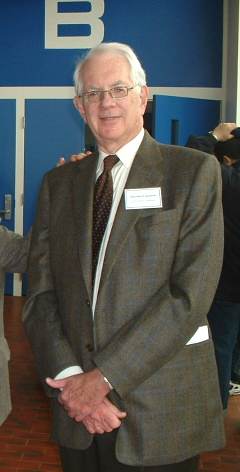
詹姆士·约克1941—
James A. Yorke
mathematician, researcher ORCID ID = 0000-0002-9599-0136
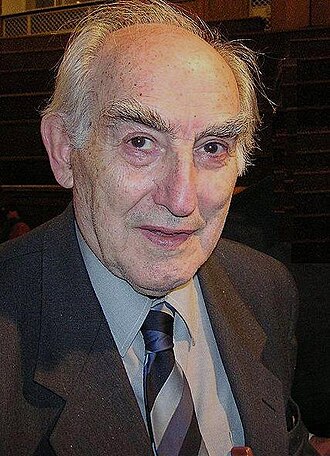
詹姆斯·阿兰·约克,美国数学家和理论物理学家,马里兰大学学院市分校数学和物理和数学系前任系主任。
摘自维基百科「詹姆士·约克」,CC BY-SA 4.0
- 出生
- 1941 年 8 月 3 日,普兰菲尔德
- 国籍
- 美国
- 学科
- 物理学、数学、博物与综合
- 职业
- 物理学家、大学教师、理论物理学家、数学家
- 母语 / 工作语言
- 英语
- 母校
- 哥伦比亚大学、马里兰大学科利奇帕克分校、勒阿弗尔大学
- 工作单位
- 马里兰大学科利奇帕克分校
研究领域
师承
博士导师1
博士生42
来自 Wikidata 的「博士导师」「师从」「博士生」「学生」记录,可能不全。
所获奖项(6)
- 2003美国物理学会会士
- 2003日本国际奖
- 2013Fellow of the Society for Industrial and Applied Mathematics
- 2013美国数学会会士
- 2016汤森路透引文桂冠奖
- —古根海姆学者奖
学会与院士
百科正文
他和本华·曼德博是2003年日本国际奖科学技术领域的获得者。约克被选定是因为他的混沌理论的研究成果。在2012年,他成为了美国数学学会的资深会员。
以上内容摘自维基百科「詹姆士·约克」,按 CC BY-SA 4.0 使用,去掉了参考文献、外部链接等尾部小节,公式改写成了纯文本。全文、配图和出处见原文。
英文维基百科补充中文条目比较短,下面是英文条目「James A. Yorke」的原文
James Alan Yorke (born August 3, 1941) is an American mathematician who is a Distinguished University Research Professor of Mathematics and Physics and former chair of the Mathematics Department at the University of Maryland, College Park.
Life and career
Born in Plainfield, New Jersey, United States, Yorke attended The Pingry School, then located in Hillside, New Jersey. He received his PhD at the University of Maryland College Park in 1966, under the supervision of Aaron Strauss. in Yorke is now a Distinguished University Research Professor of Mathematics and Physics with the Institute for Physical Science and Technology at the University of Maryland. In June 2013, Yorke retired as chair of the University of Maryland's Math department. He devotes his university efforts to collaborative research in chaos theory and genomics.
He and Benoit Mandelbrot were the recipients of the 2003 Japan Prize in Science and Technology: Yorke was selected for his work in chaotic systems. In 2003 he was elected a Fellow of the American Physical Society, and in 2012 became a fellow of the American Mathematical Society.
He received the Doctor Honoris Causa degree from the Universidad Rey Juan Carlos, Madrid, Spain, in January 2014. In June 2014, he received the Doctor Honoris Causa degree from Le Havre University, Le Havre, France. He was a 2016 Thomson Reuters Citations Laureate in Physics.
Contributions
Period three implies chaos
He and his co-author T.Y. Li coined the mathematical term chaos in a paper they published in 1975 entitled Period three implies chaos, in which it was proved that every one-dimensional continuous map
F: R → R
that has a period-3 orbit must have two properties:
(1) For each positive integer p, there is a point in R that returns to where it started after p applications of the map and not before.
This means there are infinitely many periodic points (any of which may or may not be stable): different sets of points for each period p. This turned out to be a special case of Sharkovskii's theorem.
The second property requires some definitions. A pair of points x and y is called “scrambled” if as the map is applied repeatedly to the pair, they get closer together and later move apart and then get closer together and move apart, etc., so that they get arbitrarily close together without staying close together. The analogy is to an egg being scrambled forever, or to typical pairs of atoms behaving in this way. A set S is called a scrambled set if every pair of distinct points in S is scrambled. Scrambling is a kind of mixing.
(2) There is an uncountably infinite set S that is scrambled.
A map satisfying Property 2 is sometimes called "chaotic in the sense of Li and Yorke". Property 2 is often stated succinctly as their article's title phrase "Period three implies chaos". The uncountable set of chaotic points may, however, be of measure zero (see for example the article Logistic map), in which case the map is said to have unobservable nonperiodicity or unobservable chaos.
O.G.Y. control method
He and his colleagues (Edward Ott and Celso Grebogi) had shown with a numerical example that one can convert a chaotic motion into a periodic one by a proper time-dependent perturbation of the parameter. This article is considered a classic among the works in the control theory of chaos, and their control method is known as the O.G.Y. method.
以上内容摘自英文维基百科「James A. Yorke」,按 CC BY-SA 4.0 使用,去掉了参考文献、外部链接等尾部小节,公式改写成了纯文本。全文、配图和出处见原文。
同年获同一奖项
同一学科、同时代的科学家




同一学科的科学家
更多 ›