格物
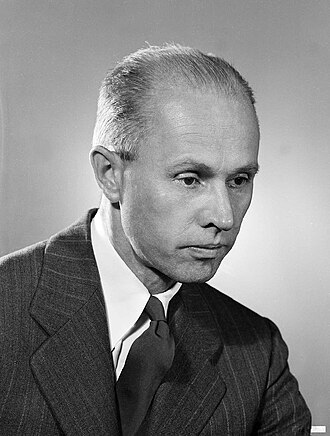
图:Los Alamos National Laboratory · Attribution · Wikimedia Commons
乔治·基斯提亚科斯基1900—1982
George Kistiakowsky
Ukrainian-American physical chemistry professor
乔治·博格丹诺维奇·基斯佳科夫斯基,乌克兰裔美国物理学家,哈佛大学的物理化学教授,曾参与过曼哈顿计划,并在国防部科研委员会中负责爆炸物的相关研究工作,后任艾森豪政府的美国总统科学顾问。
摘自维基百科「乔治·基斯佳科夫斯基」,CC BY-SA 4.0
- 出生
- 1900 年 11 月 18 日,塔拉西夫卡
- 逝世
- 1982 年 12 月 7 日,剑桥
- 国籍
- 俄罗斯帝国、美国
- 学科
- 物理学、化学、博物与综合
- 职业
- 物理学家、化学家、大学教师、核物理学家
- 母语 / 工作语言
- 英语
- 母校
- 柏林洪堡大学
- 工作单位
- 普林斯顿大学、哈佛大学
研究领域
师承
博士导师1
博士生4
来自 Wikidata 的「博士导师」「师从」「博士生」「学生」记录,可能不全。
所获奖项(10)
- 1947威廉·H·尼克尔斯奖
- 1960英国皇家学会外籍会员
- 1961Centenary Prize
- 1961查尔斯·拉瑟罗普·帕森斯奖
- 1967美国国家科学奖章
- 1968彼得·德拜奖
- 1972富兰克林奖
- 1972普里斯特利奖章
- —威拉德·吉布斯奖
- —美国物理学会会士
学会与院士
百科正文
英文维基百科补充中文条目比较短,下面是英文条目「George Kistiakowsky」的原文
George Bogdanovich Kistiakowsky (Russian: Георгий Богданович Кистяковский, Ukrainian: Георгій Богданович Кістяківський, romanized: Heorhii Bohdanovych Kistiakivskyi; 1 December [O.S. 18 November] 1900 – December 7, 1982) was a Ukrainian-American physical chemistry professor at Harvard who participated in the Manhattan Project and later served as President Dwight D. Eisenhower's Science Advisor.
Born in Boyarka in the old Russian Empire, into "an old Ukrainian Cossack family which was part of the intellectual elite in pre-revolutionary Russia", Kistiakowsky fled his homeland during the Russian Civil War. He made his way to Germany, where he earned his PhD in physical chemistry under the supervision of Max Bodenstein at the University of Berlin. He emigrated to the United States in 1926, where he joined the faculty of Harvard University in 1930, and became a citizen in 1933.
During World War II, Kistiakowsky was the head of the National Defense Research Committee (NDRC) section responsible for the development of explosives, and the technical director of the Explosives Research Laboratory (ERL), where he oversaw the development of new explosives, including RDX and HMX. He was involved in research into the hydrodynamic theory of explosions, and the development of shaped charges. In October 1943, he was brought into the Manhattan Project as a consultant. He was soon placed in charge of X Division, which was responsible for the development of the explosive lenses necessary for an implosion-type nuclear weapon. In July 1945, he watched the first atomic explosion in the Trinity test. A few weeks later, another implosion-type weapon (Fat Man) was dropped on Nagasaki.
From 1962 to 1965, Kistiakowsky chaired the National Academy of Sciences's Committee on Science, Engineering, and Public Policy (COSEPUP), and was its vice president from 1965 to 1973. He severed his connections with the government in protest against the war in Vietnam, and became active in an antiwar organization, the Council for a Livable World, becoming its chairman in 1977.
Early life
George Bogdanovich Kistiakowsky was born in Boyarka, in the Kyiv Governorate of the Russian Empire (now part of Ukraine), on 1 December [O.S. 18 November] 1900. George's grandfather Aleksandr Fedorovych Kistiakovsky was a professor of law and an attorney of the Russian Empire who specialized in criminal law. His father Bogdan Kistiakovsky was a professor of legal philosophy at the University of Kyiv, and was elected a member of the National Academy of Sciences of Ukraine in 1919. Kistiakowsky's mother was Maria Berendshtam, and he had a brother, Alexander who became an ornithologist.
World War II
National Defense Research Committee
Foreseeing an expanded role for science in World War II, which the United States had not yet joined, President Franklin D. Roosevelt created the National Defense Research Committee (NDRC) on June 27, 1940, with Vannevar Bush as its chairman. James B. Conant, the President of Harvard, was appointed head of Division B, which was responsible for bombs, fuels, gases, and chemicals. He appointed Kistiakowsky to head its Section A-1, which was concerned with explosives. In June 1941, the NDRC was absorbed into the Office of Scientific Research and Development (OSRD).
White House service
In 1957, during the Eisenhower Administration, Kistiakowsky was appointed to the President's Science Advisory Committee, and succeeded James R. Killian as chairman in 1959. He directed the Office of Science and Technology Policy from 1959 to 1961, when he was succeeded by Jerome B. Wiesner.
In 1958, Kistiakowsky suggested to President Eisenhower that inspection of foreign military facilities was not sufficient to control their nuclear weapons. He cited the difficulty in monitoring missile submarines, and proposed that the arms control strategy focus on disarmament rather than inspections.
Later life
Between his work for the Manhattan Project and his White House service, and again after he left the White House, Kistiakowsky was a professor of physical chemistry at Harvard. When asked to teach a freshman class in 1957, he turned to Hubert Alyea, whose lecture style had impressed him. Alyea sent him some 700 4-by-6-inch (10.2 by 15.2 cm) index cards containing details of lecture demonstrations. Aside from the cards, Kistiakowsky never prepared the demonstrations. He later recalled:I didn't think that was giving mother Nature a sporting chance.
以上节选摘自英文维基百科「George Kistiakowsky」,按 CC BY-SA 4.0 使用,去掉了参考文献、外部链接等尾部小节,公式改写成了纯文本。篇幅所限,较长的小节只摘了开头一部分,有的小节没有收;全文、配图和出处见原文。
同一学科、同时代的科学家


同一学科的科学家
更多 ›