 格物
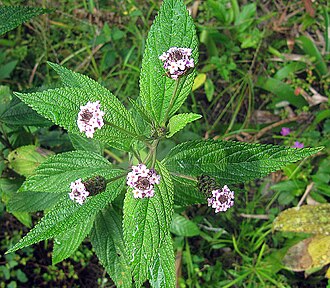
图:Dick Culbert from Gibsons, B.C., Canada · CC BY 2.0 · Wikimedia Commons
- 学名
- Lantana
- 分类等级
- 属
- 上级类群
- 马鞭草科
- 大类
- 被子植物
- 命名
- 卡尔·林奈,1753 年
- 数据库
- NCBI 分类 · GBIF
下级类群(2)
百科正文
英文维基百科补充中文条目比较短,下面是英文条目「Lantana」的原文
Lantana is a genus of about 150 species of perennial flowering plants in the verbena family, Verbenaceae. They are native to tropical regions of the Americas but exist as an introduced species in numerous areas, especially in the Australian-Pacific region, South and Northeastern part of India. The genus includes both herbaceous plants and shrubs growing to 0.5–2 m (1.6–6.6 ft) tall. Their common names are shrub verbenas or lantanas. The generic name originated in Late Latin, where it refers to the unrelated Viburnum lantana.
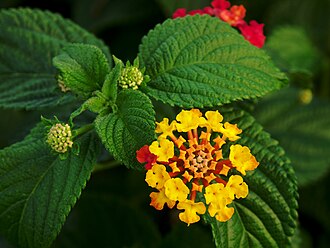
Lantana's aromatic flower clusters (called umbels) are a mix of red, orange, yellow, or blue and white florets. Other colors exist as new varieties are being selected. The flowers typically change color as they mature, resulting in inflorescences that are two- or three-colored.
"Wild lantanas" are plants of the unrelated genus Abronia, usually called "sand-verbenas".
Ecology
Some species are invasive, and are considered to be noxious weeds, such as in South Asia, Southern Africa and Australia. In the United States, lantanas are invasive in Hawai’i and the southeast, especially coastal regions of the Carolinas, Georgia, Florida, and the Gulf Coast.
The spread of lantana is aided by the fact that their leaves are poisonous to most animals and thus avoided by herbivores, while their fruit is a delicacy for many birds, including the yellow-fronted white-eye of Vanuatu, the superb fairy-wren in Australia, the scaly-breasted munia, and the Mauritius bulbul in the Mascarenes; these distribute the seeds and thereby spread lantana throughout the ecosystem.
Biological control of introduced lantanas has been attempted, without robust success. In Australia, about 30 insects have been introduced in an attempt to control the spread of lantanas, and this has caused problems of its own. The lantana bug (Aconophora compressa) for example is a polyphagous species introduced in 1995 that feeds on dozens of plants, and not only has it failed to have a noticeable impact on the lantana population, it has even become a pest in horticulture, parasitizing the related fiddlewoods (Citharexylum). The small Lantana-feeding moths Epinotia lantana and Lantanophaga pusillidactyla, while not becoming pests, have nonetheless failed to stem the spread of the invasive weed, as has the lantana scrub-hairstreak butterfly (Strymon bazochii) which was introduced to control lantanas on the Hawaiian Islands.
Other Lepidoptera whose caterpillars feed on lantana species include the common splendid ghost moth (Aenetus ligniveren), Aenetus scotti, Endoclita malabaricus, Hypercompe orsa and the setaceous Hebrew character (Xestia c-nigrum). The swamp wallaby (Wallabia bicolor) is one of the few mammals that eat lantana leaves without apparent ill effect.
Uses
Lantana species are widely cultivated for their flowers in tropical and subtropical environments and (as an annual plant) in temperate climates.
Most of the plants sold as lantana are either Spanish flag (species of section Lantana and their hybrids, including L. camara, L. depressa, L. hirsuta, L. horrida, L. splendens, L. strigocamara, etc.), or trailing lantana (L. montevidensis). Numerous cultivars of the Spanish flag exist, including 'Irene', 'Christine' and 'Dallas Red' (all tall-growing cultivars) and several recently introduced shorter ones. The shorter cultivars may flower more prolifically than the taller ones. Lantana montevidensis gives blue (or white) flowers all year round. Its foliage is dark green and has a distinct odor.
Although lantanas are generally hardy and, being somewhat toxic, usually rejected by herbivores, they may still become infested with pests.
The edibility of Lantana berries is contested. Some experts claim Lantana berries are edible when ripe though like many other kinds of fruit, they are mildly poisonous if eaten while still green. Other experts claim that experimental research indicates that both unripe and ripe Lantana berries are potentially lethal, despite the claims by others that ripe berries are not poisonous.
Extracts of Lantana camara may be used for protection of cabbage against the aphid Lipaphis erysimi.
Tribal people of the MM Hills in southern Karnataka, India, produce roughly 50 different types of furniture from lantana. It is considered a "near match" to the more highly-priced cane and bamboo, while being resistant to sun, rain, and termite damage.
以上节选摘自英文维基百科「Lantana」,按 CC BY-SA 4.0 使用,去掉了参考文献、外部链接等尾部小节,公式改写成了纯文本。篇幅所限,较长的小节只摘了开头一部分,有的小节没有收;全文、配图和出处见原文。