 格物
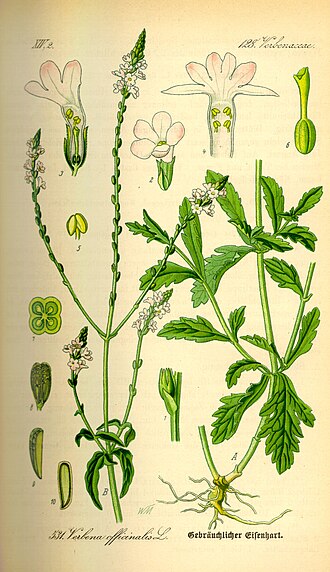
图:Public domain · Wikimedia Commons
- 学名
- Verbena
- 分类等级
- 属
- 上级类群
- 马鞭草科
- 大类
- 被子植物
- 命名
- 卡尔·林奈,1753 年
- 数据库
- NCBI 分类 · GBIF
下级类群(6)
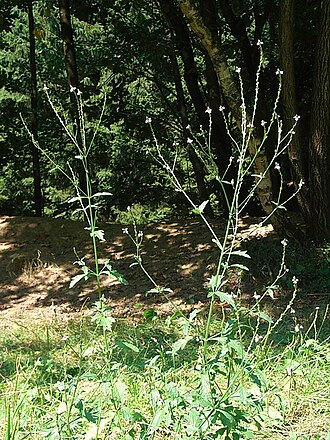
- 马鞭草 Verbena officinalis 种
- 柳叶马鞭草 Verbena bonariensis 种
- 狭叶马鞭草 Verbena brasiliensis 种
- Verbena hastata 种
- Verbena rigida 种
- Verbena litoralis 种
百科正文
属名Verbena源于拉丁语verbena,意为“鞭子”。
本属植物被称为“神圣之枝”,因其多供药用。
以上内容摘自维基百科「马鞭草属」,按 CC BY-SA 4.0 使用,去掉了参考文献、外部链接等尾部小节,公式改写成了纯文本。全文、配图和出处见原文。
英文维基百科补充中文条目比较短,下面是英文条目「Verbena」的原文
Verbena , also known as vervain or (in obsolete spelling) verveine, is a genus in the family Verbenaceae. It contains about 150 species of annual and perennial herbaceous or semi-woody flowering plants. The majority of the species are native to the Americas and Asia; however, Verbena officinalis, the common vervain or common verbena, is the type species and native to Europe.
Naming
In English, the name Verbena is usually used in the United States and the United Kingdom; elsewhere, the terms verveine or vervain are in use.
Description
Verbena is a herbaceous flowering plant, belonging to the Verbenaceae family, and may be annual or perennial depending on the species. The leaves are usually opposite, simple, and in many species hairy, often densely so. The flowers are small, with five petals, and borne in dense spikes. Typically some shade of blue, they may also be white, pink, or purple, especially in cultivars.
The genus can be divided into a diploid North American and a polyploid South American lineage, both with a base chromosome number of seven. The European species is derived from the North American lineage. It seems that verbena as well as the related mock vervains (Glandularia) evolved from the assemblage provisionally treated under the genus name Junellia; both other genera were usually included in the Verbenaceae until the 1990s.
Cultivation
Some species, hybrids and cultivars of verbena are used as ornamental plants. They are drought-resistant, tolerating full to partial sun, and enjoy well-drained, average soils. Plants are usually grown from seed. Some species and hybrids are not hardy and are treated as half-hardy annuals in bedding schemes. The most common cultivated kinds of verbena for the garden are the freeze-intolerant garden verbena (V. × hybrida), purpletop vervain (V. bonariensis), and various cold-hardy mock vervains (V. canadensis, V. peruviana).
They are valued in butterfly gardening in suitable climates, attracting Lepidoptera such as the Hummingbird hawk-moth, Chocolate albatross, or the Pipevine swallowtail, and also hummingbirds, especially V. officinalis, which is also grown as a honey plant.
The hybrid cultivars "Silver Anne" and "Sissinghurst" have gained the Royal Horticultural Society's Award of Garden Merit.
Pests and diseases
For some verbena pathogens, see List of verbena diseases. Cultivated verbenas are sometimes parasitized by sweet potato whitefly (Bemisia tabaci) and spread this pest to other crops.
Uses
Although verbena ("vervain") has been used in herbalism and traditional medicine, usually as an herbal tonic, there is no high-quality evidence for its effectiveness. Verbena has been listed as one of the 38 plants used to prepare Bach flower remedies, a kind of alternative medicine promoted for its effect on health. According to Cancer Research UK, "Essences do not prevent, control, or cure cancer or any other physical condition.
The essential oil of various species, mainly common vervain, is traded as "Spanish verbena oil". Considered inferior to oil of lemon verbena (Aloysia citrodora) in perfumery, it is of some commercial importance for herbalism.
In culture
Verbena has long been associated with divine and other supernatural forces. It was called "tears of Isis" in ancient Egypt, and later called "Hera's tears". In ancient Greece, it was dedicated to Eos Erigineia. The generic name is the Latin term for a plant sacred to the ancient Romans. Pliny the Elder describes verbena presented on Jupiter altars; it is not entirely clear if this referred to a verbena rather than the general term for prime sacrificial herbs.
Pliny the Elder notes "the Magi especially make the maddest statements about the plant: that [among other things] a circle must be drawn with iron round the plant". The common names of verbena in many Central and Eastern European languages often associate it with iron. These include for example the Dutch IJzerhard ("iron-hard"), Danish Læge-Jernurt ("medical ironwort"), German Echtes Eisenkraut ("true ironherb"), Slovak Železník lekársky ("medical ironherb"), and Hungarian vasfű ("iron grass").
Species
The following species are accepted:
(See also Aloysia, Glandularia, and Junellia for species formerly placed here.)
以上节选摘自英文维基百科「Verbena」,按 CC BY-SA 4.0 使用,去掉了参考文献、外部链接等尾部小节,公式改写成了纯文本。篇幅所限,较长的小节只摘了开头一部分,有的小节没有收;全文、配图和出处见原文。