 格物
- 学名
- Pica nuttallii
- 分类等级
- 种
- 英文名
- Yellow-billed Magpie
- 上级类群
- 喜鹊属
- 大类
- 鸟类
- 命名
- 约翰·詹姆斯·奥杜邦,1837 年
- 保护状况(IUCN)
- 易危物种
- 体重
- 8.1 克(出生体重);166 克(成年体重、雄性);142.1 克(成年体重、雌性)
- 数据库
- NCBI 分类 · GBIF · IUCN 红色名录
百科正文
黄嘴喜鹊的平均体重约为159.0克。栖息地包括温带森林、乡村花园、耕地和牧草地。
以上内容摘自维基百科「黄嘴喜鹊」,按 CC BY-SA 4.0 使用,去掉了参考文献、外部链接等尾部小节,公式改写成了纯文本。全文、配图和出处见原文。
英文维基百科补充中文条目比较短,下面是英文条目「Yellow-billed magpie」的原文
The yellow-billed magpie (Pica nuttallii), also known as the California magpie, is a bird that is endemic to California's Central Valley and the adjacent chaparral foothills and mountains. Apart from its having a yellow bill and a yellow streak around the eye and being slightly smaller, it is virtually identical to the black-billed magpie (Pica hudsonia) found in much of the rest of western North America. The scientific name commemorates the English naturalist Thomas Nuttall.
Taxonomy
Audubon first named the species in 1837 using the spelling "nutallii". This mis-spelling of Nuttall's name was soon corrected by subsequent authors, but most recent literature has used the spelling "nuttalli", itself also an error as the original Latin ending -ii must be retained; the correct spelling is thus nuttallii.
mtDNA sequence analysis indicates a close relationship between the yellow-billed magpie and the black-billed magpie, rather than between the outwardly more similar black-billed and Eurasian magpies (P. pica); it is possibly even genetically embedded within black-billed magpie, but this is not certain.
Description
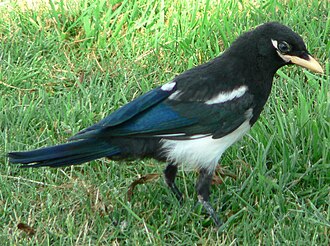
It is a medium-sized corvid, at 43–54 centimeters (17–21 in) long averaging slightly smaller than the black-billed magpie's 45–60 cm (18–24 in) but overlapping with it. Like other magpies in the genus Pica, it has pied plumage, with black head, back, wings, and tail, and white belly and shoulders. The black feathering, particularly the tail and wing feathers, are glossed iridescent in good light, reflecting variably green, blue, purple, or bronzed, depending on the angle of the light. The wing primary feathers are also white on the inner vane; this is not visible when perched, but shows as a white outer wing patch in flight. The bill is bright yellow, and it also has a small patch of yellow bare skin around the eyes. The eyes and legs are black.
Behavior
The yellow-billed magpie is gregarious and roosts communally. There may be a cluster of communal roosts in one general area made up of a central roost containing many birds and several outlying roosts with fewer.
Yellow-billed magpie flocks are known to engage in funeral-like behavior for their dead. When a magpie dies, a gathering of them congregates around the deceased bird where they call out loudly for 10–15 minutes.
The yellow-billed magpie is adapted to the hot summers of California's Central Valley and experiences less heat stress than the black-billed magpie.
Breeding
The yellow-billed magpie prefers groves of tall trees along rivers and near open areas, though in some cities they have begun to nest in vacant lots and other weedy places.
Diseases
This bird is extremely susceptible to West Nile virus. Between 2004 and 2006 it is estimated that 50% of all yellow-billed magpies died of the virus. Because the bird tends to roost near water bodies such as rivers, it is often exposed to mosquitoes.
Avian poxvirus is another contagious viral infection that yellow-billed magpies face that have raised concerns for their population. It has been documented in some individuals, leading to the development of skin lesions, nodules, and sometimes death. While the prevalence of avian poxvirus in yellow-billed magpies varies, it is considered a potential concern for the species.
The birds are also at risk of lead poisoning, primarily due to the ingestion of spent lead ammunition fragments found in carrion or discarded game animals.
Conservation
The IUCN classifies the bird as a vulnerable species. The Nature Conservancy places it in the vulnerable category. Besides West Nile Virus, threats include loss of habitat and rodent poison. The bird has a limited area of distribution but is widespread throughout the area and still common in many places.
Habitat Loss is the ongoing urbanization and agricultural development in California's Central Valley have led to the destruction and fragmentation of the yellow-billed magpie's preferred nesting and foraging habitats. As groves of tall trees are cleared for development, the available breeding sites for these birds are diminishing.
Rodent Poison also is the use of rodenticides and pesticides in agricultural and urban areas poses a direct threat to the yellow-billed magpie population.
以上节选摘自英文维基百科「Yellow-billed magpie」,按 CC BY-SA 4.0 使用,去掉了参考文献、外部链接等尾部小节,公式改写成了纯文本。篇幅所限,较长的小节只摘了开头一部分,有的小节没有收;全文、配图和出处见原文。