 格物
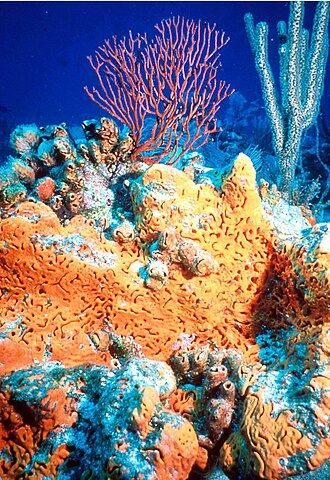
图:Florida Keys National Maritime Sancturay · Public domain · Wikimedia Commons
- 学名
- Holozoa
- 上级类群
- 后鞭毛生物
- 大类
- 其他真核生物
- 命名
- 2002 年
下级类群(1)
- 蜷丝生物 Filozoa
百科正文
英文维基百科补充中文条目比较短,下面是英文条目「Holozoa」的原文
Holozoa (from Ancient Greek ὅλος (holos) 'whole' and ζῷον (zoion) 'animal') is a clade of organisms that includes animals and their closest single-celled relatives, but excludes fungi and all other organisms. Together they amount to more than 1.5 million species of purely heterotrophic organisms, including around 300 unicellular species. It consists of various subgroups, namely Metazoa (or animals) and the protists Choanoflagellata, Filasterea, Pluriformea and Ichthyosporea. Along with fungi and some other groups, Holozoa is part of the Opisthokonta, a supergroup of eukaryotes. Choanofila was previously used as the name for a group similar in composition to Holozoa, but its usage is discouraged now because it excludes animals and is therefore paraphyletic.
The holozoan protists play a crucial role in understanding the evolutionary steps leading to the emergence of multicellular animals from single-celled ancestors. Recent genomic studies have shed light on the evolutionary relationships between the various holozoan lineages, revealing insights into the origins of multicellularity. Some fossils of possible metazoans have been reinterpreted as holozoan protists.
Characteristics
Composition
Holozoa is a clade that includes animals and their closest relatives, as well as their common ancestor, but excludes fungi. It is defined on a branch-based approach as the clade encompassing all relatives of Homo sapiens (an animal), but not Neurospora crassa (a fungus). Holozoa, besides animals, primarily comprises unicellular protist lineages of varied morphologies such as choanoflagellates, filastereans, ichthyosporeans, and the distinct genera Corallochytrium, Syssomonas, and Tunicaraptor.
Choanoflagellata, with around 250 species, are the closest living relatives of animals. They are free-living unicellular or colonial flagellates that feed on bacteria using a characteristic "collar" of microvilli. The collar of choanoflagellates closely resembles sponge collar cells, leading to theories since the 19th century about their relatedness to sponges. The mysterious Proterospongia is an example of a colonial choanoflagellate that was thought to be related to the origin of sponges. The affinities of the other single-celled holozoans only began to be recognized in the 1990s.
Evolution
Phylogeny
Holozoa, along with a clade that contains fungi and their protist relatives (Holomycota), are part of the larger supergroup of eukaryotes known as Opisthokonta. Holozoa diverged from their opisthokont ancestor around 1070 million years ago (Mya). The choanoflagellates, animals and filastereans group together as the clade Filozoa. Within Filozoa, the choanoflagellates and animals group together as the clade Choanozoa. Based on phylogenetic and phylogenomic analyses, the cladogram of Holozoa is shown below:
Uncertainty remains around the relationship of the two most basal groups, Ichthyosporea and Pluriformea. They may be sister to each other, forming the putative clade Teretosporea. Alternatively, Ichthyosporea may be the earliest-branching of the two, while Pluriformea is sister to the Filozoa clade comprising filastereans, choanoflagellates and animals. This second outcome is more strongly supported after the discovery of Syssomonas.
The position of Tunicaraptor, the newest holozoan member, is still unresolved.
Taxonomy
History
Prior to 2002, a relationship between Choanoflagellata, Ichthyosporea and the animal-fungi divergence was considered on the basis of morphology and ultrastructure. Early phylogenetic analyses gave contradicting results, because the amount of available DNA sequences was insufficient to yield unambiguous results. The taxonomic uncertainty was such that, for example, some Ichthyosporea were traditionally treated as trichomycete fungi.
Holozoa was first recognized as a clade in 2002 through a phylogenomic analysis by Franz Bernd Lang, Charles J. O'Kelly and other collaborators, as part of a paper published in the journal Current Biology. The study used complete mitochondrial genomes of a choanoflagellate (Monosiga brevicollis) and an ichthyosporean (Amoebidium parasiticum) to firmly resolve the position of Ichthyosporea as the sister group to Choanoflagellata+Metazoa. This clade was named Holozoa (from Ancient Greek ὅλος (holos) 'whole' and ζῷον (zoion) 'animal'), meaning 'whole animal', referencing the wider animal ancestry that it contains.
以上节选摘自英文维基百科「Holozoa」,按 CC BY-SA 4.0 使用,去掉了参考文献、外部链接等尾部小节,公式改写成了纯文本。篇幅所限,较长的小节只摘了开头一部分,有的小节没有收;全文、配图和出处见原文。