 格物
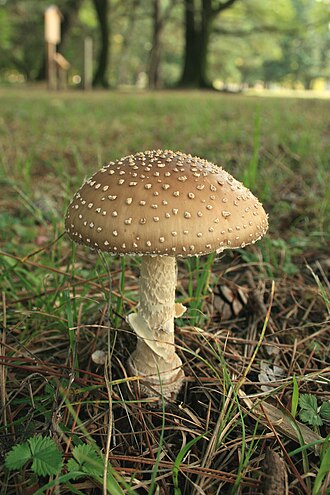
图:ccfarmer (Prst) · CC BY-SA 3.0 · Wikimedia Commons
- 学名
- Holomycota
- 分类等级
- 亚门
- 上级类群
- 后鞭毛生物
- 大类
- 其他真核生物
- 命名
- 2009 年
- 异名
- Nucletmycea
下级类群(2)
百科正文
种系发生
透过支序图可以看出真菌和其他物种之间的关系,是根据Philippe Silar的研究及《The Mycota: A Comprehensive Treatise on Fungi as Experimental Systems for Basic and Applied Research》的资料。
以上内容摘自维基百科「菌物总界」,按 CC BY-SA 4.0 使用,去掉了参考文献、外部链接等尾部小节,公式改写成了纯文本。全文、配图和出处见原文。
英文维基百科补充中文条目比较短,下面是英文条目「Holomycota」的原文
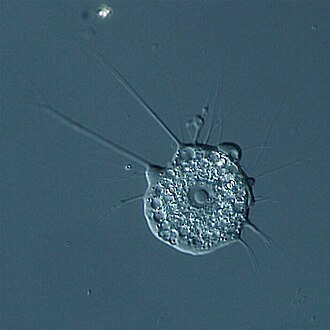
Holomycota or Nucletmycea are a basal Opisthokont clade as sister of the Holozoa. It consists of the Cristidiscoidea, also called Nucleariidae, as well as the kingdom Fungi. Nucleariids are unicellular free-living phagotrophic amoebae, and are considered the earliest lineage of Holomycota. This suggests that animals and fungi independently acquired complex multicellularity from a common unicellular ancestor and that the osmotrophic lifestyle (one of the fungal hallmarks) was originated later in the divergence of this eukaryotic lineage. Opisthosporidians is a recently proposed taxonomic group that includes aphelids, Microsporidia and Cryptomycota, three groups of endoparasites.
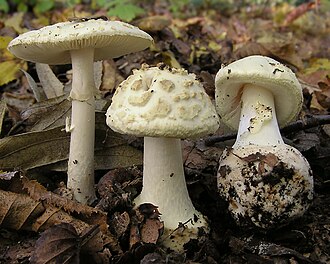
Rozella (Cryptomycota) is the earliest diverging fungal genus in which chitin has been observed at least in some stages of their life cycle, although the chitinous cell wall (another fungal hallmark) and osmotrophy originated in a common ancestor of Blastocladiomycota and Chytridiomycota, which still contain some ancestral characteristics such as the flagellum in zoosporic stage. The groups of fungi with the characteristic hyphal growth, Zoopagomycota, Mucoromycotina and Dikarya, originated from a common ancestor ~700 Mya. Zoopagomycota are mostly pathogens of animals or other fungi, Mucoromycotina is a more diverse group including parasites, saprotrophs or ectomycorrhizal. Dikarya is the group embracing Ascomycota and Basidiomycota, which comprise ~98% of the described fungal species. Because of this rich diversity, Dikarya includes highly morphologically distinct groups, from hyphae or unicellular yeasts (such as the model organism Saccharomyces cerevisiae) to the complex multicellular fungi popularly known as mushrooms. Contrary to animals and land plants with complex multicellularity, the inferred phylogenetic relationships indicate that fungi acquired and lost multicellularity multiple times along Ascomycota and Basidiomycota evolution.
Phylogeny
The phylogenetic tree depicts the fungi and their close relationship to other organisms, based on the work of Philippe Silar and "The Mycota: A Comprehensive Treatise on Fungi as Experimental Systems for Basic and Applied Research". The holomycota tree is following Tedersoo et al.
以上内容摘自英文维基百科「Holomycota」,按 CC BY-SA 4.0 使用,去掉了参考文献、外部链接等尾部小节,公式改写成了纯文本。全文、配图和出处见原文。