 格物
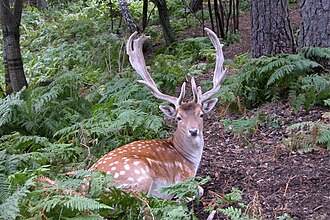
图:Fidel León Darder · CC BY-SA 3.0 · Wikimedia Commons
- 学名
- Cervinae
- 分类等级
- 亚科
- 上级类群
- 鹿科
- 大类
- 哺乳动物
- 命名
- 格奥尔格·奥古斯特·戈德弗斯,1820 年
- 数据库
- NCBI 分类
下级类群(2)
百科正文
分类
鹿属 Cervus
- 尾短,是中大型的鹿亚科动物:
- 加拿大马鹿(白臀鹿) Cervus canadensis
- 欧洲马鹿(赤鹿) Cervus elaphus
- 梅花鹿 Cervus nippon
白唇鹿属 Przewalskium
白唇鹿 Przewalskium albirostris
水鹿属 Rusa
- 鬣鹿(爪哇鹿) Rusa timorensis
- 水鹿 Rusa unicolor
- 菲律宾梅花鹿(阿氏鹿、杜鹿) Rusa alfredi
- 菲律宾黑鹿 Rusa mariannus
沼鹿属 Rucervus
- 泽鹿 Rucervus duvaucelii
- 坡鹿(海南坡鹿) Rucervus eldi
- 熊氏鹿 Rucervus schomburgki † 已灭绝
黇鹿属 Dama
- 是中型鹿亚科动物:
- 黇鹿 Dama dama
- 波斯黇鹿(美索布达米亚鹿) Dama mesopotamica
花鹿属 Axis
- 是小型鹿亚科动物:
- 花鹿(斑鹿) Axis axis
- 喀拉米豚鹿 Axis calamianensis
- 巴岛花鹿(印度豚鹿、巴文豚鹿) Axis kuhlii
- 豚鹿 Axis porcinus
麋鹿属 Elaphurus
是大型鹿亚科动物:
麋鹿 Elaphurus davidianus
以上内容摘自维基百科「真鹿亚科」,按 CC BY-SA 4.0 使用,去掉了参考文献、外部链接等尾部小节,公式改写成了纯文本。全文、配图和出处见原文。
英文维基百科补充中文条目比较短,下面是英文条目「Cervinae」的原文
The Cervinae or the Old World deer, are a subfamily of deer. Alternatively, they are known as the plesiometacarpal deer, due to having lost the parts of the second and fifth metacarpal bones closest to the foot (though retaining the parts away from the foot), distinct from the telemetacarpal deer of the Capreolinae (which have instead retained these parts of those metacarpals, while losing the parts away from the foot instead).
Classification and species
- The following species are recognised in extant genera:
- Tribe Muntiacini
- Genus Elaphodus
- Tufted deer (E. cephalophus)
- Genus Muntiacus
- Bornean yellow muntjac (M. atherodes)
- Hairy-fronted muntjac (M. crinifrons)
- Fea's muntjac (M. feae)
- Gongshan muntjac (M. gongshanensis)
- Malabar red muntjak (M. malabaricus)
- Northern red muntjac (M. vaginalis)
- Southern red muntjac (M. muntjak)
- Sumatran muntjac (M. montanum)
- Pu Hoat muntjac (M. puhoatensis)
- Leaf muntjac (M. putaoensis)
- Reeves's muntjac (M. reevesi)
- Roosevelt's muntjac (M. rooseveltorum)
- Truong Son muntjac or Annamite muntjac (M. truongsonensis)
- Giant muntjac (M. vuquangensis)
- Tribe Cervini ("true" deer)
- Genus Dama
- Common fallow deer (D. dama)
- Persian fallow deer (D. mesopotamica)
- Genus Axis
- Chital (A. axis)
- Calamian deer (A. calamianensis)
- Bawean deer (A. kuhlii)
- Indian hog deer (A. porcinus)
- Genus Rucervus
- Barasingha (R. duvaucelii)
- Eld's deer (R. eldii)
- †Schomburgk's deer (R. schomburgki)
- Genus Elaphurus
- Père David's deer (E. davidianus)
- Genus Rusa
- Visayan spotted deer or Prince Alfred's deer (R. alfredi)
- Philippine deer or Philippine sambar (R. mariannus)
- Javan rusa deer (R. timorensis)
- Sambar (R. unicolor)
- Genus Cervus
- Thorold's deer (C. albirostris)
- Elk or American wapiti (C. canadensis)
- Red deer (C. elaphus)
- Central Asian red deer (C. hanglu)
- Sika deer (C. nippon)
The taxonomy of Cervini is poorly resolved due to conflict between nuclear DNA and mitochondrial DNA phylogenies:
Mitchondrial DNA phylogeny after Heckeberg (2020) and Xiao et al. 2023
Nuclear DNA phylogeny after Heckeberg (2020)
Extinct genera
†Amphiprox
†Cervavitus? (Eurasia, Late Miocene-Early Pleistocene)
†Croizetoceros?
- †Dicrocerus
- †Euprox
- †Praesinomegaceros
- †Heteroprox
- †Metacervocerus
- †Praeelaphus
- †Megaloceros (Eurasia, Early/Middle Pleistocene-Holocene, ~5700 BC)
- †Praemegaceros (Europe, Early Pleistocene-Holocene, ~5500 BC)
- †Pseudodama (Eurasia, Early Pleistocene)
- †Sinomegaceros (Central and East Asia, Early-Late Pleistocene)
- †Megaceroides (North Africa, Late Pleistocene-Holocene, ~ 4000 BC)
- †Eucladoceros (Eurasia, Late Pliocene-Early Pleistocene)
- †Candiacervus (Crete, Late Pleistocene)
- †Haploidoceros (Europe, Middle-Late Pleistocene)
- †Xenocervulus (Europe, Early Pliocene)
Evolution
Cervinae is suggested to have split from Capreolinae at least 13.8 million years ago based on the first appearance of Euprox, suggested to be a stem-group cervine in Europe at this time. Modern Cervinae first appeared during the Late Miocene in Eastern Asia, arriving in the Indian subcontinent and Europe during the Early Pilocene. The ancestor of Cervinae probably had a bifurcated antlers similar to muntjacs, with the complex antlers of Cervini evolving independently from those of Capreolinae. Cervinae radiated during the Early Pleistocene, becoming the dominant group of deer across Eurasia.
以上内容摘自英文维基百科「Cervinae」,按 CC BY-SA 4.0 使用,去掉了参考文献、外部链接等尾部小节,公式改写成了纯文本。全文、配图和出处见原文。