 格物
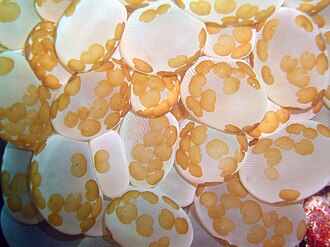
图:Samuel Chow · CC BY 2.0 · Wikimedia Commons
- 学名
- Acoelomorpha
- 分类等级
- 亚门
- 上级类群
- 异腔动物门
- 大类
- 其他动物
- 命名
- Ernst Ehlers,1985 年
- 数据库
- NCBI 分类
百科正文
无腔动物柔软的身体缺乏一些两侧对称动物的关键特征,令学者难以将其分类。它们最初根据形态特征被归入扁形动物门涡虫纲,后来被认为是后口动物,但有学者将它们列为一个独立于真两侧对称动物(即后口动物和原口动物)的门。经过miRNA分析,若按照亲缘分支分类法,无腔动物应为异涡动物的姊妹群,两者共同组成异无腔动物门这一演化支。
解剖
无腔动物非常细小,只长2毫米以下,没有消化道。消化是由合胞体产生的液泡来包围吞下的食物。液泡是没有上皮组织细胞围堵,不过有时会在口部会有咽连接液泡。所以它们的身体是实心的。
无腔动物在很多方面都很像扁形动物,但其构造更为简单。它们像扁形动物一样没有循环系统、呼吸系统或排泄系统。它们没有真正的脑部或神经节,只有在表皮下的简单神经网络。这个网络在前端略为密集。感官器官包括平衡囊,一些会有非常原始的单眼来感应光线。
无腔动物是雌雄同体的,但没有性腺,也没有雌性的繁殖系统。配偶子是由间叶细胞所生产,间叶细胞充满了它们表皮及消化液泡之间的身体。
以上内容摘自维基百科「無腔動物」,按 CC BY-SA 4.0 使用,去掉了参考文献、外部链接等尾部小节,公式改写成了纯文本。全文、配图和出处见原文。
英文维基百科补充中文条目比较短,下面是英文条目「Acoelomorpha」的原文
Acoelomorpha is a subphylum of very simple and small soft-bodied animals with planula-like features that live in marine or brackish waters. They usually live between grains of sediment, swimming as plankton, or crawling on other organisms, such as algae and corals. Except for two acoel freshwater species, all known acoelomorphs are marine.
Systematics
Etymology
The term "acoelomorph" derives from the Ancient Greek words ἀ (a), the alpha privative, expressing negation or absence, κοιλία (koilía), meaning "cavity", and μορφή (morphḗ), meaning "form". This refers to the fact that acoelomorphs have a structure lacking a fluid-filled body cavity.
Classification
The subphylum Acoelomorpha is divided into two classes. There are at least 408 described species, with a majority of these falling within the Crucimusculata infraorder in Acoela.
Acoela comprise small, flattened worms, classified into a dozen families.
Nemertodermatida comprises millimetre-sized, mostly interstitial worms, distributed into two families.
Phylogeny
The soft bodies and the lack of some of the key bilaterian traits make acoelomorphs difficult to classify. Traditionally, based on phenotypic features, acoelomorphs were considered to belong to the phylum Platyhelminthes, which was long seen as the sister group to all other bilaterian phyla. However, a series of molecular phylogenetics studies at the hinge between the 20th and 21st centuries demonstrated that they are fast-evolving organisms not closely related to platyhelminthes, therefore involving the polyphyly of flatworms.
Acoelomorpha appeared to constitute a separate, deep-branching phylum, the kingpin of bilaterian evolution. Yet their evolutionary affinities remain enigmatic, as they might be the sister-group either to all other bilateral animals or to all deuterostomes. Resolving this debate would indicate whether acoelomorphs are simple or simplified. If they are the sister group to Bilateria, it would point to a simple body plan for the first bilaterian. Alternatively, if acoelomorphs are related to deuterostomes, this would imply that their organisation is the result of secondary simplification.
In addition, comparative analyses of morphological, developmental, and molecular characters raised two points.
Xenoturbellida is the sister group to acoelomorphs, constituting the so-called Xenacoelomorpha clade. The close evolutionary relationship between Acoelomorpha and Xenoturbella is supported by the morphology (structure of epidermal cilia), the embryology (direct development without a feeding larval stage), and the concatenation of hundreds of proteins.
The phylogenetic placement of Xenacoelomorpha among bilaterian animals is not yet well defined, despite increased taxon and gene sampling, (re)-analyses of published data sets, and use of more sophisticated models of sequence evolution in phylogenomic studies.
Anatomy
Acoelomorphs resemble flatworms in many respects, but have a simpler anatomy, not even having a gut. Like flatworms, they have no circulatory or respiratory systems, but they also lack an excretory system. They lack body cavities (acoelomate structure), a hindgut, or an anus.
The epidermal cells of acoelomorphs are unable to proliferate, a feature that is only shared with rhabditophoran flatworms and was, for some time, considered strong evidence for the position of Acoelomorpha within Platyhelminthes. In both groups, the epidermis is renewed from mesodermal stem cells.
The nervous system of acoelomorphs is formed by a set of longitudinal nerve bundles beneath the ciliated epidermis. Close to the anterior end, these bundles are united by a ring commissure, but do not form a true brain, although it is hypothesized that such organization was the precursor of the cephalization of the nerve system in more derived bilaterians. After decapitation, such a "brain" (rather, a cerebroid ganglion) regenerates in a few weeks.
The sensory organs include a statocyst, which presumably helps them orient to gravity, and, in some cases, ancestral pigment-spot ocelli capable of detecting light.
Acoelomorphs are simultaneous hermaphrodites but have no gonads and no ducts associated with the female reproductive system. Instead, gametes are produced from the mesenchymal cells that fill the body between the epidermis and the digestive vacuole.
以上节选摘自英文维基百科「Acoelomorpha」,按 CC BY-SA 4.0 使用,去掉了参考文献、外部链接等尾部小节,公式改写成了纯文本。篇幅所限,较长的小节只摘了开头一部分,有的小节没有收;全文、配图和出处见原文。