 格物
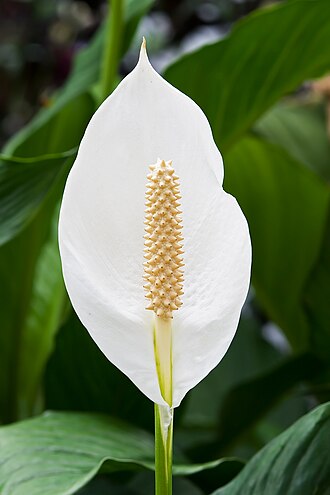
图:JJ Harrison (https://www.jjharrison.com.au/) · CC BY-SA 3.0 · Wikimedia Commons
- 学名
- Spathiphyllum
- 分类等级
- 属
- 上级类群
- 天南星科
- 大类
- 被子植物
- 命名
- 海因里希·威尔海姆·肖特,1832 年
- 数据库
- NCBI 分类 · GBIF
下级类群(1)
- 弯穗苞叶芋 Spathiphyllum wallisii 种
百科正文
白鹤芋属为多年生常绿草本植物,叶片长12至65厘米、宽3至25厘米。其肉穗花序外包有10至30厘米长,白色、泛黄或泛绿的大苞片,被称为佛焰苞。该属植物无需大量光照和水分便可存活。
以上内容摘自维基百科「白鹤芋属」,按 CC BY-SA 4.0 使用,去掉了参考文献、外部链接等尾部小节,公式改写成了纯文本。全文、配图和出处见原文。
英文维基百科补充中文条目比较短,下面是英文条目「Spathiphyllum」的原文
Spathiphyllum is a genus of 59 species of monocotyledonous flowering plants in the family Araceae, native to tropical regions of the Americas and southeastern Asia. Certain species of Spathiphyllum are commonly known as spath or peace lilies.
They are evergreen herbaceous perennial plants with large leaves 12–65 centimetres (4.7–25.6 in) long and 3–25 centimetres (1.2–9.8 in) broad. The flowers are produced in a spadix, surrounded by a 10–30 centimetres (3.9–11.8 in) long, white, yellowish, or greenish spathe. The plant does not require large amounts of light or water to survive. It is most often grown as a houseplant. However, it can withstand the elements well enough to thrive when planted outdoors in hot and humid environments.
Description
Spathiphyllum is a genus of herbaceous evergreen plants with dark green foliage that can reach 1 to 6 feet (0.30 to 1.83 m) in height. Rosettes of glossy, dark green leaves emerge directly from a low-lying or underground creeping stem. The leaves are elliptical or lanceolate, 4 to 25 inches (10 to 64 cm) long and 1 to 10 inches (2.5 to 25.4 cm) wide. They are supported on shoots (petioles) of shorter or similar length to the leaf.
The flowering structure rises above the foliage, with a single white or greenish-white spathe (a specialized leaf associated with the flower) partially surrounding the flower structure. The spathe is elliptical or lanceolate, and 4 to 12 inches (10 to 30 cm) long.
Ecology and distribution
Members of Spathiphyllum are widespread in Central America and northern South America. Two species are found on Pacific islands: one on Cocos Island (S. laeve) and one in Indonesia and the Philippines (S. commutatum). They grow on the forest floors of tropical humid forests, in shady, moist or wet areas along rivers and streams, in river valleys and foothills. They often grow in colonies along waterways, and can be in places periodically inundated with water.
Taxonomy
Spathiphyllum includes 59 accepted species. Several sections of the genus have also been recognized. Massowia, which includes the widespread American S. cannifolium and the Pacific S. laeve and S. commutatum; Dysspathiphyllum containing only the Colombian S. humboldtii; and the larger sections Spathiphyllum and Amomophyllum.
Selected species
- Species include:
- Cultivated hybrids include:
- Spathiphyllum × clevelandii
Cultivation and uses
Spathiphyllum are popular houseplants due to their attractive dark foliage and contrasting white flowers, easy care, and variety of cultivars available of different sizes. Commercially, Spathiphyllum plants are typically propagated by plant tissue culture, then potted up to multi-well plastic trays, then on into larger containers containing peat, pine bark, vermiculite, and/or coir. Plants grow best between 70 and 90 °F (21 and 32 °C). Once at a size ready for sale, plants are sprayed with gibberellic acid, which induces flowering 9 to 12 weeks after a single treatment.
It lives best in shade and needs little sunlight to thrive, and is watered approximately once a week.
Toxicity
Although it is called a "lily", the peace lily is not a true lily from the family Liliaceae. True lilies are highly toxic (poisonous) to cats and dogs, but the peace lily, Spathiphyllum is only mildly toxic to humans and other animals when ingested. Like many Araceae, it contains calcium oxalate crystals, which can cause skin irritation, a burning sensation in the mouth, difficulty swallowing, and nausea, but it does not contain the toxins found in true lilies, which can cause acute kidney failure in cats and some other animals.
Diseases
Infection of peace lilies with Botrytis cinerea was first documented in Tokyo, Japan from 1989 to 1994. Myrothecium roridum has also been used to harden in vitro cultures of the plant. Alternaria alternata leaf rot was documented on peace lilies in Argentina in 2008.
History
Heinrich Wilhelm Schott formally described the genus Spathiphyllum – literally "leaf spathe" – in his and Stephan Endlicher's 1832 book Meletemata Botanica. It encompassed two species: S. lanceifolium (previously described as Dracontium lanceaefolium by Nikolaus Joseph von Jacquin in 1790) and S. sagittaefolium. Examinations of similar specimens by others resulted in new genera: Frederik Liebmann's Hydnostachyon in 1849 and Karl Koch's Massowia in 1852. Schott redefined Spathiphyllum in 1853, moving S. sagittaefolium into the new genus Urospatha, and claiming Massowia and Hydnostachyon to be more appropriately Spathiphyllum.
以上节选摘自英文维基百科「Spathiphyllum」,按 CC BY-SA 4.0 使用,去掉了参考文献、外部链接等尾部小节,公式改写成了纯文本。篇幅所限,较长的小节只摘了开头一部分,有的小节没有收;全文、配图和出处见原文。