 格物
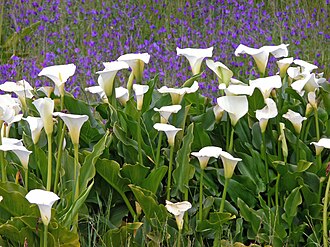
图:Octagon · CC BY-SA 3.0 · Wikimedia Commons
- 学名
- Zantedeschia
- 分类等级
- 属
- 上级类群
- 天南星科
- 大类
- 被子植物
- 命名
- 库尔特·波利卡普·约阿希姆·施普伦格尔,1826 年
- 数据库
- NCBI 分类 · GBIF
下级类群(1)
- 马蹄莲 Zantedeschia aethiopica 种
百科正文
分类
1989年之后,马蹄莲属有8个种:
马蹄莲 Zantedeschia aethiopica (L.) Spreng.
红花马蹄莲 Zantedeschia rehmannii Engl.
黄花马蹄莲 Zantedeschia elliotiana (W.Watson) Engl.
银星马蹄莲 Zantedeschia albomaculata (Hook.) Baill.
星点叶黄花马蹄莲 Zantedeschia jucunda Letty
黄金马蹄莲 Zantedeschia pentlandii (R.Whyte ex W.Watson) Wittm.
- 香水马蹄莲 Zantedeschia odorata P.L.Perry
- Zantedeschia valida (Letty) Y.Singh
- 及三个亚种。依生长习性可分为两类:
喜潮湿多水,具根状地下茎,在冷凉的环境下生长良好,叶片常绿,耐寒性强可忍受近摄氏零度的低温,对软腐病及病毒的抗病性强,浆果成熟时由绿转黄且产生黏液。
喜排水良好的沙质壤土,地下茎为块茎,生长适温在摄氏13度以上,落叶性,对于软腐病及病毒的抗性弱,浆果成熟时仍保持绿色亦不软化。
以上内容摘自维基百科「馬蹄蓮屬」,按 CC BY-SA 4.0 使用,去掉了参考文献、外部链接等尾部小节,公式改写成了纯文本。全文、配图和出处见原文。
英文维基百科补充中文条目比较短,下面是英文条目「Zantedeschia」的原文
Zantedeschia is a genus of eight species of herbaceous, perennial, flowering plants in the aroid family, Araceae, native to southern Africa (from South Africa northeast to Malawi). The genus has been introduced, in some form, on every continent other than Antarctica.
Common names include arum lily for Z. aethiopica, calla and calla lily for Z. elliottiana and Z. rehmannii. However, members of this genus are not true lilies (which belong to the family Liliaceae), and the genera Arum and Calla, although related, are distinct from Zantedeschia, despite visual similarities. The colourful flowers and leaves, of both species and cultivars, are greatly valued and commonly grown as ornamental and garden plants.
Etymology
The name of the genus was given as a tribute to Italian botanist Giovanni Zantedeschi (1773–1846) by the German botanist Kurt Sprengel (1766–1833).
Description
Zantedeschia species are rhizomatous, herbaceous, perennial plants with some species, e.g., Zantedeschia aethiopica, growing to 1.2 m (3 ft 11 in) tall, while Zantedeschia rehmannii does not exceed 60 cm (24 in) in height, growing in clumps or clusters.
Roots: Contractile, emerging from the top of the tubers in Group II.
Stem: The underground portion is variously described as a thick underground stem, i.e., a rhizome or tuber.
Taxonomy
Zantedeschia is the sole genus in the tribe Zantedeschieae in a 1997 classification of the Araceae.
Species
Eight species are currently recognized:
Zantedeschia aethiopica (L.) Spreng. – giant white arum lily or common arum lily – South Africa, Eswatini, Lesotho
Zantedeschia albomaculata (Hook.) Baill. – spotted arum lily – widespread from South Africa north to Nigeria and Tanzania
Zantedeschia elliottiana (W.Watson) Engl. – yellow or golden arum lily – Mpumalanga Province of South Africa
Zantedeschia jucunda Letty – Leolo Mountains of northern South Africa
Distribution and habitat
All species are endemic to central and southern Africa, from Nigeria to Tanzania and South Africa. Z. aethiopica grows naturally in marshy areas and is only deciduous when water becomes scarce. It grows continuously when watered and fed regularly and can survive periods of minor frosts. Z. aethiopica is a very strong and sturdy plant, being able to grow in many soils and habitats, multiplying by rhizome-offsets; it is naturalised and regarded as a weed throughout much of the world. Z. odorata is a rare species, resembling Z.
Cultivation
All Zantedeschia produce large, showy flowers spathes and are often grown both as ornamental plants and for cut flowers. Zantedeschia are relatively hardy plants, but some are more winter-hardy than others. In this regard there may be considered two groups, a hardy outdoor group with large white flowers (arum lilies) and less hardy group with white-spotted leaves and flowers in many colours (calla lilies), such as yellow, orange, pink and purple.
Hardy forms (arum lilies)
These include Zantedeschia aethiopica and Zantedeschia pentlandii and their cultivars.
Toxicity
Zantedeschia shares the general properties of the family Araceae in causing contact irritation. Zantedeschia species are also poisonous due to the presence of calcium oxalate crystals in the form of raphides. All parts of the plant are poisonous, typically producing local irritation or a burning sensation in the mouth and occasionally vomiting and diarrhea. However leaves are sometimes cooked and eaten.
Uses
Extensive commercial production of Zantedeschia for cut flowers and/or planting material occurs in California, Colombia, New Zealand and Kenya. Plant breeders in California and New Zealand continue to produce an extensive range of new hybrid cultivars. The so-called white calla derived from Z. aethiopica. All varieties with flowers with shades of yellow, orange, red, purple are mainly derived from Z. albomaculata, Z. pentlandii, Z. elliottiana and Z. rehmanni.
Culture
Zantedeschia has often been used in paintings and is featured in many of Diego Rivera's works of art (see The Flower Vendor, amongst others). It was a favourite subject of the painter Georgia O'Keeffe.
In Ireland, the calla lily has long been a symbol of Irish republicanism, traditionally worn during Easter to commemorate dead Irish republicans. In this capacity it is often referred to as an Easter lily.
以上节选摘自英文维基百科「Zantedeschia」,按 CC BY-SA 4.0 使用,去掉了参考文献、外部链接等尾部小节,公式改写成了纯文本。篇幅所限,较长的小节只摘了开头一部分,有的小节没有收;全文、配图和出处见原文。