 格物
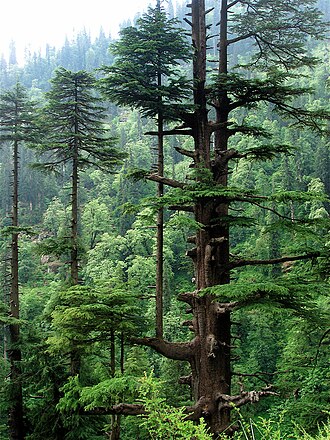
图:Paul Evans from London, United Kingdom · CC BY 2.0 · Wikimedia Commons
生命之树 › 真核生物 › 植物 › 绿色植物 › 链型植物 › 松柏纲 › 松柏目 › 松科 › 雪松属
喜马拉雅雪松种
Cedrus deodara
喜马拉雅雪松 是雪松的一个物种,为阿富汗东部、巴基斯坦北部(特别是在开伯尔-普赫图赫瓦省境内)、印度(查谟-克什米尔邦、喜马偕尔邦、锡金、大吉岭、北阿坎德邦)、西藏地区西南端以及尼泊尔西部的本土植物,通常出现在海拔1,500—3,200米(4,921—10,499英尺)的地方。它是一种常青松柏,可长至40—50米(131—164英尺)高(偶尔可高达60米 ),树干最粗可达直径3米(10英尺)。它有着圆锥形树冠,树干水平,树针下垂。
摘自维基百科「喜马拉雅雪松」,CC BY-SA 4.0
- 学名
- Cedrus deodara
- 分类等级
- 种
- 上级类群
- 雪松属
- 大类
- 其他植物
- 命名
- 乔治·顿,1830 年
- 中文别名
- 雪松、香柏
- 保护状况(IUCN)
- 无危物种
- 用途
- 植树造林、食物、药用植物、木材
- 数据库
- NCBI 分类 · GBIF · IUCN 红色名录
百科正文
英文维基百科补充中文条目比较短,下面是英文条目「Cedrus deodara」的原文
Cedrus deodara, the deodar cedar, Himalayan cedar, or deodar, is a species of cedar, a conifer in the pine family, Pinaceae, native to the Himalayas.
Description
It is a large coniferous tree reaching 40–50 metres (131–164 feet) tall, exceptionally 60 m (197 ft) with a trunk up to 3 m (10 ft) in diameter. It has a conic crown with level branches and drooping branchlets.
The leaves are needle-like, mostly 2.5–5 centimetres (1–2 inches) long, occasionally up to 7 cm (3 in) long, slender (1 millimetre or 1⁄32 in thick), borne singly on long shoots, and in dense clusters of 20–30 on short shoots; they vary from bright green to glaucous blue-green in colour. The female cones are barrel-shaped, 7–13 cm (2+3⁄4–5 in) long and 5–9 cm (2–3+1⁄2 in) broad, and disintegrate when mature (in 12 months) to release the winged seeds. The male cones are 4–6 cm (1+1⁄2–2+1⁄4 in) long, and shed their pollen in autumn.
Chemistry
The bark of Cedrus deodara contains large amounts of taxifolin. The wood contains cedeodarin, ampelopsin, cedrin, cedrinoside, and deodarin (3′,4′,5,6-tetrahydroxy-8-methyl dihydroflavonol).
Etymology
The botanical name, which is also the English common name, is derived from the Sanskrit term devadāru, which means "wood of the gods", a compound of deva "god" and dāru "wood and tree".
Distribution and habitat
The species natively occurs in East-Afghanistan, South Western Tibet, Western Nepal, Northern Pakistan, and North-Central India.
It grows at elevations of 1,500–3,200 m (5,000–10,000 ft).
Reproduction
"Deodar is a wind-pollinated monoecious species".
Cultivation
It is widely grown as an ornamental tree, often planted in parks and large gardens for its drooping foliage. General cultivation is limited to areas with mild winters, with trees frequently killed by temperatures below about −25 °C (−13 °F), limiting it to USDA zone 7 and warmer for reliable growth. It can succeed in rather cool-summer climates, as in Ushuaia, Argentina.
The most cold-tolerant trees originate in the northwest of the species' range in Kashmir and Paktia Province, Afghanistan. Selected cultivars from this region are hardy to USDA zone 7 or even zone 6, tolerating temperatures down to about −30 °C (−22 °F). Named cultivars from this region include 'Eisregen', 'Eiswinter', 'Karl Fuchs', 'Kashmir', 'Polar Winter', and 'Shalimar'.
Uses
Construction material
Deodar is in great demand as building material because of its durability, rot-resistant character and fine, close grain, which is capable of taking a high polish. Its historical use to construct religious temples and in landscaping around temples is well recorded. Its rot-resistant character also makes it an ideal wood for constructing the well-known houseboats of Srinagar, Kashmir. In Pakistan and India, during the British colonial period, deodar wood was used extensively for construction of barracks, public buildings, bridges, canals and railway cars. Despite its durability, it is not a strong timber, and its brittle nature makes it unsuitable for delicate work where strength is required, such as chair-making.
Herbal Ayurveda
C. deodara is used in Ayurvedic medicine.
The inner wood is aromatic and used to make incense. Inner wood is distilled into essential oil. As insects avoid this tree, the essential oil is used as insect repellent on the feet of horses, cattle and camels.
Culture
Among Hindus, as the etymology of deodar suggests, it is worshiped as a divine tree. Deva, the first half of the Sanskrit term, means divine, deity, or deus. Dāru, the second part, is cognate with (related to) the words durum, druid, tree, and true. Several Hindu legends refer to this tree. For example, Valmiki Ramayan reads:
In the stands of Lodhra trees, Padmaka trees and in the woods of Devadaru, or Deodar trees, Ravana is to be searched there and there, together with Sita. [4-43-13]
The deodar is the national tree of Pakistan, and the state tree of Himachal Pradesh, India. In particular regions of Indian Central Himalayas such as the Jaunsar-Bawar region of Dehradun, Uttarakhand control over deodar trees is also caste-mediated. Upper-caste groups control and extract these trees for smuggling and developing personal wealth and profit. Deodar trees are huge sources of both economic and social capital.
以上节选摘自英文维基百科「Cedrus deodara」,按 CC BY-SA 4.0 使用,去掉了参考文献、外部链接等尾部小节,公式改写成了纯文本。篇幅所限,较长的小节只摘了开头一部分,有的小节没有收;全文、配图和出处见原文。