格物

图:Olivier BEZES · CC BY 2.5 · Wikimedia Commons
- 学名
- Pinaceae
- 分类等级
- 科
- 上级类群
- 松柏目
- 大类
- 其他植物
- 命名
- Friedrich Karl Ludwig Rudolphi,1830 年
- 异名
- Abietaceae
- 数据库
- NCBI 分类 · GBIF
下级类群(8)
百科正文
分类
- 本科可分成若干亚科及属如下:
- 松亚科 Pinoideae
- 松属 Pinus(约115种)
- 云杉亚科 Piceoideae
- 云杉属 Picea(约35种)
- 落叶松亚科 Laricoideae
- 银杉属 Cathaya(1种)
- 落叶松属 Larix(约14种)
- 黄杉属 Pseudotsuga(5种)
- 冷杉亚科 Abietoideae
- 冷杉属 Abies(约50种)
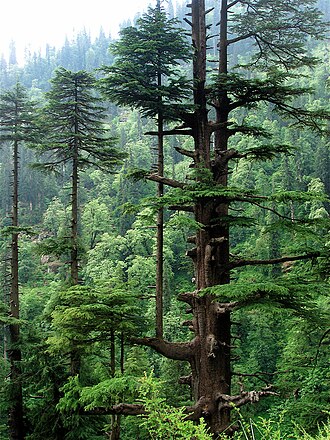
- 雪松属 Cedrus(2-4种)
- 金钱松属 Pseudolarix(1种)
- 油杉属 Keteleeria(3种)
- 长苞铁杉属 Nothotsuga(1种)
- 铁杉属 Tsuga(9种)
以上内容摘自维基百科「松科」,按 CC BY-SA 4.0 使用,去掉了参考文献、外部链接等尾部小节,公式改写成了纯文本。全文、配图和出处见原文。
英文维基百科补充中文条目比较短,下面是英文条目「Pinaceae」的原文
The Pinaceae, or pine family, is a large family of conifers, including many of the well-known conifers of commercial importance such as cedars, firs, hemlocks, larches, pines, and spruces. The family is included in the order Pinales, formerly known as Coniferales. Pinaceae have distinctive cones with woody scales bearing typically two ovules, and are supported as monophyletic by both morphological trait and genetic analysis. They are the largest extant conifer family in species diversity, with between 220 and 250 species (depending on taxonomic opinion) in 11 genera, and the second-largest (after Cupressaceae) in geographical range, found in most of the Northern Hemisphere, with the majority of the species in temperate climates, but ranging from subarctic to tropical. The family often forms the dominant component of boreal, coastal, and montane forests. One species, Pinus merkusii, grows just south of the equator in Southeast Asia. Major centres of diversity are found in the mountains of southwest China, Mexico, central Japan, and California.
Description
The members of the family Pinaceae are trees (rarely shrubs) growing from 2 to 100 metres (7 to 300 feet) tall, mostly evergreen (except the deciduous Larix and Pseudolarix), resinous, monoecious, with subopposite or whorled branches, and spirally arranged, linear (needle-like) leaves. The embryos of Pinaceae have three to 24 cotyledons.
The female cones are large and usually woody, 2–60 centimetres (1–24 inches) long, with numerous spirally arranged scales, and two winged seeds on each scale. The male cones are small, 0.5–6 cm (1⁄4–2+1⁄4 in) long, and fall soon after pollination; pollen dispersal is by wind. Seed dispersal is mostly by wind, but some species have large seeds with reduced wings, and are dispersed by birds. Analysis of Pinaceae cones reveals how selective pressure has shaped the evolution of variable cone size and function throughout the family. Variation in cone size in the family has likely resulted from the variation of seed dispersal mechanisms available in their environments over time.
Evolution
Fossil history
The Pinaceae diverged from other conifer groups during the late Carboniferous ~313 million years ago. Various possible stem-group relatives have been reported from as early as the Late Permian (Lopingian) The extinct conifer cone genus Schizolepidopsis likely represent stem-group members of the Pinaceae, the first good records of which are in the Middle-Late Triassic, with abundant records during the Jurassic across Eurasia. The oldest crown group (descendant of the last common ancestor of all living species) member of Pinaceae is the cone Eathiestrobus, known from the Upper Jurassic (lower Kimmeridgian, 157.3-154.7 million years ago) of Scotland, which likely belongs to the pinoid grouping of the family. Pinaceae rapidly radiated during the Early Cretaceous. Members of the modern genera Pinus (pines), Picea (spruce), and Cedrus (cedar) first appear during the Early Cretaceous.
Genera
Extant
- Abies
- Cedrus
- Keteleeria
- Nothotsuga
- Pseudolarix
- Tsuga
- Pinus
- Picea
- Pseudotsuga
- Cathaya
- Larix
Extinct
- †Tsugaepollenites
- †Abietipites
- †Cedripites
- †Schizolepidopsis
- †Eathiestrobus
- †Pesudoaraucaria
- †Obirostrobus
- †Pityostrobus
Defense mechanisms
External stresses on plants have the ability to change the structure and composition of forest ecosystems. Common external stresses that Pinaceae experience are herbivore and pathogen attacks, which can kill trees. In order to combat these stresses, trees need to adapt or evolve defenses against these stresses. Pinaceae have evolved myriad mechanical and chemical defenses, or a combination of the two, in order to protect themselves against antagonists. Pinaceae have the ability to up-regulate a combination of constitutive mechanical and chemical strategies to further their defenses.
Pinaceae defenses are prevalent in the bark of the trees. This part of the tree contributes a complex defensive boundary against external antagonists. Constitutive and induced defenses are both found in the bark.
Constitutive defenses
Constitutive defenses are typically the first line of defenses used against antagonists. These defenses include sclerified cells, lignified periderm cells, and secondary compounds such as phenolics and resins.
以上节选摘自英文维基百科「Pinaceae」,按 CC BY-SA 4.0 使用,去掉了参考文献、外部链接等尾部小节,公式改写成了纯文本。篇幅所限,较长的小节只摘了开头一部分,有的小节没有收;全文、配图和出处见原文。