 格物
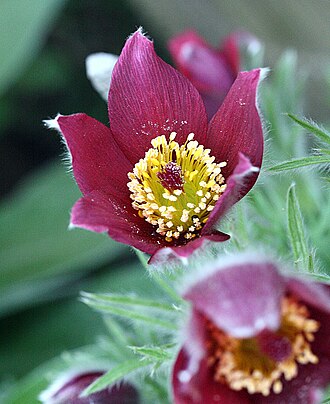
图:Hedwig Storch · CC BY-SA 3.0 · Wikimedia Commons
- 学名
- Pulsatilla
- 分类等级
- 属
- 上级类群
- 毛茛科
- 大类
- 被子植物
- 命名
- 菲利普·米勒,1754 年
- 数据库
- NCBI 分类 · GBIF
下级类群(8)
- 欧白头翁 Pulsatilla vulgaris 种
- Pulsatilla alpina 种
- Pulsatilla vernalis 种
- Pulsatilla pratensis 种
- 肾叶白头翁 Pulsatilla patens 种
- Pulsatilla halleri 种
- Pulsatilla grandis 种
- 白头翁 Pulsatilla chinensis 种
百科正文
下属物种
- 本属包括以下物种:
- 蒙古白头翁 Pulsatilla ambigua
- 钟萼白头翁 Pulsatilla campanella
- 朝鲜白头翁 Pulsatilla cernua
- 白头翁 Pulsatilla chinensis
- 兴安白头翁 Pulsatilla dahurica
- 欧白头翁 Pulsatilla halleri
- 紫蕊白头翁 Pulsatilla kostyczewii
- 西南白头翁 Pulsatilla millefolium
- 肾叶白头翁 Pulsatilla patens
岩生白头翁 Pulsatilla saxatilis L. Xu & T.G. Kang
- 黄花白头翁 Pulsatilla sukaczevii
- 细裂白头翁 Pulsatilla tenuiloba
- 细叶白头翁 Pulsatilla turczaninovii
- Pulsatilla vulgaris
- 杂交种
- Pulsatilla × yanbianensis
以上内容摘自维基百科「白头翁属」,按 CC BY-SA 4.0 使用,去掉了参考文献、外部链接等尾部小节,公式改写成了纯文本。全文、配图和出处见原文。
英文维基百科补充中文条目比较短,下面是英文条目「Pulsatilla」的原文
Pulsatilla is a genus that contains about 40 species of herbaceous perennial plants native to meadows and prairies of North America, Europe, and Asia. Common names include pasque flower (or pasqueflower), wind flower, prairie crocus, Easter flower, and meadow anemone. Several species are valued ornamentals because of their finely-dissected leaves, solitary bell-shaped flowers, and plumed seed heads. The showy part of the flower consists of sepals, not petals.
The common name pasque flower refers to its flowering period in the spring during Passover (in Biblical Hebrew: פֶּסַח pāsaḥ).
Taxonomy
The genus Pulsatilla was first formally named in 1754 by the English botanist Philip Miller. The type species is Pulsatilla vulgaris, the European pasque flower. The genus is placed in the tribe Anemoneae within the family Ranunculaceae. The tribe has been shown repeatedly to be monophyletic in molecular phylogenetic studies, but the number of genera recognized within the tribe and their relationship has varied. Multiple studies have shown that Pulsatilla forms a monophyletic group, but the rank assigned to the group has differed. In one approach, Pulsatilla is treated as a section within a more broadly circumscribed Anemone. In another approach, molecular phylogenetic evidence is used to separate Pulsatilla from Anemone as a separate genus, dividing it into three subgenera. Morphologically, Pulsatilla can be distinguished from Anemone by the long hairy beak on the achenes formed by the persistent style and stamens. Pulsatilla species can also be distinguished by DNA barcoding. As of March 2024, many sources, such as Plants of the World Online and the Flora of Korea, support the treatment of Pulsatilla as a distinct genus.
Species
As of March 2024, Plants of the World Online listed the following species in the genus Pulsatilla:
- Plants of the World Online also listed a number of named hybrids:
- Pulsatilla × bolzanensis Murr
- Pulsatilla × celakovskyana Domin
- Pulsatilla × emiliana (F.O.Wolf) Beauverd
Pulsatilla × gayeri Simonk.
Pulsatilla × girodii (Rouy) P.Fourn.
Pulsatilla × hackelii Pohl
Pulsatilla × knappii (Palez.) Palez.
Pulsatilla × mixta Halácsy
Pulsatilla × weberi (Widder) Janch. ex Holub
Pulsatilla × wilczekii (F.O.Wolf ex Hegi) P.Fourn.
Pulsatilla × yanbianensis H.Z.Lv
Cultural significance
Pulsatilla nuttalliana (as the synonym P. patens) is the provincial flower of Manitoba, Canada and (as the synonym P. hirsutissima) the state flower of the US state of South Dakota. Pulsatilla vulgaris is the County flower for both Hertfordshire and Cambridgeshire in England. Pulsatilla vernalis is the county flower of Oppland, Norway. The UK has introduced the UK biodiversity action plan to address the 49% decline in wild Pulsatilla species.
Use and toxicity
Pulsatilla is a toxic plant. Misuse can lead to diarrhea, vomiting and convulsions, hypotension, and coma. It has been used as a medicine by Native Americans for centuries. Blackfoot Indians used it to induce abortions and childbirth. Pulsatilla should not be taken during pregnancy nor during lactation.
Extracts of Pulsatilla have been used to treat reproductive problems such as premenstrual syndrome and epididymitis. Additional applications of plant extracts include uses as a sedative and for treating coughs.
以上内容摘自英文维基百科「Pulsatilla」,按 CC BY-SA 4.0 使用,去掉了参考文献、外部链接等尾部小节,公式改写成了纯文本。全文、配图和出处见原文。