 格物
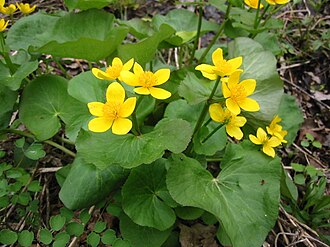
图:carol · CC BY-SA 3.0 · Wikimedia Commons
- 学名
- Caltha
- 分类等级
- 属
- 上级类群
- 毛茛科
- 大类
- 被子植物
- 命名
- 卡尔·林奈,1753 年
- 数据库
- NCBI 分类 · GBIF
下级类群(1)

- 驴蹄草 Caltha palustris 种
百科正文
下属物种
本属包括以下物种:
Caltha alba Cambess.
Caltha appendiculata Lechl. ex Müll.Stuttg.
Caltha appendiculata Pers.
Caltha biflora DC.
Caltha cespitosa Schipcz.
Caltha dionaeifolia Hook.fil.
Caltha dioneaefolia Hook.f., 1843
Caltha dysosmoides Tao Zhang, Bing Liu, Y.Q.Hao, Y.Yang & Y.J.Lai
Caltha dysosmoides TaoZhang et al.
Caltha funstonii K.C.Davis, 1900
Caltha introloba F.Muell.
Caltha leposepala
Caltha leptosepala DC.
Caltha metans Pall.
白花驴蹄草 Caltha natans Pallas ex Georgi
Caltha novae-zelandiae Hook.fil.
Caltha obtusa Cheeseman
驴蹄草 Caltha palustris L.
Caltha phylloptera A.W.Hill
Caltha sagittata Cav.
花葶驴蹄草 Caltha scaposa Hook.fil. & Thomson
- Caltha sibirica Makino
- 细茎驴蹄草 Caltha sinogracilis W.T.Wang
- 杂交种:
- Caltha ×goodalliana T.R.Dudley
- 归入本属的物种:
- Psychrophila dioneifolia Gay
以上内容摘自维基百科「驴蹄草属」,按 CC BY-SA 4.0 使用,去掉了参考文献、外部链接等尾部小节,公式改写成了纯文本。全文、配图和出处见原文。
英文维基百科补充中文条目比较短,下面是英文条目「Caltha」的原文
Caltha is a genus of rhizomatous perennial flowering plants in the family Ranunculaceae ("buttercup family"), to which ten species have been assigned. They occur in moist environments in temperate and cold regions of both the Northern and Southern Hemispheres. Their leaves are generally heart-shaped or kidney-shaped, or are characteristically diplophyllous (the auricles of the leaf blades form distinctly inflexed appendages). Flowers are star shaped and mostly yellow to white. True petals and nectaries are missing but the five or more sepals are distinctly colored. As usual in the buttercup family there is a circle of stamens around (two to twenty-five) free carpels.
Description
Caltha species are hairless, dwarf to medium size (1–80 cm high) perennial herbs, with alternate leaves. These leaves are simple (in all Northern Hemisphere species), or have one pair of lobes at the base (in C. sagittata) which is mostly oriented at a straight angle to the larger top lobe but is sometimes in the same plane (in some of its northern populations), or the basal lobes are merged with the top lobe to form two (occasionally three) appendages (in all remaining species) which are attached next to the midvein, with the adaxial surfaces of top lobe and appendages facing each other. This condition of the Southern Hemisphere species is referred to as diplophylly. All species have stalked basal leaves, and some also have one or few leaves on the flowerstalk.
Key to the species
This key makes use of the taxonomic opinions and characters described in Smit (1973).
Taxonomy
Taxonomic history
The oldest description that is generally acknowledged in the botanical literature dates from 1700 under the name Populago by Joseph Pitton de Tournefort in part 1 of his Institutiones rei herbariae. He distinguished between P. flore major, P. flore minor and P. flore plena, and already says all of these are synonymous to Caltha palustris, without mentioning any previous author. As a plant name published before 1 May 1753, Populago Tourn. is invalid. And so is the first description as Caltha palustris by Carl Linnaeus in his Genera Plantarum of 1737. But Linnaeus re-describes the species under the same name in Species Plantarum of 1 May 1753, thus providing the correct name.
Caltha palustris is a highly variable species. When the growing season is shorter, plants are generally much smaller and may root at the nodes of the stems after flowering.
Distribution
Caltha species are found in the cold and temperate regions of the Northern Hemisphere, the Andes and Patagonia, and alpine areas in Australia and New Zealand. It is absent from lower altitudes in the tropics and subtropics, in Africa, on Greenland and some other arctic island, from Antarctica and subantarctic islands and from oceanic islands. C. natans occurs in Siberia and North America, but not in Europe. C. palustris has the widest distribution and is present in the cold and temperate regions of the Northern Hemisphere, but cannot be found in the Western United States. C. scaposa is an alpine species with a limited distribution on the south-eastern rim of the Highland of Tibet. Caltha leptosepala occurs in western North-America from Alaska to California and Colorado. C.
Ecology
Information about the ecology of Caltha species is scarce except for C. palustris. This species contains a number of noxious chemicals such as anemonin, a trait it shares with other ranunculids, and this is probably the reason members of the entire family are avoided by vertebrate animals. Beetles and mining fly larvae cause little damage in C. palustris. Pollination is mediated by a lot of different insects, but most prominently by flies, bees and beetles.
Although it was suggested that pollination in C. palustris could be assisted by rain, there is also proof for self-infertility. When ripe follicles open, they form a "splash cup" from which seeds are expelled if raindrops hit them at the right angle. C. palustris seeds also have some spongy tissue that makes them float on water, until they wash up in a location that may be suitable for this species to grow. C.
以上节选摘自英文维基百科「Caltha」,按 CC BY-SA 4.0 使用,去掉了参考文献、外部链接等尾部小节,公式改写成了纯文本。篇幅所限,较长的小节只摘了开头一部分,有的小节没有收;全文、配图和出处见原文。