 格物

图:Marie-Lan Nguyen · CC BY 2.5 · Wikimedia Commons
- 学名
- Nymphaeaceae
- 分类等级
- 科
- 上级类群
- 睡莲目
- 大类
- 被子植物
- 命名
- 理查德·安东尼·索尔兹伯里,1805 年
- 异名
- Barclayaceae、Euryalaceae、Nupharaceae
- 数据库
- NCBI 分类 · GBIF
下级类群(3)
百科正文
演化
睡莲科植物是被子植物中分化时间较早的一支,既不是真双子叶植物,也不是单子叶植物,因此在研究被子植物的起源和早期演化中具有较重要的地位。
睡莲科许多成员各轮花器官的分化不完全,部分物种(如王莲属)的各轮花器官甚至呈现连续的形态渐变,部分观点认为睡莲科的花部形态可能代表了最早期被子植物的典型花部结构模式。然而,系统发育分析表明,睡莲科中部分看似“原始”的花部性状(如每轮包含多数器官部件)可能为次生演化结果,因此部分观点认为,在推断被子植物祖先花型时,应结合科内拓扑结构及与其它早期分化类群(如莼菜科)的比较,而不宜将睡莲科或其它某一的早期起源被子植物形态直接视为祖征。
特征
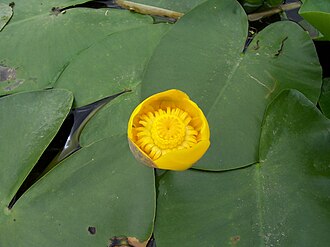
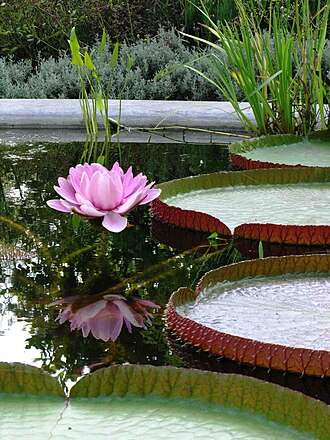
草本,水生植物,地下茎发达且埋于水面下的泥土里,圆形的叶与花漂浮于水面或伸出水面之上。睡莲属及萍蓬草属的叶上有一纵裂,而王莲属的叶为全缘。
应用
本科植物睡莲可做水景庭园的观赏植物,地下茎可做蔬菜;芡的种子(芡实)可食用或药用;合瓣莲属可做观赏水草。
需注意,睡莲与荷花亲缘关系较远,不会结出莲藕或是莲子。
分类
- 睡莲科可分为2亚科共5属:
- 睡莲亚科 Nymphaeoideae
- 合瓣莲属 Barclaya
- 芡属 Euryale
- 睡莲属 Nymphaea
- 王莲属 Victoria
- 萍蓬草亚科 Nupharoideae
- 萍蓬草属 Nuphar
以上内容摘自维基百科「睡蓮科」,按 CC BY-SA 4.0 使用,去掉了参考文献、外部链接等尾部小节,公式改写成了纯文本。全文、配图和出处见原文。
英文维基百科补充中文条目比较短,下面是英文条目「Nymphaeaceae」的原文
Nymphaeaceae is a family of flowering plants, commonly called water lilies. They live as rhizomatous aquatic herbs in temperate and tropical climates around the world. The family contains five genera with about 70 known species. Water lilies are rooted in soil in bodies of water, with leaves and flowers floating on or rising from the surface. Leaves are oval and heart-shaped in Barclaya. Leaves are round, with a radial notch in Nymphaea and Nuphar, but fully circular in Victoria and Euryale.
Water lilies are a well-studied family of plants because their large flowers with multiple unspecialized parts were initially considered to represent the floral pattern of the earliest flowering plants. Later genetic studies confirmed their evolutionary position as basal angiosperms. Analyses of floral morphology and molecular characteristics and comparisons with a sister taxon, the family Cabombaceae, indicate, however, that the flowers of extant water lilies with the most floral parts are more derived than the genera with fewer floral parts. Genera with more floral parts, Nuphar, Nymphaea, Victoria, have a beetle pollination syndrome, while genera with fewer parts are pollinated by flies or bees, or are self- or wind-pollinated. Thus, the large number of relatively unspecialized floral organs in the Nymphaeaceae is not an ancestral condition for the clade.
Description
Vegetative characteristics
The Nymphaeaceae are annual or perennial, aquatic, rhizomatous herbs. The family is further characterized by scattered vascular bundles in the stems, and frequent presence of latex, usually with distinct, stellate-branched sclereids projecting into the air canals. Hairs are simple, usually producing mucilage (slime).
Leaves are alternate and spiral, opposite or occasionally whorled, simple, peltate or nearly so, entire to toothed or dissected, short to long petiolate, with blade submerged, floating or emergent, with palmate to pinnate venation. Stipules are either present or absent.
Generative characteristics
Flowers are solitary, bisexual, radial, with a long pedicel and usually floating or raised above the surface of the water, with girdling vascular bundles in receptacle.
Taxonomy
Nymphaeaceae has been investigated systematically for decades because botanists considered their floral morphology to represent one of the earliest groups of angiosperms. Modern genetic analyses by the Angiosperm Phylogeny Group researchers has confirmed its basal position among flowering plants. In addition, the Nymphaeaceae are more genetically diverse and geographically dispersed than other basal angiosperms. Nymphaeaceae is placed in the order Nymphaeales, which is the second diverging group of angiosperms after Amborella in the most widely accepted flowering plant classification system, APG IV system.
Nymphaeaceae is a small family of three to six genera: Barclaya, Euryale, Nuphar, Nymphaea, Ondinea, and Victoria.
Invasiveness
The beautiful nature of water lilies has led to their widespread use as ornamental plants. The Mexican waterlily, native to the Gulf Coast of North America, is planted throughout the continent. It has escaped from cultivation and become invasive in some areas, such as California's San Joaquin Valley. It can infest slow-moving bodies of water and is difficult to eradicate. Populations can be controlled by cutting top growth. Herbicides can also be used to control populations using glyphosate and fluridone.
Culture
The water lily is the national flower of Bangladesh, Iran, and Sri Lanka. The Emblem of Bangladesh contains a lily floating on water. It is also the birth flower for the month of July.
The Nymphaeaceae, which is also called Nilufar Abi in Persian, can be seen in many reliefs of the Achaemenid period (552 BC) such as the statue of Anahita in the Persepolis. Lotus flower was included in Kaveh the blacksmith's Derafsh and later as the flag of the Sasanian Empire Derafsh Kaviani. Today, it is known as the symbol of Iranians Solar Hijri Calendar.
Lily pads, also known as Seeblätter, are a charge in Northern European heraldry, often coloured red (gules), and appear on the flag of Friesland and the coat of arms of Denmark (in the latter case often replaced by red hearts).
以上节选摘自英文维基百科「Nymphaeaceae」,按 CC BY-SA 4.0 使用,去掉了参考文献、外部链接等尾部小节,公式改写成了纯文本。篇幅所限,较长的小节只摘了开头一部分,有的小节没有收;全文、配图和出处见原文。