 格物
- 学名
- Victoria
- 分类等级
- 属
- 上级类群
- 睡莲科
- 大类
- 被子植物
- 命名
- 罗伯特·赫尔曼·尚伯克,1837 年
- 数据库
- NCBI 分类 · GBIF
下级类群(2)

百科正文
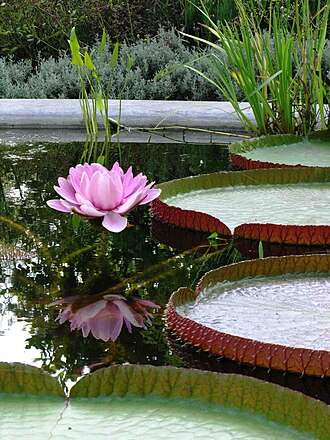
此属只有两个物种,但于2022年在裘园莲花馆确认第三种。它们拥有巨型奇特似盘的叶片,浮于水面,十分壮观,并以它娇容多变的花色和浓厚的香味闻名于世。叶片直径可以达到2.9米。
形态
王莲是多年生水生草本植物。根茎直立块状,具粗壮发达的侧根,质地软而脆。叶子浮于水面,大而圆,直径100~300厘米;叶子边缘向上折转、直立,高7~10厘米;上面绿色无刺,下面深红色,有突起的网状叶脉,脉上具2~3厘米长的锐刺;叶柄长而粗且密布粗刺;一株大王莲所有叶片伸展开的覆盖面约达6~10平方米。王莲的叶盘可承受3个儿童(50~70 kg),甚为奇观。
夏季开花,单生,浮于水面,初为白色,次日变为深红而枯萎。
分布
王莲原产于南美热带地区,主要产于巴西、玻利维亚等国。须要高温、高湿、阳光充足的环境下生长发育。生长适宜的温度为摄氏25~35度,低于20度时,植株会停止生长。
1825年法国植物学家埃梅·邦普兰首次对王莲进行了描述,但未引起重视。在1837年,亚马逊王莲被英属圭亚那的罗伯特·赫尔曼·尚伯克传入英国,由约翰·林德利进行描述,以“维多利亚女王”之拉丁文定名Victoria regia。并在那里被当成观赏植物安家落户,成为园艺爱好者争相收藏的对象。当王莲的子孙首次在英国伦敦开花的时候,吸引了成千上万的观众前往观赏。到今天,许多现代化的机场大厅、宫殿、厂房,都有应用王莲这一超承重力的原理。
下属物种
本属包括以下物种:
亚马逊王莲 Victoria amazonica (Poepp.) J.C.Sowerby
玻利维亚王莲 Victoria boliviana Magdalena & L.T.Sm.
Victoria borbonica Buc'hoz
克鲁兹王莲 Victoria cruziana A.D.Orb.
以上内容摘自维基百科「王蓮」,按 CC BY-SA 4.0 使用,去掉了参考文献、外部链接等尾部小节,公式改写成了纯文本。全文、配图和出处见原文。
英文维基百科补充中文条目比较短,下面是英文条目「Victoria (plant)」的原文
Victoria or giant waterlily is a genus of aquatic herbs in the plant family Nymphaeaceae. The leaves are a remarkable size; Victoria boliviana produces leaves up to 3.2 metres (10 ft) in width. The genus name was given in honour of Queen Victoria of the United Kingdom.
Description
Vegetative characteristics
Victoria species are rhizomatous, aquatic, short-lived, perennial herbs with tuberous rhizomes bearing contractile adventitious roots. The floating leaves are peltate and orbicular. The margin of the lamina is raised to form a rim 10–20 cm (4–8 in) high. The lamina possesses stomatodes (i.e. microscopic perforations) which are believed to allow rainwater to escape. The leaves emerge from a stipular sheath 16 cm (6 in) long and wide or more. The abaxial leaf surface possesses prominent, reticulate venation. In Victoria amazonica the leaves are glabrous, with long, hard spines and the underside is red. In Victoria cruziana the leaves are fuzzy with soft spines and the underside is purple. The shape of the rims is also different.
Generative characteristics
The up to 25 cm wide, nocturnal, thermogenic, solitary, actinomorphic, chasmogamous, protogynous flowers have prickly pedicels with 4 primary and 8 secondary air canals. The flowers have four petaloid, 12 cm long, and 7–8 cm wide sepals. The 50-100 petals gradually transition towards the shape of the stamens, however there is an abrupt change between the innermost petals to the outermost staminodia. The androeceum consists of 150–200 stamens. The gynoecium consists of 30–44 fused carpels. The 0–15 cm wide, spiny, irregularly dehiscencent fruit bears arillate, glabrous, smooth or granular seeds. Proliferating pseudanthia are absent.
Cytology
The ploidy level is 2x and the chromosome count ranges from 2n = 20 to 2n = 24.
Taxonomy
Victoria R.H.Schomb. was published by Robert Hermann Schomburgk in September 1837. The type species is Victoria regina R.H.Schomb. The genus has two synonyms, both published within the same year with the same name: Victoria Lindl. published by John Lindley in October 1837 and Victoria J. E. Gray published by John Edward Gray in December 1837. There is, however, disagreement over the correct taxon authority. Victoria R.H.Schomb. is seen as correct by several sources, but Victoria Lindl. is also widely regarded as correct, despite being published a month later.
Evolutionary relationships
Together with the genus Euryale, Victoria may be placed within the genus Nymphaea, rendering it paraphyletic in its current circumscription.
Ecology
Habitat
Species are aquatic: occurring in lakes and streams.
Pollination
Victoria amazonica flowers are known to be pollinated by Cyclocephala beetles.
Use
Horticulture
Victoria is a popular ornamental plant.
Food
The seeds, petioles, and rhizomes are used as food.
Other uses
Root extracts are used as black dye.
以上内容摘自英文维基百科「Victoria (plant)」,按 CC BY-SA 4.0 使用,去掉了参考文献、外部链接等尾部小节,公式改写成了纯文本。全文、配图和出处见原文。