 格物
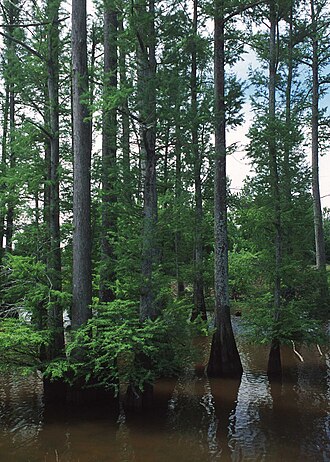
图:Public domain · Wikimedia Commons
- 学名
- Taxodium distichum
- 分类等级
- 种
- 上级类群
- 落羽松属
- 大类
- 其他植物
- 命名
- 路易·克洛德·里夏尔,1810 年
- 中文别名
- 落羽松
- 保护状况(IUCN)
- 无危物种
- 栖息地
- cypress swamp
- 用途
- 植树造林、木材
- 数据库
- NCBI 分类 · GBIF · IUCN 红色名录
百科正文
特性
性喜潮湿,生长在沼泽地者有木质圆柱形膝状根,拱出地面,在排水通畅之地,生长良好;为水岸造景树种。
落叶:春季生短桠及嫩绿色小羽叶,秋季变为黄褐色,冬季脱落,为落叶针叶树种。
发芽:在沼泽环境下,幼苗一般在湿土发芽;种子不会在水下发芽,但可以在水下保存30个月。
形态
落羽杉为落叶乔木,高可达10-40米,树干直径可达1-2米,树干通直,外形似水杉。
树皮:树皮呈现灰棕色、红棕色,薄,具黏性。
叶:叶片扁平线形,薄纸质,长约1-1.5厘米,较水杉略短;小羽叶互生,其上的线形叶,排成二列羽状,种名 distichum 的意思即为“二列生的”;小枝互生。
球花:雌雄同体,长在靠近小枝边缘的流苏状上,早冬时授粉,12个月成熟。
球果:球果圆球或卵球形,木质,长约2.5厘米左右,果鳞盾状,含二枚种子;种子为不等三角形,绿色,成熟时灰棕色,有厚棱角,长度约5-10毫米。
分布
落羽杉原产美国东南部的佛罗里达州、德克萨斯州、俄克拉荷马州东南部,以及伊利诺伊州和印第安纳州南部,密西西比河和俄亥俄河的沿岸。成熟的标本也种植在匹兹堡及安大略省渥太华。中国大陆的杭州、武汉、广州、上海、南京、庐山等地都有引种栽培,常栽种于平原地区及湖边、河岸、水网地区。
在台湾台南市的巴克礼公园,苗栗县、南投县、云林县以及中国大陆安徽省宣城、广东省江门潮连岛等地的山区,水边有落羽松森林,因11月起叶片会转红,成为热门的观光景点,其中桃园八德落羽松大道、三湾落羽松庄园、向山落羽松是台湾民众喜爱的前三名落羽松景点。
用途
落羽杉木材材质轻软,纹理细致,易于加工,耐腐朽,可作建筑、杆、船舶、家具等用材。
以上内容摘自维基百科「落羽杉」,按 CC BY-SA 4.0 使用,去掉了参考文献、外部链接等尾部小节,公式改写成了纯文本。全文、配图和出处见原文。
英文维基百科补充中文条目比较短,下面是英文条目「Taxodium distichum」的原文
Taxodium distichum, the bald cypress, bald-cypress, baldcypress, or swamp cypress; French: cyprès chauve;
cipre in Louisiana) is a deciduous conifer in the cypress family, Cupressaceae. It is native to the Southeastern United States. Hardy and tough, this tree adapts to a wide range of soil types, whether wet, salty, dry, or swampy. It is noted for the russet-red fall color of its lacy needles. It is both extremely flood tolerant and rather drought hardy.
This plant has some cultivated varieties and is often used in groupings in public spaces. Common names include bald cypress, swamp cypress, white cypress, tidewater red cypress, gulf cypress, and red cypress.
The bald cypress was designated the official state tree of Louisiana in 1963.
Bald cypress trees are valued because of their rot-resistant heartwood when the trees are mature. Because of this, the trees are often used for making fence posts, doors, flooring, caskets, and a number of other items.
Description
Taxodium distichum is a large, slow to fast-growing, and long-lived deciduous coniferous tree. It typically grows to heights of 35–120 feet (10–40 m) and has a trunk diameter of 3–7 feet (0.9–2.1 m).
The main trunk is often surrounded by cypress knees. The bark is grayish brown to reddish brown, thin, and fibrous with a stringy texture. Young trees have more easily-peelable bark.
Taxonomy
The closely related Taxodium ascendens (pond cypress) is treated by some botanists as a distinct species, while others classify it as merely a variety of bald cypress, as Taxodium distichum var. imbricatum (Nutt.) Croom. It differs in shorter leaves borne on erect shoots, and in ecology, being largely confined to low-nutrient blackwater habitats. A few authors also treat Taxodium mucronatum as a variety of bald cypress, as T. distichum var.
Habitat and distribution
The native range extends from southeastern New Jersey south to Florida and west to Central Texas and southeastern Oklahoma, and also inland up the Mississippi River to southernmost Illinois and Indiana. Ancient bald cypress forests, with some trees more than 1,700 years old, once dominated swamps in the Southeast. The original range had been thought to only reach as far north as Delaware, but researchers have now found a natural forest on the Cape May Peninsula in southern New Jersey.
Reproduction and early growth
The bald cypress is monoecious. Male and female strobili mature in one growing season from buds formed the previous year. The male catkins are about 2 mm (0.079 in) in diameter and are borne in slender, purplish, drooping clusters 7 to 13 cm (2+3⁄4 to 5 in) long that are conspicuous during the winter on this deciduous conifer. Pollen is shed in March and April. Female conelets are found singly or in clusters of two or three.
Ecology
The seeds remain viable for less than one year, and are dispersed in two ways. One is by water: the seeds float and move on water until flooding recedes or the cone is deposited on shore. The second is by wildlife: squirrels eat seeds, but often drop some scales from the cones they harvest. Seeds do not germinate under water and rarely germinate on well-drained soils; seedlings normally become established on continuously saturated, but not flooded, soils for one to three months.
Cultivation and uses
The bald cypress is hardy and can be planted in hardiness zones 4 through 10 in the US or prehaps even down to USDA zone 11. The species is a popular ornamental tree that is cultivated for its light, feathery foliage and orangey brown to dull red autumnal color. In cultivation it thrives on a wide range of soils, including well-drained sites where it would not grow naturally because juvenile seedlings cannot compete with other vegetation.
Building material
Still usable prehistoric wood is often found in swamps as far north as New Jersey, and occasionally as far north as Connecticut, although it is more common in the southeastern states. This partially mineralized wood is harvested from swamps in the southeastern states, and is greatly prized for special uses such as for carvings. The fungus Lauriliella taxodii causes a specific form of the wood called "pecky cypress", which is used for decorative wall paneling.
以上节选摘自英文维基百科「Taxodium distichum」,按 CC BY-SA 4.0 使用,去掉了参考文献、外部链接等尾部小节,公式改写成了纯文本。篇幅所限,较长的小节只摘了开头一部分,有的小节没有收;全文、配图和出处见原文。