 格物
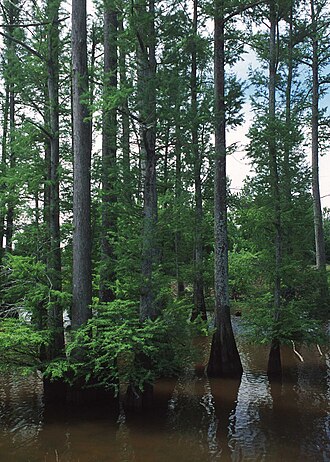
图:Public domain · Wikimedia Commons
- 学名
- Taxodium
- 分类等级
- 属
- 上级类群
- 柏科
- 大类
- 其他植物
- 命名
- 路易·克洛德·里夏尔,1810 年
- 中文别名
- 落羽杉属
- 数据库
- NCBI 分类 · GBIF
下级类群(2)
百科正文
下属物种
- 本属包括以下物种:
- 池杉 Taxodium ascendens
- Taxodium brookense Fontaine, 1889
- Taxodium capense hort. ex Endl., 1847
落羽杉 Taxodium distichum (L.) Rich.
池杉 Taxodium distichum var. imbricatum
Taxodium dubium (Sternberg, 1824) Heer†
Taxodium giganteum hort. ex Carrière, 1855
Taxodium horsfieldii Knight ex Carrière, 1855
Taxodium huegelii Hort.
- Taxodium hugelii Laws. ex Gordon, 1858
- Taxodium lakense Chandler, 1962
- Taxodium laramianum Penhallow, 1904
墨西哥落羽杉 Taxodium mucronatum Ten.
Taxodium nuciferum Brongn. ex Gordon, 1875
西方落羽松 Taxodium occidentale Newberry, 1863
- Taxodium tinajorum Heer, 1871
- Taxodium virens hort. ex Lavallée, 1877
- Taxodium virginicum Fontaine, 1889
以上内容摘自维基百科「落羽松属」,按 CC BY-SA 4.0 使用,去掉了参考文献、外部链接等尾部小节,公式改写成了纯文本。全文、配图和出处见原文。
英文维基百科补充中文条目比较短,下面是英文条目「Taxodium」的原文
Taxodium is a genus of one to three species (depending on taxonomic opinion) of extremely flood-tolerant conifers in the cypress family, Cupressaceae. The name is derived from the Latin word taxus 'yew' and the Greek word εἶδος (eidos) 'similar to'. Within the family, Taxodium is most closely related to Chinese swamp cypress (Glyptostrobus pensilis) and sugi (Cryptomeria japonica).
Species of Taxodium occur in the southern part of the North American continent and are deciduous in the north and semi-evergreen to evergreen in the south. They are large trees, reaching 100–150 ft (30–46 m) tall and 6.5–10 ft (2–3 m) (exceptionally 36 ft or 11 m) trunk diameter. The needle-like leaves, 0.2–0.8 in (0.5–2 cm) long, are borne spirally on the shoots, twisted at the base so as to appear in two flat rows on either side of the shoot. The cones are globose, 0.8–1.4 in (2–3.5 cm) diameter, with 10–25 scales, each scale with one or two seeds; they are mature in 7–9 months after pollination, when they disintegrate to release the seeds. The male (pollen) cones are produced in pendulous racemes, and shed their pollen in early spring. Taxodium species grow cypress knees, when growing in or beside water. The function of these knees is currently a subject of ongoing research.
Species
The three extant taxa of Taxodium are treated here as distinct species, though some botanists treat them in just one or two species, with the others considered as varieties of the first described. The three are distinct in ecology, growing in different environments, but hybridise where they meet.
†Taxodium dubium (Sternb.) Heer
Formerly placed here
Glyptostrobus pensilis (Staunton ex D.Don) K.Koch (as T. japonicum var. heterophyllum Brongn.)
Sequoia sempervirens (D.Don) Endl. (as T. sempervirens D.Don)
Uses
The trees are especially prized for their wood, of which the heartwood is extremely rot- and termite-resistant. The heartwood contains a sesquiterpene called cypressene, which acts as a natural preservative. It takes decades for cypressene to accumulate in the wood, so lumber taken from old-growth trees is more rot resistant than that from second-growth trees. However, age also increases susceptibility to Pecky Rot fungus (Stereum taxodii), which attacks the heartwood and causes some damaged trees to become hollow and thus useless for timber. Bald Cypress wood was much used in former days in the southeastern United States for roof shingles. The shredded bark of these trees is used as a mulch.
Evolution
In earth's history Taxodium was much more widespread in the Northern Hemisphere than today. The oldest fossils were found in Late Cretaceous deposits from North America and Asia. The trees persisted in Europe until around 2.5 million years ago, during the Pliocene.
以上内容摘自英文维基百科「Taxodium」,按 CC BY-SA 4.0 使用,去掉了参考文献、外部链接等尾部小节,公式改写成了纯文本。全文、配图和出处见原文。