格物
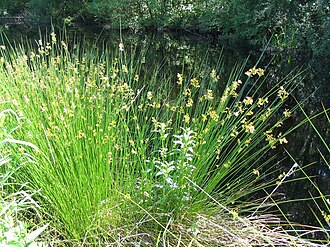
图:The original uploader was Meggar at English Wikipedia. · CC BY-SA 3.0 · Wikimedia Commons
- 学名
- Juncaceae
- 分类等级
- 科
- 上级类群
- 禾本目
- 大类
- 被子植物
- 命名
- 安托万·洛朗·德朱西厄,1789 年
- 中文别名
- 灯芯草科
- 数据库
- NCBI 分类 · GBIF
下级类群(2)
百科正文
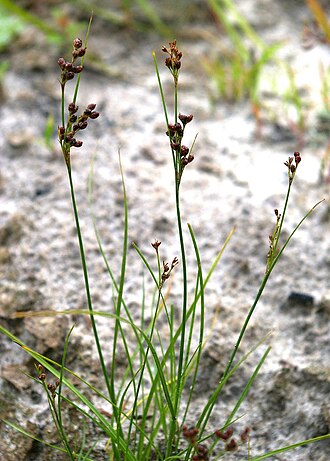
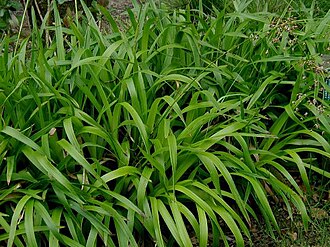
本科植物绝大部分为草本,也有灌木(如Prionium属),大部分为多年生,少数为一年生的。有匍匐状根茎和直立的茎;叶扁平或圆柱状,常绿,有时退化为膜质的鞘,在茎上分为三排,但双排草属的叶是两排,地杨梅属的叶有白色的毛;小花两性,绿色或稍白色,花瓣6,2轮,雄蕊6,稀3枚;果实为蒴果,分裂为3果瓣。
其中灯心草(Juncus effusus L.)可编席,髓心入药,在古代可以作为灯心。
1981年的克朗奎斯特分类法单独列出一个灯心草目,包括本科和梭子草科,2003年根据基因亲缘关系分类的APG II 分类法将本科列入禾本目中。
以上内容摘自维基百科「灯心草科」,按 CC BY-SA 4.0 使用,去掉了参考文献、外部链接等尾部小节,公式改写成了纯文本。全文、配图和出处见原文。
英文维基百科补充中文条目比较短,下面是英文条目「Juncaceae」的原文
Juncaceae is a family of flowering plants, commonly known as the rush family. It consists of 7 genera and about 464 known species of slow-growing, rhizomatous, herbaceous monocotyledonous plants that may superficially resemble grasses and sedges. They often grow on infertile soils in a wide range of moisture conditions. The best-known and largest genus is Juncus. Most of the Juncus species grow exclusively in wetland habitats. A few rushes, such as Juncus bufonius are annuals, but most are perennials. Despite the apparent similarity, Juncaceae are not counted among the plants with the vernacular name bulrush.
Description
The leaves are evergreen and well-developed in a basal aggregation on an erect stem. They are alternate and tristichous (i.e., with three rows of leaves up the stem, each row of leaves arising one-third of the way around the stem from the previous leaf). Only in the genus Distichia are the leaves distichous. The rushes of the genus Juncus have flat, hairless leaves or cylindrical leaves. The leaves of the wood-rushes of the genus Luzula are always flat and bear long white hairs.
The plants are monoecious or, rarely, dioecious. The small flowers are arranged in inflorescences of loose cymes, but also in rather dense heads or corymbs at the top of the stem or at its side. This family typically has reduced perianth segments called tepals. These are usually arranged in two whorls, each containing three thin, papery tepals. They are not bright or flashy in appearance, and their color can vary from greenish to whitish, brown, purple, black, or hyaline. The three stigmas are in the center of the flowers. As is characteristic of monocots, all of the flower parts appear in multiples of three.
The fruit is usually a nonfleshy, three-sectioned dehiscent capsule containing many seeds.
Uses
The dried pith of some species of this family with continuous pith is used to make a lighting implement known as a rushlight.
The common rush (Juncus effusus) is called igusa in Japanese and is used to weave the soft surface cover of tatami mats.
In medieval Europe, loose fresh rushes would be strewn on earthen floors in dwellings for cleanliness and insulation. Particularly favored for such a purpose was Acorus calamus (sweet flag), but despite its alternate vernacular name "sweet rush", it is a plant from a different monocot order, Acorales. Up until the 1960s in Ireland, rushes were spread on the earthen floor of homes during wet weather to help keep the floor dry during periods of snow or rain, or during hot weather to keep rooms cool. Rushes used in Ireland included Juncus effusus, Juncus inflexus, and Juncus conglomeratus.
The stems and leaves of Juncus kraussii were used by Indigenous Australians for fibre, for string, fishing lines, woven rugs and woven baskets. It is commonly used today for stabilisation of the banks of estuaries, around salt marshes and riparian zones next to sites developed for human use. It is also used in biofiltration systems and rain gardens.
以上内容摘自英文维基百科「Juncaceae」,按 CC BY-SA 4.0 使用,去掉了参考文献、外部链接等尾部小节,公式改写成了纯文本。全文、配图和出处见原文。