 格物
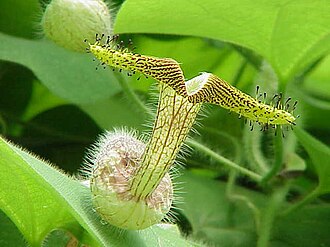
图:Kurt Stüber 1 · CC BY-SA 3.0 · Wikimedia Commons
- 学名
- Aristolochiaceae
- 分类等级
- 科
- 上级类群
- 胡椒目
- 大类
- 被子植物
- 命名
- 安托万·洛朗·德朱西厄,1789 年
- 异名
- 鞭寄生亚科、短蕊花科、Asaraceae
- 数据库
- NCBI 分类 · GBIF
下级类群(3)
- 鞭寄生属 Hydnora 属
- 牧豆寄生属 Prosopanche 属
- Asaroideae 亚科
百科正文
马兜铃科属于被子植物木兰类植物,以前单独分为马兜铃目,现在新的《APG II 分类法》将其列入胡椒目。马兜铃科植物大部分是多年生植物,有草本、灌木和藤本。
叶为单叶,互生,叶形为心形,有叶柄,无托叶,叶缘通常为全缘。花腋生,由叶腋长出,花辐射对称或左右对称。
大部分马兜铃科植物含有马兜铃酸,微量服用就会大幅提高上泌尿系统(包含肾脏)癌症的可能性、较为多量、长期的服用则会造成不可逆、不可停止的肾衰竭;是华人及巴尔干半岛居民洗肾或腹膜透析的重要原因。
分类
- 马兜铃亚科 Aristolochioideae
- 马兜铃属 Aristolochia
- 线果兜铃属 Thottea
- 细辛亚科 Asaroideae
- 细辛属 Asarum
- 马蹄香属 Saruma
- 鞭寄生亚科 Hydnoroideae
- 鞭寄生属 Hydnora
- 牧豆寄生属 Prosopanche
- 囊粉花亚科 Lactoridoideae
- 囊粉花属 Lactoris
代表植物
马兜铃
细辛
以上内容摘自维基百科「馬兜鈴科」,按 CC BY-SA 4.0 使用,去掉了参考文献、外部链接等尾部小节,公式改写成了纯文本。全文、配图和出处见原文。
英文维基百科补充中文条目比较短,下面是英文条目「Aristolochiaceae」的原文
The Aristolochiaceae (English:) are a family, the birthwort family, of flowering plants with eight genera and about 400 known species belonging to the order Piperales. The type genus is Aristolochia L.
Description
They are mostly perennial, herbaceous plants, shrubs, or lianas. The membranous, cordate simple leaves are spread out, growing alternately along the stem on leaf stalks. The margins are commonly entire. No stipules are present. The flowers are large to medium-sized, growing in the leaf axils. They are bilaterally or radially symmetrical.
Classification
Aristolochiaceae are magnoliids, a basal group of angiosperms which are not part of the large categories of monocots or eudicots. As of APG IV (2016), the former families Hydnoraceae and Lactoridaceae are included, because exclusion would make Aristolochiaceae in the traditional sense paraphyletic.
Some newer classification schemes, such as the update of the Angiosperm Phylogeny Group, place the family Aristolochiaceae in the order Piperales, but it is still quite common, though superseded, for the Aristolochiaceae to be assigned, sometimes with some other families, their own order (Aristolochiales).
Phylogeny
Eight genera are accepted – Aristolochia, Asarum, Euglypha, Hydnora, Lactoris, Prosopanche, Saruma, and Thottea.
Four assemblages can be distinguished in the genus-level cladogram of Aristolochiaceae:
Aristolochia is closely related to Thottea.
Hydnora is closely related to Prosopanche.
Lactoris occupies an isolated position.
Asarum is closely related to Saruma, and both genera display a deep-branching position in the family.
Phytochemistry
Many members of Aristolochia and some of Asarum contain the toxin aristolochic acid, which discourages herbivores and is known to be carcinogenic in rats. Aristolochia species are carcinogenic to humans.
Genomics
The complete plastid genome sequence of one species of Aristolochiaceae, Hydnora visseri, has been determined. As compared to the chloroplast genome of its closest photosynthetic relatives, the plastome of Hydnora visseri shows extreme reduction in both size (ca. 27 kilo base pairs) and gene content (24 genes appear to be functional). This Aristolochiaceae species therefore possesses one of the smallest plastid genomes among flowering plants.
Ecology
Pipevine swallowtail butterflies lay their eggs on pipevine (Aristolochia species), and the larvae feed on the plant, but are not affected by the toxin, which then offers the adult butterfly protection against predators.
Fossil record
The earliest records of the family are the fossil seeds of †Aristospermum huberi and †Siratospermum mauldinense from the Early Cretaceous of Portugal and Virginia, United States. The oldest fossil leaf remains are of †Aristolochites dentata from the Late Cretaceous of Nebraska. Pollen record of †Aristolochiacidites viluiensis has been described from Upper Cretaceous sediments of Siberia. Fossil wood is known from the Deccan Traps of India some 66 million years ago. Leaf fossils of Aristolochia are known from the Early and Late Tertiary of North America and the Late Tertiary of Abkhazia, Ukrainia and Poland. Fossil leaf remains of †Aristolochia austriaca have been described from Late Miocene sediments of the Pellendorf site at the Vienna Basin in Austria. †A. austriaca is most similar to the extant Mediterranean species A. rotunda and A. baetica.
以上内容摘自英文维基百科「Aristolochiaceae」,按 CC BY-SA 4.0 使用,去掉了参考文献、外部链接等尾部小节,公式改写成了纯文本。全文、配图和出处见原文。