 格物

图:Franz Eugen Köhler, Köhler's Medizinal-Pflanzen · Public domain · Wikimedia Commons
- 学名
- Piperaceae
- 分类等级
- 科
- 上级类群
- 胡椒目
- 大类
- 被子植物
- 命名
- 保罗·迪特里希·吉塞克,1792 年
- 异名
- Peperomiaceae
- 数据库
- NCBI 分类 · GBIF
下级类群(1)
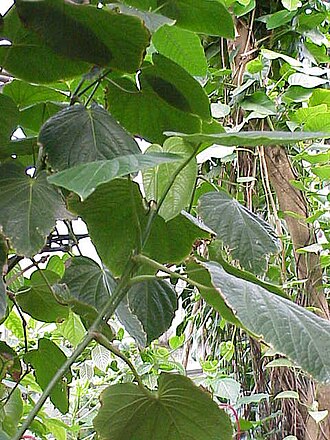
- 胡椒属 Piper 属
百科正文
不论是克朗奎斯特分类法还是2003年的APG II 分类法都将胡椒科分入胡椒目,克氏分类法将其列入木兰亚纲,APG将其列入木兰分支。
形态
直立、蔓生的草本、灌木;木质的常绿,茎具分离维管束,有时多少散开,似单子叶植物,草本的常多汁。
单叶互生,对生或轮生,往往肉质,掌状脉或羽状脉,全缘,具叶柄,如托叶存在,与叶柄合生。
花极小,有苞,常两性,有些单性,常集成肉质的穗状花序,或再排列成伞状,无花被,雄蕊1~10,花药有2个药室,纵裂,花粉粒小,具单槽,有厚皮层;草胡椒属的花粉无萌发孔;雌蕊1,子房上位,心皮1~4(5)合成一室,有一着生基底的直生胚珠,花柱1或无,柱头1~4(5);
小型核果,种子小,有多量粉状外胚乳,染色体基数x=8、11、12、14、20。
属
- 胡椒科包含3亚科共5属:
- 多柱椒草亚科 Verhuellioideae Samain & Wanke
- 多柱椒草属 Verhuellia Miquel, 1843 —— 3种
- 齐头绒亚科 Zippelioideae Samain & Wanke
- 齐头绒属 Zippelia Blume, 1830 —— 1种
- 鞭胡椒属 Manekia Trelease, 1927 —— 6种
- 胡椒亚科 Piperoideae Arnott
- 胡椒属 Piper Linnaeus, 1753 —— 逾2500种
草胡椒属 Peperomia Ruiz & Pavon, 1794 —— 逾1400种
以上内容摘自维基百科「胡椒科」,按 CC BY-SA 4.0 使用,去掉了参考文献、外部链接等尾部小节,公式改写成了纯文本。全文、配图和出处见原文。
英文维基百科补充中文条目比较短,下面是英文条目「Piperaceae」的原文
The Piperaceae , also known as the pepper family, are a large family of flowering plants. The group contains roughly 3,600 currently accepted species in five genera, the vast majority within Piper and Peperomia. The bell and chili pepper, meanwhile, belong to a different family.
Piperaceae members may be small trees, shrubs, or herbs. The family's distribution is best described as pantropical. The best-known species, Piper nigrum, yields most peppercorns that are used as spices, including black pepper, although its relatives in the family include many other spices.
Description
Members of pepper family are small trees, shrubs, or perennial or annual herbs. The plants are often rhizomatous and can be terrestrial or epiphytic. The stems can be either simple or branched.
The leaves are simple with entire margins, and are positioned at the base of the plant or along the stem, and can be alternate, opposite, or whorled in arrangement. Stipules are usually present, as are petioles. The leaves are often noticeably aromatic when crushed.
The inflorescences (in the form of spikes) are terminal, opposite the leaves, or located in the axils. The flowers are bisexual, with no perianth, and each subtended by a peltate bract. There are 2–6 stamens, which are hypogynous, with 2-locular anthers. There are usually three or four stigmas attached to a single pistil per flower, which is 1 or 3–4 carpellate. The ovary is 1-locular, and superior.
The fruits are drupelike, with a single seed per fruit. The seeds have a minute embryo, and mealy perisperm.
Taxonomy
The APG III system of 2009 recognizes this family and assigns it to the order Piperales in the unranked clade magnoliids. The family consists of five genera: Piper, Peperomia, Zippelia, Manekia, and Verhuellia. The previously recognised Pacific genus Macropiper, was recently merged into Piper. A tentative cladogram showing relationships based on Wanke et al. (2007) is shown below. This phylogeny was based on 6,000 base pairs of chloroplast DNA. Only recently has it become clear that Verhuellia is sister to the other four genera in the family.
The group contains roughly 3,600 currently accepted species in five genera. The vast majority of species can be found within the two main genera Piper (2,171 species) and Peperomia (over 1,000 species).
Etymology
The name Piperaceae is derived from the Sanskrit term pippali (पिप्पलि).
The family is unrelated to the South American family Solanaceae (the nightshades), which includes bell and chili peppers; Columbian-era Europeans thought the spicy fruits were a variety of the black pepper.
Distribution and habitat
The distribution of this group is best described as pantropical.
Uses
The best-known species, Piper nigrum, yields most peppercorns that are used as spices, including black pepper, although its relatives in the family include many other spices.
Numerous members of the family are used in the traditional medicine of indigenous population for a wide variety of illnesses. Many studies have been undertaken to investigate these uses, with a large number of them focusing especially on the active ingredient Piperine and related compounds found in many members of this family, especially black pepper, long pepper and Betel, as well as kavalactones found in Kava.
以上内容摘自英文维基百科「Piperaceae」,按 CC BY-SA 4.0 使用,去掉了参考文献、外部链接等尾部小节,公式改写成了纯文本。全文、配图和出处见原文。