 格物
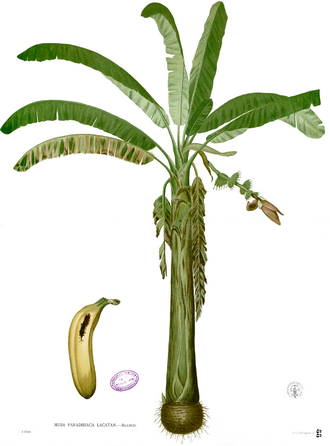
图:Francisco Manuel Blanco (O.S.A.) · Public domain · Wikimedia Commons
- 学名
- Musaceae
- 分类等级
- 科
- 上级类群
- 姜目
- 大类
- 被子植物
- 命名
- 安托万·洛朗·德朱西厄,1789 年
- 数据库
- NCBI 分类 · GBIF
下级类群(2)
百科正文
形态
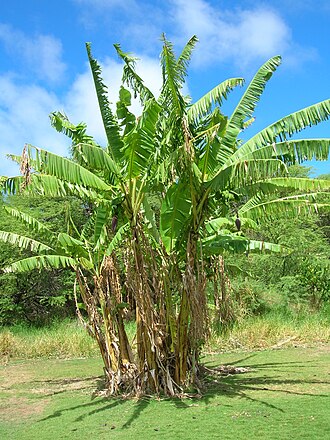
多年生高大草本,单生不分枝,结一次或多次果。
叶螺旋状排列,有厚的中肋和多数羽状平行脉;幼叶芽时呈卷筒状。
花常为单性,偶有两性,成1或2列簇生于着色的大苞片内。花序直立,下垂或半下垂。雄花着生于上部的苞片内,雌花着生于下部的苞片内。合生花被片位于外轮,先端具5(3+2)齿或3深裂成条形,中裂片两侧有一个小裂片或无小裂片。离生花被片位于内轮,长圆形至近圆形,全缘或具尾尖或具3尖头,两侧裂片近圆形而中裂片为狭长具长尖头。雄蕊5,完全,第6个雄蕊不存在或为较小的退化雄蕊,花丝丝状,花药线形,2室,花粉粒表面为规则的疣状(象腿蕉属)或细颗粒状(地涌金莲属、芭蕉属)。子房下位3室,每室有多数生于中轴胎座的胚珠。花柱丝状,柱头具小裂片或近头状。
浆果肉质,通常不开裂,3室。种子有厚硬的外种皮,光滑或具疣;胚直,有丰富的胚乳。染色体基数x=9、10、11,稀7、9。
分布
主要分布于亚洲及非洲热带地区,种数最多的在印度东南亚至泰国地区,其次是印度尼西亚。中国有3属12种,除1种(芭蕉)可北达秦岭、淮河露地栽培外,其余各种均产于西南至东南及台湾的热带及亚热带地区。
分类
截至2026年7月 (2026-07),芭蕉科共有100种左右,分为以下3属:
象腿蕉属 Ensete Bruce ex Horan., 1862
约8种。
芭蕉属 Musa L., 1753
约88种。
地涌金莲属 Musella (Franch.) H.W.Li, 1978
单型属(仅一种)。该属最初由吴征镒提出,后由李锡文正式有效发表。
以上内容摘自维基百科「芭蕉科」,按 CC BY-SA 4.0 使用,去掉了参考文献、外部链接等尾部小节,公式改写成了纯文本。全文、配图和出处见原文。
英文维基百科补充中文条目比较短,下面是英文条目「Musaceae」的原文
Musaceae is a family of flowering plants composed of three genera with about 91 known species, placed in the order Zingiberales. The family is native to the tropics of Africa and Asia. The plants have a large herbaceous growth habit with leaves with overlapping basal sheaths that form a pseudostem making some members appear to be woody trees. In most treatments, the family has three genera, Musa, Musella and Ensete. Cultivated bananas are commercially important members of the family, and many others are grown as ornamental plants.
Taxonomy
The family has been practically universally recognized by taxonomists, although with differing circumscriptions. Older circumscriptions of the family commonly included the genera now included in Heliconiaceae and Strelitziaceae.
The APG III system, of 2009 (unchanged from the APG system, 1998), assigns Musaceae to the order Zingiberales in the clade commelinids in the monocots.
The oldest fossil evidence of the family is thought to possibly be the Late Cretaceous palynotaxon Spirematospermum chandlerae from North Carolina, unlike most other Spirematospermum species which are thought to represent members of Zingiberaceae. In contrast, "Musa" cardiosperma from the Maastrichtian Intertrappean Beds of India, formerly considered the earliest record of the genus Musa, is now thought to be a member of the Zingiberaceae and has been reclassified into the extinct genus Momordiocarpon. The oldest unequivocal fossil of the family is Ensete oregonense from the Eocene Clarno Formation of Oregon, although its actual placement within the family is uncertain.
Genera
As currently circumscribed the family includes three genera. All genera and species are native to the Old World tropics. The largest and most economically important genus in the family is Musa, famous for the banana and plantain. The genus Musa was formally established in the first edition of Linnaeus' Species Plantarum in 1753 — the publication that marks the start of the present formal botanical nomenclature. At the time he wrote Species Plantarum, Linnaeus had first hand knowledge of only one type of banana, which he personally had the opportunity of seeing growing under glass in the garden of Mr. George Clifford near Haarlem in the Netherlands.
Before 1753, the genus had already been described by the pre-Linnaean botanist Georg Eberhard Rumphius and Linnaeus himself had described the banana he had seen as Musa cliffortiana in 1736 (this might be described as a "pre-Linnaean" Linnaean name). The 1753 name Musa paradisiaca L. for plantains and Musa sapientum L. for dessert bananas are now known to refer to hybrids, rather than natural species. It is known today that most cultivated seedless bananas are hybrids or polyploids of two wild banana species - Musa acuminata and Musa balbisiana. Linnaeus' Musa sapientum is now identified to be the hybrid Latundan cultivar (M. × paradisiaca AAB Group 'Silk'), while his Musa paradisiaca are now known to be hybrids belonging generally to the AAB and ABB banana cultivar groups. Hybridization and polyploidy was the cause of much confusion in the taxonomy of the genus Musa that was not resolved until the 1940s and 1950s.
In this clearing up of the taxonomy, Ernest Entwistle Cheesman in 1947 revived the genus name Ensete which had been published in 1862, by Horaninow, but had not been accepted.
Musa section Musella Franch. was raised to the rank of genus by H.W. Li in 1978 for the Chinese species Musella lasiocarpa, which was originally described in Musa in 1889 and transferred to Ensete by Cheesman in 1948. The species combines characters like the swollen stems of Ensete with the clonal habit of Musa. Acceptance of Musella has varied; as of February 2013, the World Checklist of Selected Plant Families considers it a synonym of Ensete, other sources dispute this view.
以上内容摘自英文维基百科「Musaceae」,按 CC BY-SA 4.0 使用,去掉了参考文献、外部链接等尾部小节,公式改写成了纯文本。全文、配图和出处见原文。