 格物
- 学名
- Saponaria officinalis
- 分类等级
- 种
- 上级类群
- 肥皂草属
- 大类
- 被子植物
- 命名
- 卡尔·林奈,1753 年
- 数据库
- NCBI 分类 · GBIF
百科正文
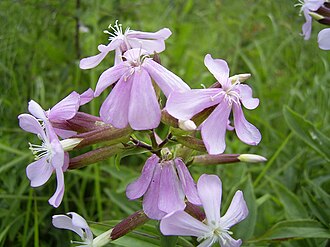
肥皂草在地中海沿岸有野生,我国北方栽培较多,在部分地区已逸生。开花时,其根中的皂素含量可达20%。
以上内容摘自维基百科「肥皂草」,按 CC BY-SA 4.0 使用,去掉了参考文献、外部链接等尾部小节,公式改写成了纯文本。全文、配图和出处见原文。
英文维基百科补充中文条目比较短,下面是英文条目「Saponaria officinalis」的原文
Saponaria officinalis is a common perennial plant from the family Caryophyllaceae. This plant has many common names, including common soapwort, bouncing-bet, crow soap, and soapweed. There are about 20 species of soapworts altogether.
The scientific name Saponaria is derived from the Latin sapo (stem sapon-) meaning "soap", which, like its common name, refers to its utility in cleaning. From this same Latin root is derived the name of the toxic substances saponins found in many plants, including a specific saporin saponarin contained in the roots at levels up to 20 percent when the plant is flowering (Indian soapnuts contain only 15 percent). The flowers colouring likely reflects the chemical environment of saponarin. Saponins produce a lather when in contact with water. The epithet officinalis indicates its medicinal functions. It is a common host plant for some moth species, including the white-lined sphinx.
Saponaria officinalis' native range extends throughout Europe, and in Asia to western Siberia. It grows in cool places at low or moderate elevations under hedgerows and along the shoulders of roadways. It can be found as a horticultural escapee and noxious invasive in much of North America.
Description
The plant possesses leafy, unbranched stems (often tinged with red). It grows in patches, attaining a height of 70 cm (28 in). The broad, lanceolate, sessile leaves are opposite and between 4 and 12 cm long. Its sweetly scented flowers are radially symmetrical and pink, or sometimes white. Each of the five flat petals have two small scales in the throat of the corolla. They are about 2.5 cm (1 in) wide. They are arranged in dense, terminal clusters on the main stem and its branches. The long tubular calyx has five pointed red teeth.
The individual flowers open in the evening, and stay open for about three days. They produce a stronger scent at night and supplement nectar production during the night. The flowers are protandrous: on the second night of blooming, the pollen is released, and the stigma develops to its final position by the third night. Much of the seed production comes from self-pollination.
External use
As its common name implies, it can be used as a very gentle soap, usually in dilute solution. It has historically been used to clean delicate or unique textiles, especially woollen fabrics; it has been hypothesized that the plant was used to treat the Shroud of Turin.
A lathery liquid that has the ability to dissolve fats or grease can be procured by boiling the leaves or roots in water. Leaves are chopped, boiled, and strained; the liquid can then be used as soap.
It has been widley used in Italy for skin conitions. In the Romanian village of Șieu-Odorhei, natives call the plant săpunele. It is traditionally used by the villagers as a soap replacement for dry skin.
Internal use
Saponins have long been known to cause throat irritation and have a bitter taste, and the maximum amount in food is regulated in many jurisdictions. Some have medicinal uses and are well known plant toxins so an overdose could cause nausea, diarrhea, and vomiting. Different types of saponins are synthesized by the species. The saponin saponarin has low acute rat toxicity and no evidence of genotoxicity, so not all saponins are necessarily toxic when ingested.
Despite its toxic potential, Saponaria officinalis finds culinary use as an emulsifier in the commercial preparation of tahini and in brewing to create beer with a good head. In the Middle East, the root is often used as an additive in the process of making halva. The plant is used to stabilize the oils in the mixture and to create the distinctive texture of halva.
Chemistry
Saponaria officinalis contains several saponins, which are ribosome-inactivating proteins. Amongst the saponins isolated with this property are isoform 6 of saponarin (SO6, saponin S6) from the seeds, and saporin-L1 (SAP) from the leaves. Saponariosides A,B, C, D, F, G, H, I, J, K, L, and M, vaccaroside D, dianchinenoside B, hydroxygypsogenic acid derivative compounds 1 and 2 and gypsogenic acid derivative compound 3 have been isolated from the whole plant or roots.
The many compounds responsible for the floral scent (predominantly methyl benzoate), and that compose essential oil extracts from the plant have also been characterised.
Saponin S6 is able to kill cancer cells via apoptosis and saporin SO1861 found in the plant increases the cytotoxicity of other compounds.
以上节选摘自英文维基百科「Saponaria officinalis」,按 CC BY-SA 4.0 使用,去掉了参考文献、外部链接等尾部小节,公式改写成了纯文本。篇幅所限,较长的小节只摘了开头一部分,有的小节没有收;全文、配图和出处见原文。