 格物
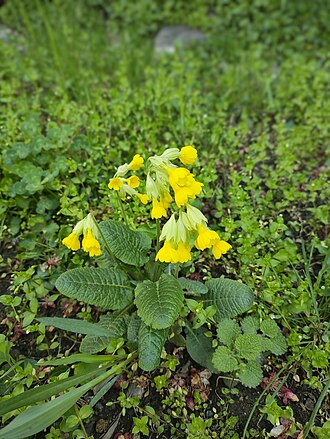
图:Avetisyan Ani · CC BY-SA 4.0 · Wikimedia Commons
- 学名
- Primula veris
- 分类等级
- 种
- 上级类群
- 报春花属
- 大类
- 被子植物
- 命名
- 卡尔·林奈,1753 年
- 中文别名
- 黄花九轮樱
- 数据库
- NCBI 分类 · GBIF
百科正文
该物种经常与欧报春杂交形成多花报春(Primula ×polyantha)。多花报春经常与高报春(Primula elatior)混淆。
以上内容摘自维基百科「黄花九轮草」,按 CC BY-SA 4.0 使用,去掉了参考文献、外部链接等尾部小节,公式改写成了纯文本。全文、配图和出处见原文。
英文维基百科补充中文条目比较短,下面是英文条目「Primula veris」的原文
Primula veris, the cowslip, common cowslip, or cowslip primrose (syn. Primula officinalis Hill), is a herbaceous perennial flowering plant in the primrose family Primulaceae. The species is native throughout most of temperate Europe and western Asia, and although absent from more northerly areas including much of northwest Scotland, it reappears in northernmost Sutherland and Orkney and in Scandinavia. This species frequently hybridizes with other Primulas such as the common primrose Primula vulgaris to form false oxlip (Primula × polyantha) which is often confused with true oxlip (Primula elatior), a much rarer plant.
Names
The common name cowslip may derive from the old English for cow dung, probably because the plant was often found growing amongst the manure in cow pastures. An alternative derivation simply refers to slippery or boggy ground; again, a typical habitat for this plant. The name "cowslop" derived from Old English still exists in some dialects, but the politer-sounding "cowslip" became standard in the 16th century.
The species name veris ('of spring', referring to the season) is the genitive case form of Latin ver ('spring'). However, primrose P. vulgaris, flowers earlier, from December to May in the British Isles.
Description
Primula veris is a variable evergreen or semi-evergreen perennial plant growing to 25 cm (10 in) tall and broad, with a rosette of leaves 5–15 cm long and 2–6 cm broad. The deep yellow flowers are produced in spring, in clusters of 10–30 blooms together on a single stem. Each flower is 9–15 mm broad. Red- and orange-flowered plants occur rarely but can be locally widespread in areas where coloured primula hybrids bloom at the same time as the native cowslip, enabling cross-pollination.
Distribution and habitat
The cowslip is frequently found on more open ground than the primrose, including open fields, meadows, coastal dunes, and clifftops.
Conservation
The plant suffered a decline due to changing agricultural practices throughout the 1970s and 1980s in Britain. It may therefore be rare locally, though where found it may be abundant. Additionally the seeds are now often included in wildflower seed mixes used to landscape motorway banks and similar civil engineering earthworks where the plants may be seen in dense stands. This practice has led to a revival in its fortunes.
Cultivation
In cultivation this plant has gained the Royal Horticultural Society's Award of Garden Merit.
Similar species
The cowslip may be confused with the closely related Primula elatior (oxlip) which has a similar general appearance and habitat, although the oxlip has larger, pale yellow flowers more like a primrose, and a corolla tube without folds.
Chemical constituents
The roots of Primula veris contain several glycosides of 5-methoxysalicylic methyl ester, such as primeverin and primulaverin. In the crude dried root, their phenolic aglycones are responsible for the typical odour reminiscent of methyl salicylate or anethole. The dried roots contain significant amounts of triterpene saponins, such as primula acid I/II, while in the flower these constituents are located in the sepals, and the dominating constituents are flavonoids. Rare side effects of the saponins can be nausea or diarrhoea while some of the phenolic constituents are possibly responsible for allergic reactions.
Cuisine
Cowslip leaves have been traditionally used in Spanish cooking as a salad green. Uses in English cookery include using the flowers to flavor country wine and vinegars; sugaring to be a sweet or eaten as part of a composed salad while the juice of the cowslip is used to prepare tansy for frying. The close cousin of the cowslip, the primrose P. vulgaris has often been confused with the cowslip and its uses in cuisine are similar with the addition of its flowers being used as a colouring agent in desserts.
Myth and folklore
This herb was already mentioned by Pliny the Elder for its early blooming attributes. Species from the genus Primula along with other ritual plants played a significant role in the pharmacy and mythology of the Celtic druids, likely as an ingredient of magical potions to increase the absorption of other herbal constituents. In the Middle-Ages it was also known as St. Peter's herb or Petrella and was sought after by Florentine apothecaries. Hildegard von Bingen recommended the medicinal parts only for topical use but the leaves were also consumed as food.
以上节选摘自英文维基百科「Primula veris」,按 CC BY-SA 4.0 使用,去掉了参考文献、外部链接等尾部小节,公式改写成了纯文本。篇幅所限,较长的小节只摘了开头一部分,有的小节没有收;全文、配图和出处见原文。