 格物
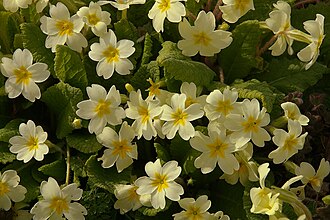
图:mattbuck (category) · CC BY-SA 3.0 · Wikimedia Commons
- 学名
- Primula vulgaris
- 分类等级
- 种
- 上级类群
- 报春花属
- 大类
- 被子植物
- 命名
- 威廉·赫德森
- 中文别名
- 西洋报春、西洋樱草花
- 数据库
- NCBI 分类 · GBIF
百科正文
形态
其高度在10—30 cm(4—12英寸)之间,在适宜的气候下常绿。其叶缘具齿状缺刻。其花黄色(偶尔为白色或粉色),具有香气,直径2-4厘米。
分类
欧报春有三个亚种:
Primula vulgaris subsp. vulgaris:西欧和南欧
Primula vulgaris subsp. balearica (Willk.) W.W.Sm. & Forrest.:巴利阿里群岛原生植物,开白色花
Primula vulgaris subsp. sibthorpii (Hoffmanns.) W.W.Sm. & Forrest.:巴尔干半岛、西南亚植物,花粉色、红色或紫色
因为是一种常见的观赏植物,19和20世纪以来出现了很多栽培和杂交品种。多花报春(Primula ×polyantha)是欧报春和黄花九轮草(P. veris)的杂交种。
以上内容摘自维基百科「歐報春」,按 CC BY-SA 4.0 使用,去掉了参考文献、外部链接等尾部小节,公式改写成了纯文本。全文、配图和出处见原文。
英文维基百科补充中文条目比较短,下面是英文条目「Primula vulgaris」的原文
Primula vulgaris is a species of flowering plant in the family Primulaceae, native to Eurasia. The common name of this plant is primrose, or occasionally common primrose or English primrose to distinguish it from other Primula species referred to as primroses.
Description
Primula vulgaris is a perennial growing 10–30 centimetres (4–12 inches) tall, with a basal rosette of leaves which are more-or-less evergreen in favoured habitats. The leaves are 5–25 cm (2–10 in) long and 2–6 cm (1–2+1⁄2 in) broad, often heavily wrinkled, with an irregularly crenate to dentate margin. The leaf blade is gradually attenuated towards the base and unevenly toothed. The single stem, extremely short, is hidden in the centre of the leaf rosette.
Taxonomy
Subspecies
Three subspecies are accepted by some sources:
Primula vulgaris subsp. vulgaris. Western and southern Europe. As described above; flowers pale yellow.
Primula vulgaris subsp. balearica (Willk.) W.W.Sm. & Forrest. Balearic Islands (endemic). Flowers white. Leaf stem longer than leaf blade.
Primula vulgaris subsp. sibthorpii (Hoffmanns.) W.W.Sm. & Forrest. Balkans, southwest Asia. Flowers pink to red or purple.
Plants of the World Online accepts only one subspecies in addition to the nominate subsp. vulgaris:
Primula vulgaris subsp. atlantica (Maire & Wilczek) Greuter & Burdet. Morocco to Algeria.
Distribution and habitat
The native range of P. vulgaris encompasses western and southern Europe. In the north, the distribution area extends from central Norway near the Faroe Islands via the British Isles, Denmark, northern Germany, the Netherlands, Belgium and France to southern Portugal in the south and the tip of North Africa in Algeria. To the east, the range extends through the southern European peninsulas to the Crimea, Balkans, Syria, Turkey, and Armenia.
In appropriate conditions, P. vulgaris can cover the ground in open woods and shaded hedgerows.
Ecology
Pollinators
Most (90%) individuals are heterostylous, the minority monostylous. The flowers of the species are visited by a variety of insects, including butterflies (Lepidoptera), Hymenoptera, beetles (Coleoptera) and Diptera. Which visitors pollinate plants is not fully established. However, good pollinators are said to be bumblebees and hairy flies of the genus Bombylius. However, the most common visitors to the flowers are small beetles of the genus Meligethes – often there are up to 12 or more pollen-covered individuals in a single flower.
Cultivation
The wild primrose is a staple of cottage garden plantings, and is widely available as seeds or young plants. It grows best in moist but well-drained soil in light shade. It is increased by seed and division. The throat is usually coloured rich yellow.
Primrose breeding of named coloured varieties became popular in the nineteenth and early twentieth century. Numerous cultivars have been selected for garden planting, often derived from subsp.
Uses
Both flowers and leaves are edible, the flavour ranging between mild lettuce and more bitter salad greens. The leaves can be cooked in soup but preferably with other plants because they are sometimes a little strong. The leaves can also be used for tea, and the young flowers can be made into primrose wine. In the past the whole plant and especially the root were considered to have analgesic, anti-spasmodic, diuretic and expectorant properties. It contains small amounts of saponins, and was given for colds.
P. vulgaris foliage contains significant amounts of vitamin C.
In culture
The primrose was Benjamin Disraeli's favourite flower; Primrose Day and the Primrose League were given their names in honour of this.
Primroses also appear as a charge in heraldry, for example the coat of arms of the Earl of Rosebery.
Italy chose a fuchsia primrose as the symbol of its 2020 COVID-19 vaccination campaign.
The primrose is on one side of Austria's 5 euro cent coin.
Primrose Yellow exists in some paint and color systems and is named after this flower.
以上节选摘自英文维基百科「Primula vulgaris」,按 CC BY-SA 4.0 使用,去掉了参考文献、外部链接等尾部小节,公式改写成了纯文本。篇幅所限,较长的小节只摘了开头一部分,有的小节没有收;全文、配图和出处见原文。