 格物
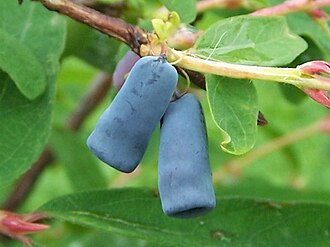
图:Opioła Jerzy (Poland) · CC BY 2.5 · Wikimedia Commons
- 学名
- Lonicera caerulea
- 分类等级
- 种
- 上级类群
- 忍冬属
- 大类
- 被子植物
- 命名
- 卡尔·林奈,1753 年
- 中文别名
- 蓝果忍冬、蓝靛果、蓝锭果
- 保护状况(IUCN)
- 无危物种
- 用途
- 药用植物
- 数据库
- NCBI 分类 · GBIF · IUCN 红色名录
百科正文
果实可食用,营养丰富,富含维生素C、花青素、钙。
特征
落叶灌木,株高1.5-2米,叶对生,卵形,长3-8厘米,宽1-3厘米,叶灰绿色,质感微偏蜡质。花黄白色,长12-16毫米,5裂均分,成对地生于嫩枝上。果实为蓝色浆果,直径1厘米。
变种
蓝靛果忍冬共有9个变种,一些学者视为亚种:
阿尔泰忍冬 Lonicera caerulea var. altaica:亚洲北部。
蓝靛果忍冬 Lonicera caerulea var. caerulea:欧洲。
Lonicera caerulea var. cauriana:北美洲西部。
Lonicera caerulea var. dependens:中亚。
蓝靛果 Lonicera caerulea var. edulis:东亚。
Lonicera caerulea var. emphyllocalyx:东亚。
Lonicera caerulea var. kamtschatica:东北亚。
Lonicera caerulea var. pallasii:亚洲北部、欧洲东北部。
Lonicera caerulea var. villosa:北美洲东部。
以上内容摘自维基百科「藍靛果忍冬」,按 CC BY-SA 4.0 使用,去掉了参考文献、外部链接等尾部小节,公式改写成了纯文本。全文、配图和出处见原文。
英文维基百科补充中文条目比较短,下面是英文条目「Lonicera caerulea」的原文
Lonicera caerulea, commonly known as honeyberry or by various honeysuckle names, is a non-climbing honeysuckle native throughout the cool temperate Northern Hemisphere regions of North America, Europe, and Asia.
The plant or its fruit has also come to be called haskap, derived from its name in the language of the native Ainu people of Hokkaido, Japan.
Description
Haskap is a deciduous shrub growing to 1.5–2 m (4 ft 11 in – 6 ft 7 in) tall. The leaves are opposite, oval, 3–8 cm (1.2–3.1 in) long and 1–3 cm (0.39–1.18 in) broad, greyish green, with a slightly waxy texture. The flowers are yellowish-white, 12–16 mm long, with five equal lobes; they are produced in pairs on the shoots. The fruit is an edible, blue berry, somewhat cylindrical in shape weighing 1.3 to 2.2 grams (0.046 to 0.078 oz), and about 1 cm (0.39 in) in diameter.
The plant is winter-hardy and can tolerate temperatures below −47 °C (−53 °F). Its flowers are frost-tolerant. Fruits mature early and are high in vitamin C.
Haskap cultivars can survive a large range of soil acidity from 3.9-7.7 (optimum 5.5-6.5), requiring high organic matter, well drained soils, and plentiful sunlight for optimum productivity.
Distribution and habitat
The species is circumpolar, primarily found in or near wetlands of boreal forests in heavy peat soils of North America, Europe, and Asia. It also can be found in high-calcium soils, in mountains, and along the coasts of northeastern Asia and northwestern North America.
Different varieties are distributed across central and northern Canada, northern United States, northern and eastern Europe, Siberia, middle Asia, and northeastern China.
Classification
The classification within the species is not settled. One classification uses nine botanical varieties:
Lonicera caerulea var. altaica. Northern Asia.
Lonicera caerulea var. caerulea. Europe.
Lonicera caerulea var. cauriana. Western North America.
Lonicera caerulea var. dependens. Central Asia.
Lonicera caerulea var. edulis, synonym: L. edulis. Eastern Asia.
Lonicera caerulea var. emphyllocalyx (also known as haskap). Eastern Asia.
Lonicera caerulea var. kamtschatica. Northeastern Asia.
Lonicera caerulea var. pallasii. Northern Asia, northeastern Europe.
Lonicera caerulea var. villosa. Eastern North America.
Cultivated varieties
- Improved cultivars include:
- 'Aurora'
- 'Boreal Beauty'
- 'Boreal Beast'
- 'Boreal Blizzard'
- 'Honeybee'
- 'Wojtek'
- 'Berry Blue'
- 'Indigo Gem'
- 'Indigo Treat'
- 'Indigo Yum'
- 'Tundra'
- 'Borealis'
- 'Atlaj'
- 'Nimfa'
- 'Polar Jewel'
- 'Sinoglaska'
Cultivation
The indigenous peoples of eastern Russia, northern Japan, and northern China have long harvested the wild berries, but cultivation efforts are relatively recent. Research into commercial cultivation improved in Hokkaido, Japan in the 1970s. The plant is mostly unknown in the Western world, even though some varieties grow in Canada and northern United States. Haskap variety edulis has been used frequently in breeding efforts, but other varieties have been bred with it to increase productivity and flavor. In several haskap breeding programs, the variety emphyllocalyx has been the dominant one used. In recent years, a new programme has aimed at growing honeyberries commercially in Scotland (with a similar climate to Northern Japan) at farms in Duns, Angus, Tayside, Perth and Fife.
Harvest and uses
Honeysuckle is harvested in late spring or early summer two weeks before strawberries for Russian type varieties, with Japanese types ripening at a similar time to strawberries. The berries are ready to harvest when the inner layer is dark purple or blue. The outer layer is dark blue and looks ripened, but the inner layer may be green with a sour flavor. Two compatible varieties are needed for cross pollination and fruit set. In North America, most Russian varieties are adapted to hardiness zones 1 to 4. The plants may take three or four years to produce an abundant harvest. Average production on a good bush is about 3 kilograms (6.6 lb), and bushes can maintain productivity for 30 years.
Phytochemicals
As a blue pigmented fruit, Lonicera caerulea contains polyphenol compounds, including cyanidin 3-glucoside, cyanidin 3-rutinoside, peonidin 3-glucoside, proanthocyanidins and organic acids, including citric acid.
Traditional medicine
Over centuries in East Asian countries, Lonicera caerulea has been used for supposed therapeutic applications in traditional medicine.
以上节选摘自英文维基百科「Lonicera caerulea」,按 CC BY-SA 4.0 使用,去掉了参考文献、外部链接等尾部小节,公式改写成了纯文本。篇幅所限,较长的小节只摘了开头一部分,有的小节没有收;全文、配图和出处见原文。