 格物
生命之树 › 真核生物 › 植物 › 绿色植物 › 链型植物 › 川续断目 › 忍冬科 › 忍冬属
香忍冬种
Lonicera periclymenum
Lonicera periclymenum, common names honeysuckle, common honeysuckle, European honeysuckle, or woodbine, is a species of flowering plant in the family Caprifoliaceae native to much of Europe, North Africa, Turkey and the Caucasus. It is found as far north as southern Norway, Sweden and Finland.
摘自英文维基百科「Lonicera periclymenum」(英文维基百科,暂无中文条目),CC BY-SA 4.0
- 学名
- Lonicera periclymenum
- 分类等级
- 种
- 上级类群
- 忍冬属
- 大类
- 被子植物
- 命名
- 卡尔·林奈,1753 年
- 数据库
- NCBI 分类 · GBIF
百科正文
本条目暂无中文维基百科条目,下面是英文维基百科原文。
Description
Growing to 7 m (23 ft) or more in height, it is a vigorous deciduous twining climber, occasionally keeping its old leaves over winter. In the UK it is the only native honeysuckle. It is often found in woodland, scrubland, and in hedgerows.
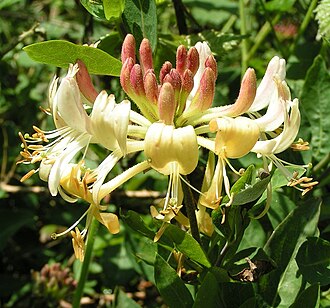
The tubular, two-lipped flowers, creamy white or yellowish in colour, may be flushed with pink or red on the outside and in bud, and are carried in showy clusters at the ends of the shoots. The flowers are highly scented by night, much less so by day.
Ecology
The plant is usually pollinated by moths or long-tongued bees and develops bright red berries. Dormice make summer nests for their young from honeysuckle bark; they also eat the flowers, which are a good source of energy-rich nectar. Night-flying moths such as the hummingbird hawk-moth can detect the scent of honeysuckle flowers up to a quarter of a mile away. The clusters of red berries are eaten in the autumn by birds such as thrushes, bullfinches and warblers.
Cultivation
Lonicera periclymenum is one of several honeysuckle species valued in the garden, for its ability to twine around other plants, or to cover unsightly walls or outbuildings; and for the intense fragrance of its profuse flowers in summer. It needs to be planted with its roots in the shade, and its flowering top in sun or light shade. Plants need to be chosen with care as they can grow to a substantial size. The cultivars 'Graham Thomas' and 'Serotina' have gained the Royal Horticultural Society's Award of Garden Merit.
Pests
Chromatomyia aprilina – honeysuckle leaf miner
Cultural references
In William Shakespeare’s play A Midsummer Night's Dream he refers to woodbine/honeysuckle twice:
(Act II Scene 1) "Quite overcanopied with luscious woodbine"
(Act IV Scene 1) "So doth the woodbine the sweet honeysuckle gently entwine"
It seems probable that the first quotation is referring to the honeysuckle L. periclymenum, a common sight in hedgerows in Shakespeare’s time. The second quotation is somewhat more confusing. It is thought that on this occasion, "woodbine" refers to a species of Convolvulus, also very common but nowadays called "bindweed".
以上内容摘自英文维基百科「Lonicera periclymenum」,按 CC BY-SA 4.0 使用,去掉了参考文献、外部链接等尾部小节,公式改写成了纯文本。全文、配图和出处见原文。