 格物
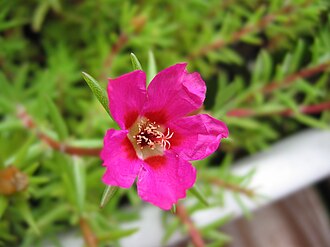
图:Laogooli · CC BY-SA 3.0 · Wikimedia Commons
- 学名
- Portulaca grandiflora
- 分类等级
- 种
- 上级类群
- 马齿苋属
- 大类
- 被子植物
- 命名
- 威廉·杰克逊·胡克
- 中文别名
- 松叶牡丹、半支莲、龙须牡丹、金丝杜鹃、太阳花
- 用途
- 药用植物
- 数据库
- NCBI 分类 · GBIF
百科正文
种名grandiflora意为“大花的”。
特征
株高小于30厘米,植株矮小,但生长迅速,一年生。叶厚,肉质,长2.5厘米,互生或丛生。花直径2.5-5厘米,5瓣。大花马齿苋为两性花,单花生命短暂约二至四天,但整个花期长,且极少病虫害。喜欢充足的阳光。花瓣有单瓣与复瓣。颜色多样,且有单色与复色不同品种。
大花马齿苋花色繁多,花形优美,适于布置花坛和作为街边行道植物。大花马齿苋俗称“死不了”,因为其生命力极其顽强,即使根茎折断,严重失水时,也可扦插成活。
用途
根据中文相关描述,大花马齿苋全株幼嫩部分均可食用,多用于热炒,亦可生食。
以上内容摘自维基百科「大花马齿苋」,按 CC BY-SA 4.0 使用,去掉了参考文献、外部链接等尾部小节,公式改写成了纯文本。全文、配图和出处见原文。
英文维基百科补充中文条目比较短,下面是英文条目「Portulaca grandiflora」的原文
Portulaca grandiflora is a succulent flowering plant in the purslane family Portulacaceae, native to southern Brazil, Argentina, and Uruguay and often cultivated in gardens. It has many common names, including rose moss, eleven o'clock, Mexican rose, moss rose, sun rose, rose Jepun, table rose, rock rose, and moss-rose purslane. Despite these names and the superficial resemblance of some cultivars' flowers to roses, it is not a true rose, nor even a part of the rose family or rosid group; rather, it is much more closely related to carnations and cacti.
It is also seen in South Asia and widely spread in most of the cities with old 18th- and 19th-century architecture in the Balkans.
Description
It is a small, but fast-growing annual plant growing to 30 cm tall, though usually less. However, if it is cultivated properly, it can easily reach this height. The leaves are thick and fleshy, up to 2.5 cm long, arranged alternately or in small clusters. The flowers are 2.5–3 cm diameter with five petals, variably red, orange, pink, white, and yellow. Their upright, or ascending, long shoots branch usually near the base. The spreading 20-to-25-millimeters-long and 2-to-3-millimeters-wide leaves are almost or completely stalk-shaped, and taper towards the tip.
The axillary leaves have few to numerous whitish, woolly hairs which are usually shorter than the sheets. The compressed inflorescences are surrounded by eight to ten leaves. The large flowers reach a diameter of up to 4 centimetres. The five bright magenta-coloured petals are obovate and 15 to 26 millimeters long. Around the ovary with four to nine whitish scars are about 50 stamens. Capsules and seeds are not visible.
P. grandiflora is one of the few plants that is a C4/CAM intermediate, utilizing both C4 carbon fixation and Crassulacean acid metabolism pathways in different cells for photosynthesis.
Cultivation and uses
Numerous cultivars have been selected for double flowers with additional petals, and for variation in flower colour, plain or variegated. It is widely grown in temperate climates as an ornamental plant for annual bedding or as a container plant. It requires ample sunlight and well-drained soils. It requires almost no attention and spreads itself very easily. In places with old architecture it can grow between the stones of the road or sidewalk. Seeds are often sold as mixtures, such as Double Flowering Mixture (see illustrations). It grows on sandy soils. In countries with a frost-free climate, it is wild.
Unlike P. oleracea and P. umbraticola, it is not edible because of its bitter taste. There are hybrids of P. grandiflora with P. oleracea, umbraticola and villosa.
It is visited by honeybees for its pollen and nectar.
以上内容摘自英文维基百科「Portulaca grandiflora」,按 CC BY-SA 4.0 使用,去掉了参考文献、外部链接等尾部小节,公式改写成了纯文本。全文、配图和出处见原文。