 格物
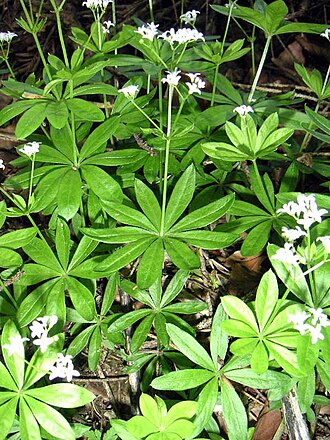
图:Jopi · Public domain · Wikimedia Commons
- 学名
- Galium odoratum
- 分类等级
- 种
- 英文名
- sweet woodruff
- 上级类群
- 拉拉藤属
- 大类
- 被子植物
- 命名
- 乔瓦尼·安东尼奥·斯科波利,1771 年
- 中文别名
- 车轴草、香车叶草
- 用途
- 香辛料
- 数据库
- NCBI 分类 · GBIF
百科正文
多年生草本植物,植株长三十至五十公分,常平卧在地面上或攀附在其他植物上。叶为单叶,披针形,光滑无毛,长二至五公分,叶六至九片轮生。花小,花径四至七毫米,白色,每一朵花有四片花瓣,花瓣在基部合生,花序为聚伞花序。种子直径二至四毫米,种子上生有极小的钩状刺毛,这些刺毛可以钩住衣服或动物的毛皮,利用人类及动物来散播种子。
香猪殃殃喜欢潮湿且肥沃的土壤,在半遮荫至完全遮荫的环境下生长良好,夏季时因为水分蒸散的较快,土壤比较快干,栽培时要注意土壤的湿润度,需常常浇水,以防止土壤过度干燥,造成植株枯死。繁殖时主要是使用分株法繁殖,将已生根的茎由母株切离或是挖取埋在土里的走茎另行种植即可。
用途
香猪殃殃的植株具有香味,这种香甜味是来自于香豆素的味道,香味会随着干燥的程度越干越香。香猪殃殃可以放在香罐内,当做熏香的原料,也可以用来防治蛾类害虫。在德国会添加香猪殃殃在葡萄酒(五月酒 Maiwein)、啤酒(柏林淡啤酒 Berliner Weisse)、白兰地、香肠与果酱内,来增加食品与酒的风味,也可以做成花草茶饮用,有镇静安眠的效果。
由于香猪殃殃有轻微的毒性,使用时需要特别注意,在德国,一升五月酒使用三公克以下的香猪殃殃,是较安全的。大剂量的使用会导致头痛,而使用极高的剂量时甚至会有意识状态改变(mind-altering)的现象,会产生眩晕、嗜睡甚至是中枢性瘫痪,昏迷时会发生窒息的现象。
以上内容摘自维基百科「香豬殃殃」,按 CC BY-SA 4.0 使用,去掉了参考文献、外部链接等尾部小节,公式改写成了纯文本。全文、配图和出处见原文。
英文维基百科补充中文条目比较短,下面是英文条目「Galium odoratum」的原文
Galium odoratum, the sweet woodruff or sweetscented bedstraw, is a flowering perennial plant in the family Rubiaceae, native to much of Europe. It is widely cultivated for its flowers and its sweet-smelling foliage.
Description
A rhizomatous herbaceous perennial plant that grows upright to 25–50 cm (10–19+1⁄2 in) high. The leaves are simple, lanceolate, glabrous, 2–5 cm (3⁄4–2 in) long, and borne in whorls of six to nine. The small (4–7 mm diameter) flowers are produced in cymes, each white with four petals joined together at the base. The fruits are 2–4 mm in diameter, produced singly, and each is covered in tiny, hooked bristles, which help disperse them by sticking temporarily to clothing and animal fur.
It owes its sweet smell to the presence of the compound coumarin.
Distribution and habitat
The plant is native to much of Europe from Spain and Ireland to Russia, as well as Western Siberia, Turkey, Iran, the Caucasus, China, and Japan. It is also sparingly naturalised in scattered locations in the United States and Canada.
Ecology
This plant prefers partial to full shade in moist, rich soils. In dry summers, it needs frequent watering. Propagation is by crown division, separation of the rooted stems, or digging up of the barely submerged perimeter stolons. It is ideal as a groundcover or border accent in woody, acidic gardens where other shade plants fail to thrive. In the northeastern United States, deer and chickens avoid eating it.
Toxicity
Industrial usage of the plant for sweets was prohibited in Germany in 1974, due to coumarin, the flavorant found in woodruff, being toxic to rats and mice in studies. It has, however, not been found to be harmful to humans, even in large doses, in which it follows a different metabolic pathway. The flavour is still popular for sweets in Germany, but is achieved artificially with 6-methyl coumarin. Products targeted towards adults, such as alcoholic drinks, are still permitted to include coumarin, in limited quantities.
Uses
It is widely cultivated for its flowers and sweet-smelling foliage.
As its specific epithet odoratum suggests, the plant is strongly scented, the sweet scent being derived from coumarin. This scent increases on wilting and then persists on drying, and the dried plant is used in potpourri and as a moth deterrent. It was, and partially is, used to flavour May wine (called Maibowle or Maitrank in German), sweet juice punch, syrup for beer (Berliner Weisse), brandy, jelly, jam, a soft drink (Tarhun, which is Georgian), ice cream, and herbal tea. Also very popular are sweet woodruff-flavoured jellies, with and without alcohol. In Germany, where it is called Waldmeister, it was and to some extent still is also used to flavour sherbet powder.
以上内容摘自英文维基百科「Galium odoratum」,按 CC BY-SA 4.0 使用,去掉了参考文献、外部链接等尾部小节,公式改写成了纯文本。全文、配图和出处见原文。