 格物
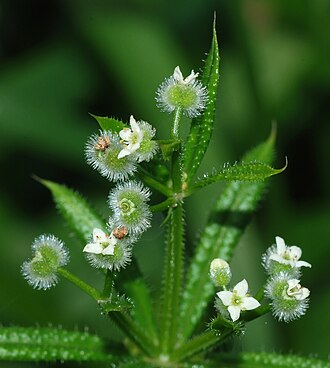
图:Alvesgaspar · CC BY-SA 3.0 · Wikimedia Commons
- 学名
- Galium aparine
- 分类等级
- 种
- 上级类群
- 拉拉藤属
- 大类
- 被子植物
- 命名
- 卡尔·林奈,1753 年
- 中文别名
- 猪殃殃、八仙草
- 用途
- 药用植物
- 数据库
- NCBI 分类 · GBIF
百科正文
英文维基百科补充中文条目比较短,下面是英文条目「Galium aparine」的原文
Galium aparine, commonly called cleavers, and also known as bedstraw, catchweed, goose grass, sticky bob, sticky willy, and velcro plant, is an annual, herbaceous plant of the family Rubiaceae.
Names
Galium aparine is known by a variety of common names in English. They include bedstraw, bobby buttons, catchweed, cleavers, clivers, (small) goosegrass, grip grass, hitchhikers, robin-run-the-hedge, stickeljack, stickyback, sticky bob, stickybud, sticky grass, stickyjack, sticky molly, stickyweed, sticky willow, sticky willy, sweetheart, velcro plant, and whippysticks.
Galium is Dioscorides's name for the plant. It is derived from the Greek word for milk, because the flowers of Galium verum were used to curdle milk in cheese making. Aparine is a name used by Theophrastus. It means 'clinging' or 'seizing', and is derived from the Greek απαίρω apairo 'lay hold of, seize', itself coming from από 'from' + αίρω 'pull to lift'.
Description
Cleavers are annuals with creeping straggling stems that branch and grow along the ground and over other plants. They attach themselves by the small hooked hairs that grow on the stems and leaves. The stems can reach up to 1.2 metres (4 ft) tall, and are angular or square shaped. The leaves are simple, narrowly oblanceolate to linear, and borne in whorls of six to eight.
Cleavers have tiny, star-shaped, white to greenish flowers, which emerge from early spring to summer. The flowers are clustered in groups of two or three, and are borne out of the leaf axils. The corolla bears 4 petals. The globular fruits are burrs which grow one to three seeds clustered together; they are covered with hooked hairs which cling to animal fur and human clothing, aiding in seed dispersal.
Distribution
The species is native to a wide region of Europe, North Africa, and Asia, from Britain and the Canary Islands to Japan. It is now naturalized throughout most of the United States, Canada, Mexico, Central America, South America, Australia, New Zealand, some oceanic islands, and scattered locations in Africa. Whether it is native to North America is a matter of some debate, but it is considered native there in most literature. It is considered a noxious weed in many places.
Ecology
The plant can be found growing in hedges and waste places, limestone scree, and as a garden weed.
G. aparine prefers moist soils and can exist in areas with poor drainage. It reportedly flourishes in heavy soils with above-average nitrogen and phosphorus content, and prefers soils with a pH value between 5.5 and 8.0. G. aparine is often found in post-fire plant communities in the United States, likely developing from onsite seed and therefore rendering controlled burns an ineffective means of removing G. aparine in areas where it is considered a noxious weed.
Geese frequently consume the plant, hence the common names "goosegrass". Many insects feed on it, including aphids and spittlebugs.
The anthraquinone aldehyde nordamnacanthal (1,3-dihydroxy-anthraquinone-2-al) present in G. aparine has an antifeedant activity against Spodoptera litura, the Oriental leafworm moth, a species which is considered an agricultural pest.
Toxicity
For some people, contact with the plant can cause skin irritation. Although the plant's hairs are small, they can scratch more sensitive parts of the skin. Numerous such scratches can resemble a rash.
Uses
Culinary
Galium aparine is edible. The leaves and stems of the plant can be cooked as a leaf vegetable if gathered before the fruits harden. However, the numerous small hooks which cover the plant and give it its clinging nature can make it less palatable if eaten raw. Cleavers are in the same family as coffee. The fruits of cleavers have often been dried and roasted, and then used as a coffee substitute, which contains less caffeine.
Folk medicine
Poultices and washes made from cleavers were traditionally used to treat a variety of skin ailments, light wounds, and burns. As a pulp, it has been used to relieve venomous bites and stings. To make a poultice, the entire plant is used and applied directly to the affected area. Making a tea with the dried leaves is most common. It can be brewed hot or cold. For a cold infusion, steep in water and refrigerate for 24–48 hours.
以上节选摘自英文维基百科「Galium aparine」,按 CC BY-SA 4.0 使用,去掉了参考文献、外部链接等尾部小节,公式改写成了纯文本。篇幅所限,较长的小节只摘了开头一部分,有的小节没有收;全文、配图和出处见原文。