 格物
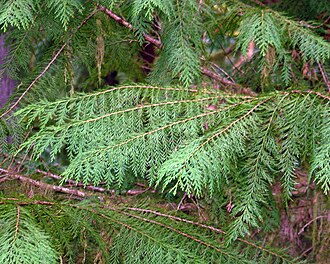
图:Jami Dwyer from Portland, OR, USA · CC BY-SA 2.0 · Wikimedia Commons
- 学名
- Chamaecyparis lawsoniana
- 分类等级
- 种
- 上级类群
- 扁柏属
- 大类
- 其他植物
- 命名
- Filippo Parlatore,1864 年
- 保护状况(IUCN)
- 近危物种
- 特有于
- 美国
- 数据库
- NCBI 分类 · GBIF · IUCN 红色名录
百科正文
英文维基百科补充中文条目比较短,下面是英文条目「Chamaecyparis lawsoniana」的原文
Chamaecyparis lawsoniana, known as Port Orford cedar or Lawson's cypress, is a species of conifer in the genus Chamaecyparis, family Cupressaceae. It is native to Oregon and northwestern California, and grows from sea level up to 1,500 metres (4,900 ft) in the valleys of the Klamath Mountains, often along streams.
Description
A large evergreen tree, specimens mature up to 50 m (160 ft) tall or more (exceptionally to 81 m (266 ft)), with trunks 1.2–2 m (4–7 ft) in diameter, exceptionally 3.65 m (12.0 ft). The bark is silver-brown, vertically furrowed, and 15–25 centimetres (6–10 in) thick near the base. The foliage is arranged in lacy, flat sprays with a feathery appearance, usually somewhat glaucous (i.e. blue-green) in color. The leaves are scale-like, 3–5 millimetres (1⁄8–3⁄16 in) long, with narrow white markings on the underside, and produced on somewhat flattened shoots. The foliage gives off a rather pungent scent, not unlike parsley. The seed cones are globose, 7–14 millimetres (9⁄32–9⁄16 in) in diameter, with 6–10 scales, green at first, maturing brown in early fall, 6–8 months after pollination. The male cones are 3–4 millimetres (1⁄8–5⁄32 in) long, dark red, turning brown after pollen release in early spring. The seeds fall quickly and can float on water.
Taxonomy
The species was first documented near Port Orford, Oregon, and introduced into cultivation in 1854 by collectors working for Charles Lawson FRSE of the Lawson & Son nursery in Edinburgh, Scotland, after whom it was named as Lawson's Cypress by the describing botanist Andrew Murray. The United States Department of Agriculture officially calls it by the name Port Orford cedar, as do most people in its native area, but some botanists prefer to use the name Lawson's cypress (or in very rare instances Port Orford cypress) instead. The name "Lawson's cypress" is widely used in horticulture.
Distribution and habitat
The species is native to southwestern Oregon and northwestern California, and grows from sea level up to 1,500 metres (4,900 ft) in the valleys of the Klamath Mountains, often along streams. It fares best at the north end of its range.
Ecology
The thick bark provides resistance to wildfires, and the species regenerates well on disrupted land in a variety of soils, but requires consistent moisture. It is shade tolerant, but not as much so as competing species western hemlock and white fir. The old-growth population near Coos Bay, Oregon, was wiped out by logging and wildfires in 1867–1868, and again by fire and root disease in 1936.
Disease
In the wild, the species is seriously and uniquely threatened by a root disease caused by the oomycete pathogen, Phytophthora lateralis, accidentally introduced in the early 1950s following the fungus's arrival to the Pacific Northwest on nursery trees. This disease is also a problem for horticultural plantings in some parts of North America. The tree is sometimes killed, though less often, by other species of Phytophthora.
Phytophthora lateralis infection begins when mycelium, from a germinated spore, invade the roots.
Cultivation
Chamaecyparis lawsoniana thrives best in well-drained but moist soils, in a fairly sheltered position in full sun. Several hundred named cultivars of varying crown shape, growth rates and foliage color have been selected for planting in parks and gardens. In the United Kingdom (UK) the following have gained the Royal Horticultural Society's Award of Garden Merit (confirmed 2017):
Uses
The species was discovered by Euro-Americans in the 1850s. The wood is light yet has great strength and rot resistance, even after long exposure to salt water. Its properties resemble those of yellow-cedar, but was historically more available in the region. On shores lacking docks, logs were transported via high-line cable directly onto ship decks. It was valued for boatbuilding. The species was important to Oregon's lumber industry until the 1950s when it was crippled by disease. It was preferred for storage battery cell separation, Venetian blinds, and other uses. Quality specimens eventually began to be shipped almost exclusively to East Asia, where it is highly valued. Large amounts have been exported to Japan where it is used in making coffins, shrines, and temples. Its lumber is known for its highly fragrant ginger aroma, caused by an oil which repulses decay and insects, including termites; this oil has been used as an insecticide.
以上节选摘自英文维基百科「Chamaecyparis lawsoniana」,按 CC BY-SA 4.0 使用,去掉了参考文献、外部链接等尾部小节,公式改写成了纯文本。篇幅所限,较长的小节只摘了开头一部分,有的小节没有收;全文、配图和出处见原文。