 格物

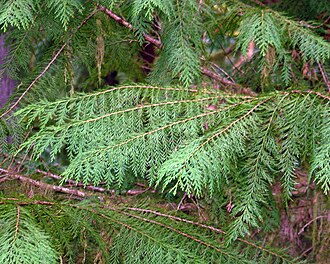
图:John B. from Highland Park, NJ, United States · CC BY 2.0 · Wikimedia Commons
- 学名
- Chamaecyparis
- 分类等级
- 属
- 上级类群
- 柏科
- 大类
- 其他植物
- 命名
- 爱德华·斯帕克,1841 年
- 异名
- Retinospora
- 数据库
- NCBI 分类 · GBIF
下级类群(6)
百科正文
属名Chamaecyparis源于希腊语chamai(矮小的)和kyparissos(柏)的合成词,指扁柏属似矮小的柏。
特征
柏科扁柏属植物有6种,为观赏和材用常绿针叶树。原产北美和东亚,木多有香气。与真柏不同之处为球果较小、圆形,种子数较少。幼树金字塔形,叶鳞片状,密生于小枝。叶色因园艺变种而异。球花单性同株,球果圆形,较小,种子也较少。雌球较小而不显,雄球花黄色或红色。
物种
- 日本扁柏 Chamaecyparis obtusa
- 分布:日本,别名:云片柏、日本黄桧
- 日本花柏 Chamaecyparis pisifera
- 分布:日本,别名:羽叶花柏
- 美国扁柏 Chamaecyparis lawsoniana
- 分布:北美西部,别名:美国桧、美洲花柏、罗森桧、罗森氏扁柏
- 美国尖叶扁柏 Chamaecyparis thyoides
- 分布:北美东部,别名:大西洋雪杉、雪松、侧叶扁柏
- 台湾红桧 Chamaecyparis formosensis
- 分布:台湾,别名:红桧、松萝、薄皮、水古杉
台湾扁柏 Chamaecyparis obtusa var. formosana
分布:台湾,别名:黄桧、松梧、厚壳
用途
扁柏属常作为木材、建材、家具、盆栽、工艺品的材料,因为其俱备浓郁香气,所以也是制作线香、精油、香水常见的植物素材。
以上内容摘自维基百科「扁柏屬」,按 CC BY-SA 4.0 使用,去掉了参考文献、外部链接等尾部小节,公式改写成了纯文本。全文、配图和出处见原文。
英文维基百科补充中文条目比较短,下面是英文条目「Chamaecyparis」的原文
Chamaecyparis, the false-cypresses (to distinguish it from related true cypresses), is a genus of conifers in the cypress family Cupressaceae, native to eastern Asia (Japan and Taiwan) and to the western and eastern margins of the United States. The name is derived from the Greek khamai (χαμαί), meaning "on the earth", and kuparissos (κυπάρισσος) for "cypress".
They are medium-sized to large trees growing from 20–70 m (66–230 ft) tall, with foliage in flat sprays. The leaves are of two types, needle-like juvenile leaves on young seedlings up to a year old, and scale-like adult leaves. The cones are globose to oval, with 8-14 scales arranged in opposite decussate pairs; each scale bears 2-4 small seeds.
Taxonomy
Species
Chamaecyparis formosensis Matsum. – Taiwan
Chamaecyparis lawsoniana (A.Murray) Parl., Port Orford cedar or Lawson cypress – California, Oregon, Washington
- Chamaecyparis obtusa (Siebold & Zucc.) Endl. – Japan
- Chamaecyparis pisifera (Siebold & Zucc.) Endl. – Honshu, Kyushu
- Chamaecyparis taiwanensis Masam. & Suzuki – Taiwan
Chamaecyparis thyoides (L.) Britton, Atlantic white cedar (among other names) – Eastern United States (Mississippi to Maine)
Chamaecyparis taiwanensis is treated by many authors as a variety of C. obtusa (as C. obtusa var. formosana).
Genus Fokienia is not always recognized as a separate genus from Chamaecyparis, in which case Chamaecyparis hodginsii (=Fokienia hodginsii) should be added to the above list. On the other hand, a species which used to be included in this genus, as Chamaecyparis nootkatensis, had been transferred on the basis of strong genetic and morphological evidence to the separate genus Xanthocyparis as Xanthocyparis nootkatensis in the early 2000s. After further phylogenetic work the species was moved to the monotypic genus Callitropsis nootkatensis, being sister to the genus Hesperocyparis, and both genera forming a clade with Xanthocyparis as its sister.
There are also several species described from the fossil record including:
†Chamaecyparis eureka – Middle Eocene, Axel Heiberg Island, Canada.
†Chamaecyparis linguaefolia – Early-Middle Oligocene, Colorado, USA.
†Chamaecyparis ravenscragensis – (=Fokienia ravenscragensis), if genus Fokienia is not recognized.
Chamaecyparis species are used as food plants by the larva of some Lepidoptera species, including juniper pug and pine beauty.
Cultivation and uses
Four species (C. lawsoniana, C. obtusa, C. pisifera, and C. thyoides) are of considerable importance as ornamental trees in horticulture; several hundred cultivars have been selected for various traits, including dwarf size, yellow, blue, silvery or variegated foliage, permanent retention of juvenile leaves, and thread-like shoots with reduced branching. In some areas, cultivation is limited by Phytophthora root rot diseases, with C. lawsoniana being particularly susceptible to P. lateralis.
The wood is scented, and is highly valued, particularly in Japan, where it is used for temple construction.
以上内容摘自英文维基百科「Chamaecyparis」,按 CC BY-SA 4.0 使用,去掉了参考文献、外部链接等尾部小节,公式改写成了纯文本。全文、配图和出处见原文。