 格物
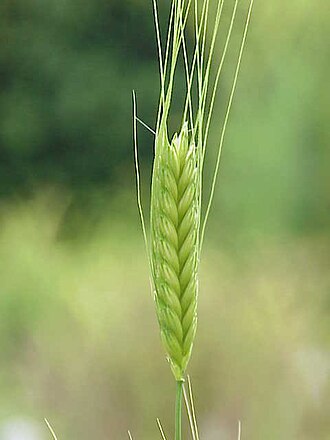
- 学名
- Triticum monococcum
- 分类等级
- 种
- 上级类群
- 小麦属
- 大类
- 被子植物
- 命名
- 卡尔·林奈,1753 年
- 保护状况(IUCN)
- 无危物种
- 用途
- 谷物
- 数据库
- NCBI 分类 · GBIF · IUCN 红色名录
百科正文
英文维基百科补充中文条目比较短,下面是英文条目「Einkorn」的原文
Einkorn (from German Einkorn, literally "single grain") can refer to either a wild species of wheat (Triticum) or a domesticated form of wheat. The wild form is T. boeoticum (syn. T. m. subsp. boeoticum), and the domesticated form is T. monococcum (syn. T. m. subsp. monococcum). Einkorn is a diploid species (2n = 14 chromosomes) of hulled wheat, with tough glumes (husks) that tightly enclose the grains. The cultivated form is similar to the wild, except that the ear stays intact when ripe and the seeds are larger. The domestic form is known as petit épeautre in French, Einkorn in German, "einkorn" or "littlespelt" in English, piccolo farro in Italian and escanda menor in Spanish. The name refers to the fact that each spikelet contains only one grain. Einkorn was one of the first forms of wheat to be cultivated.
Description
Einkorn is a short variety of wild wheat, usually less than 70 centimetres (28 in) tall, and is not very productive of edible seeds. The principal difference between wild einkorn and cultivated einkorn is the method of seed dispersal. In the wild variety, the seed head usually shatters and drops the kernels (seeds) of wheat onto the ground. This facilitates a new crop of wheat. In the domestic variety, the seed head remains intact. While such a mutation may occasionally occur in the wild, it is not viable there in the long term: the intact seed head will only drop to the ground when the stalk rots, and the kernels will not scatter but form a tight clump which inhibits germination and makes the mutant seedlings susceptible to disease.
Taxonomy
Cultivated Einkorn was described as a taxon, Triticum monococcum, by Carl Linnaeus in 1753. Later descriptions by other taxonomists, now treated as synonyms, include Triticum pubescens by von Bieberstein in 1800; Triticum hornemanii by Clementi in 1818; Nivieria monococcum in 1841; Triticum vulgare monococcum by Alefeld in 1866; Triticum monococcum subsp. cereale by Albert Thellung in 1918. Wild Einkorn is known either as Triticum monococcum subsp. aegilopoides or as Triticum boeoticum.
Wild and domesticated einkorns are diploid wheats. Unlike emmer and bread wheat, which were formed by hybridisation with Aegilops goatgrasses, einkorn is not a hybrid.
Ecology and distribution
Einkorn wheat commonly grows wild in the hill country in the northern part of the Fertile Crescent and Anatolia, although it has a wider distribution reaching into the Balkans and south to Jordan near the Dead Sea.
History
Early human use
Einkorn wheat is one of the earliest cultivated forms of wheat, alongside emmer wheat (T. dicoccum). Hunter gatherers in the Fertile Crescent may have started harvesting einkorn as early as 30,000 years ago, according to archaeological evidence from Syria.
Domestication
Although gathered from the wild for thousands of years, einkorn wheat was first domesticated approximately 10,000 years BP in the Pre-Pottery Neolithic A (PPNA) or B (PPNB) periods. Evidence from DNA fingerprinting suggests einkorn was first domesticated near Karaca Dağ in southeast Turkey, an area in which a number of PPNB farming villages have been found. Yuval Noah Harari suggests that the domestication of einkorn was linked to intensive agriculture to support the nearby Göbekli Tepe site.
Agronomy
Einkorn wheat is low-yielding, but can survive on poor, dry, marginal soils where other varieties of wheat will not. As with other ancient varieties of wheat such as emmer, Einkorn is a "covered wheat", as its kernels do not break free from its seed coat (glume) with threshing. This makes it difficult to separate the husk from the seed.
Uses
Einkorn is a common food in northern Provence, France. It is used for bulgur or as animal feed in mountainous areas of countries including France, India, Italy, Morocco, the former Yugoslavia, and Turkey. It contains gluten (so is not suitable for people with gluten-related disorders) and has a higher percentage of protein than modern red wheats. It is considered more nutritious because it has higher levels of fat, phosphorus, potassium, pyridoxine, and beta-carotene.
Use in baking
Historically, einkorn was not used in breadmaking, having primarily been eaten boiled in whole grains or in porridge, meaning that cultivars were not selected for their breadmaking potential. Until recently, einkorn was not thought to be suitable for baking, as its dough is sticky, inelastic and difficult to handle.
以上节选摘自英文维基百科「Einkorn」,按 CC BY-SA 4.0 使用,去掉了参考文献、外部链接等尾部小节,公式改写成了纯文本。篇幅所限,较长的小节只摘了开头一部分,有的小节没有收;全文、配图和出处见原文。