 格物
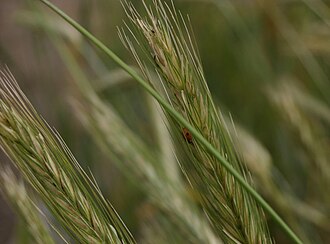
图:Sten Porse · CC BY-SA 3.0 · Wikimedia Commons
- 学名
- Triticum durum
- 分类等级
- 种
- 上级类群
- 小麦属
- 大类
- 被子植物
- 命名
- 勒内·卢伊什·德方丹
- 用途
- 谷物
- 数据库
- GBIF
百科正文
基因组学研究表明:50万年前,二倍体的小麦属乌拉尔图小麦(Triticum urartu)与山羊草属的拟山羊草(Aegilops speltoides)杂交,形成了圆锥小麦(T. turgidum)与提莫非维小麦(T.timopheevii),这两种均为四倍体。硬粒小麦曾经是圆锥小麦的一个亚种。
以上内容摘自维基百科「硬粒小麦」,按 CC BY-SA 4.0 使用,去掉了参考文献、外部链接等尾部小节,公式改写成了纯文本。全文、配图和出处见原文。
英文维基百科补充中文条目比较短,下面是英文条目「Durum wheat」的原文
Durum , also called pasta wheat or macaroni wheat (Triticum durum or Triticum turgidum subsp. durum), is a tetraploid species of wheat. It is the second-most cultivated species of wheat after common wheat, although it represents only 5 to 8% of global wheat production. It was developed by artificial selection of the domesticated emmer wheat strains formerly grown in Central Europe and the Near East around 7000 BC, which developed a naked, free-threshing form. Like emmer, durum is awned (with bristles). It is the predominant wheat grown in the Middle East.
Taxonomy
Some authorities synonymize "durum" and Triticum turgidum. Some reserve "durum" for Triticum turgidum subsp. durum. The grain classification for durum is typically based on the hard vitreous kernel (HVK) count.
Durum in Latin means "hard". The species is the hardest of all wheats regarding its resistance of the grain to milling, in particular of the starchy endosperm, causing dough made from its flour to be weak or "soft".
Genetics
Durum is a tetraploid wheat, having four sets of chromosomes for a total of 28, unlike hard red winter and hard red spring wheats, which are hexaploid (six sets of chromosomes) for a total of 42.
Durum originated through intergeneric hybridization and polyploidization involving two diploid (having two sets of chromosomes) grass species: T. urartu (2n=2x=14, AA genome) and a B-genome diploid related to Aegilops speltoides (2n=2x=14, SS genome) and is thus an allotetraploid (having four sets of chromosomes, from unlike parents) species.
Durum—and indeed all tetraploids—lack Fhb1 alleles. The only exception is found by Buerstmayr et al. (2012) on the 3B chromosome.
One of the predominant production areas of durum—Italy—has domesticated varieties with lower genetic diversity than wild types, but subspecies T. d. turanicum, T. d. polonicum, and T. d. carthlicum have a level of diversity intermediate between those groups. There is evidence of an increase in the intensity of breeding after 1990.
Uses
Commercially produced dry pasta, or pasta secca, is made almost exclusively from durum semolina. Most homemade fresh pastas also use durum or a combination of soft and hard wheats. Its hardness makes it favorable for semolina and pasta and less practical for flour, which requires more work to mill than with hexaploid wheats such as common bread wheats.
Husked but unground, or coarsely ground, it is used to produce the semolina in the couscous of North Africa and the Levant. It is also used for Levantine dishes such as tabbouleh, kashk, kibbeh, bitfun, and the bulgur for pilafs. In North African and Levantine cuisines, it forms the basis of many soups, gruels, stuffings, puddings, and pastries. When ground as fine as flour, it is used for making bread. In the Middle East, it is used for flat, round breads, and in Europe and elsewhere, it can be used for pizza or torte. In South Asia, Bombay rava is used widely for puddings and flatbreads.
The use of wheat to produce pasta was described as early as the 10th century by Ibn Wahshīya of Cairo. The North Africans called the product itrīya, from which Italian sources derived the term tria (or aletría in the case of Spanish sources) during the 15th century.
Production
Durum wheat (T. d. durum) is the 10th-most cultivated cereal worldwide, with a total production of around 38 million tons.
Most of the durum grown today is amber durum, the grains of which are amber-colored due to the extra carotenoid pigments and are larger than those of other types of wheat. Durum has a yellow endosperm, which gives pasta its color. When durum is milled, the endosperm is ground into a granular product called semolina. Semolina made from durum is used for premium pastas and breads. Notably, semolina is also one of the only flours that are purposely oxidized for flavor and color. Red durum is grown for use mostly in livestock feed.
The cultivation of durum generates greater yield than other wheats in areas of low precipitation. Good yields can be obtained by irrigation, but this is rarely done. Durum is one of the most important food crops in West Asia. Although the variety of the wheat there is diverse, it is not extensively grown there, thus it must be imported. West amber durum produced in Canada is used mostly for semolina/pasta, but some is also exported to Italy for bread production.
In the Middle East and North Africa, local bread-making accounts for half the consumption of durum. Some flour is even imported.
以上节选摘自英文维基百科「Durum wheat」,按 CC BY-SA 4.0 使用,去掉了参考文献、外部链接等尾部小节,公式改写成了纯文本。篇幅所限,较长的小节只摘了开头一部分,有的小节没有收;全文、配图和出处见原文。