 格物
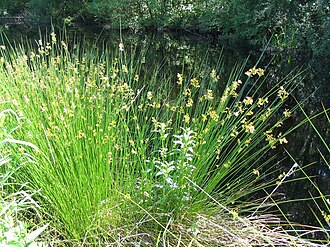
图:The original uploader was Meggar at English Wikipedia. · CC BY-SA 3.0 · Wikimedia Commons
- 学名
- Juncus effusus
- 分类等级
- 种
- 上级类群
- 灯心草属
- 大类
- 被子植物
- 命名
- 卡尔·林奈,1753 年
- 中文别名
- 灯芯草、灯心草根
- 保护状况(IUCN)
- 无危物种
- 用途
- 纤维、药用植物
- 数据库
- NCBI 分类 · GBIF · IUCN 红色名录
百科正文
特征
秆丛生,株高0.4-1.5米,常生于溪渠边,而在其他土壤湿润的地区也可生长,如沼泽、湿地、沟渠、河滩等腐殖质丰富的地区。
灯心草秆为圆柱形,内充满乳白色的轻髓,淡黄色聚伞花序从距植株顶端约5-20厘米处生出,而此处就是茎的末端,其上段实际上是苞片,宛如茎秆状直立延伸,因此花序是假侧生。叶退化,芒刺状,植株下部有鳞状鞘叶,基部叶紫褐或淡褐色,叶鞘先端尖。花期5-6月,果期7-8月。
用途
灯心草在古代是蜡烛的替代品,普遍为平民使用。18世纪的学者吉尔伯特·怀特的1789年的《塞尔伯恩博物志》中记录当时只需要1先令就能购入一磅的晒干灯心草(共1600根),再用2先令购入6磅油脂用来浸泡灯心草,一根能燃烧57分钟,当时3先令不过一支蜡烛的价钱。他的老管家表示一磅半的灯心草足够他一家全年的照明需求。燃烧用的油除了动物油外,还可以使用植物油如亚麻、油菜、核桃等。
相关文化
灯心草帽子 (Cap-o'-Rushes) 是一个著名的英国童话。
以上内容摘自维基百科「灯心草」,按 CC BY-SA 4.0 使用,去掉了参考文献、外部链接等尾部小节,公式改写成了纯文本。全文、配图和出处见原文。
英文维基百科补充中文条目比较短,下面是英文条目「Juncus effusus」的原文
Juncus effusus is a perennial herbaceous flowering plant species in the rush family Juncaceae, with the common names common rush or soft rush.
Distribution and habitat
Juncus effusus has a wide distribution, considered native in Europe, Asia, Africa, Madagascar, North America, and South America. It has naturalized in Australia, New Zealand, South Africa and various oceanic islands.
It grows in wet areas, such as wetlands, riparian areas, and marshes with sandy and peaty substrates. It is common throughout the British Isles by rivers, streams and lakes, in wet heathland and pastures, including purple moor-grass and rush pastures and fen-meadow plant associations.
Description
Juncus effusus grows in large clumps up to about 1.2 metres (3 ft 11 in) tall. The stems are smooth cylinders with light pith filling. The yellowish inflorescence appears to emerge from one side of the stem about 20 centimetres (8 in) from the top. In fact the stem ends there; the top part is the bract, that continues with only a slight colour-band marking it from the stem. The lower leaves are reduced to a brown sheath at the bottom of the stem.
Subspecies
Five subspecies are currently recognized:
Juncus effusus subsp. austrocalifornicus Lint — endemic to California and Baja California.
Juncus effusus subsp. effusus — widespread
Juncus effusus subsp. laxus (Robyns & Tournay) Snogerup — tropical Africa, Madagascar, Mauritius, Canary Islands, Madeira.
Juncus effusus subsp. pacificus (Fernald & Wiegand) Piper & Beattie — Alaska, British Columbia, Washington, Idaho, Oregon, California, Baja California.
Juncus effusus subsp. solutus (Fernald & Wiegand) Hämet-Ahti — central and eastern United States.
Juncus effusus can be differentiated from the rarer Juncus pylaei by the number of ridges on the stem. Juncus effusus has 30 to 40 ridges and J. pylaei has 10 to 20.
Uses
Wildlife
The species provides wildfowl, wader feeding, and nesting habitats, and also habitats for small mammals. The rootstalks are eaten by muskrats, and birds take shelter amongst the plant's stems. A number of invertebrates feed on soft rush, including the rufous minor moth.
Humans
J. effusus is one of the seven ingredients of hui sup tea (去濕茶). In Japan, this rush is called igusa (藺草) and is grown to be woven into the covering of tatami mats (the filling is rice straw, extruded styrofoam, chip board, or some combination). In Europe, this rush was once used to make rushlights (by soaking the pith in grease), a cheap alternative to candles.
Cultivation
The species is cultivated as an ornamental plant, for planting in water gardens, native plant and wildlife gardens, and for larger designed natural landscaping and habitat restoration projects.
The cultivar Juncus effusus 'Spiralis' (syn. Juncus spiralis), with the common names corkscrew rush or spiral rush, is a distinctive potted and water garden plant due to its curled spiral like foliage.
Weed control
Juncus effusus can become a naturalized or invasive species, undesirable in rangelands for its unpalatability to livestock. Suggested methods of controlling rushes include: ploughing; high applications of inorganic fertilizer (can pollute watersheds); and topping to prevent seed formation.
Chemistry
Juncusol is a 9,10-dihydrophenanthrene found in J. effusus, which also contains effusol.
以上内容摘自英文维基百科「Juncus effusus」,按 CC BY-SA 4.0 使用,去掉了参考文献、外部链接等尾部小节,公式改写成了纯文本。全文、配图和出处见原文。