 格物
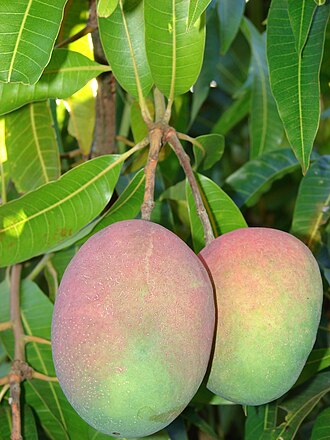
图:Forest & Kim Starr · CC BY 3.0 · Wikimedia Commons
- 学名
- Mangifera
- 分类等级
- 属
- 上级类群
- 漆树科
- 大类
- 被子植物
- 命名
- 卡尔·林奈,1753 年
- 中文别名
- 芒果属
- 数据库
- NCBI 分类 · GBIF
下级类群(6)
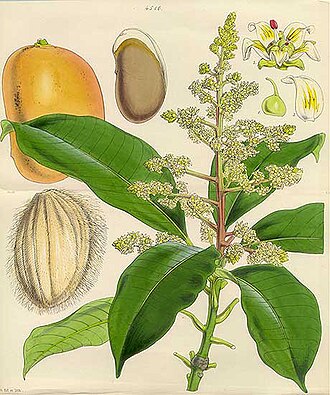
百科正文
属名Mangifera来源于葡萄牙语manga(杧果)和fora(发育)的合成词,指长有杧果的树。
分布
本属的多样性的中心位于东南亚、南亚至华南一带,并被引入到世界各地的亚热带及热带地区。本属物种通常是生存于低地雨林中的林冠树,树的高度可达30—40米(98—131英尺)。
用途
本属植物在亚洲和其他地方广泛种植。 该属中超过27种具有可食用的肉质水果,尤其是普通芒果(M. indica)。 其他的,例如臭果杧(Mangifera foetida),产出可以腌制的涩味水果。
以上内容摘自维基百科「杧果属」,按 CC BY-SA 4.0 使用,去掉了参考文献、外部链接等尾部小节,公式改写成了纯文本。全文、配图和出处见原文。
英文维基百科补充中文条目比较短,下面是英文条目「Mangifera」的原文
Mangifera is a genus of flowering plants in the family Anacardiaceae. It contains 64 species, with the best-known being the common mango (Mangifera indica). The center of diversity of the genus is in the Malesian ecoregion of Southeast Asia, particularly in Sumatra, Borneo, and the Malay Peninsula. They are generally canopy trees in lowland rainforests, reaching a height of 30–40 m (98–131 ft).
Description
Vegetative characteristics
Mangifera are evergreen or deciduous, laticiferous or non-laticiferous trees with smooth bark and long tap roots. The simple leaves have an entire margin.
Generative characteristics
The conical paniculate inflorescence with a stout, thick peduncle bears numerous flowers. The anthers are dorsifixed. The large, fleshy, indehiscent fruit with a fibrous, woody endocarp bears one non-endospermic, flattened, ovoid-oblong seed.
Cytology
The chromosome count is 2n = 40.
Taxonomy
The genus Mangifera L. was described by Carl Linnaeus in 1753 with Mangifera indica L. as the type species.
Subgenera and sections
- The genus Mangifera is divided into two subgenera and several sections:
- Mangifera subg. Mangifera
- Mangifera sect. Marchandora Pierre
- Mangifera sect. Euantherae Pierre
Mangifera sect. Rawa Kosterm.
Mangifera sect. Mangifera
Mangifera subg. Limus (Marchand) Kosterm.
Fossil record
The earliest fossil species thought to be related to Mangifera is Eomangiferophyllum damalgiriense from the upper Paleocene in northeastern India. Leaves have also been reported from the Paleocene of Japan and the Eocene of Germany, though these have been considered questionable. Leaf fossils confidently assignable to Mangifera have been collected from Oligocene or early Miocene sediments in northern Thailand.
Formerly placed here
- Bouea oppositifolia (Roxb.) Meisn. (as M. oppositifolia Roxb.)
- Buchanania axillaris (Desr.) Ramamoorthy (as M. axillaris Desr.)
- Elaeodendron glaucum (Rottb.) Pers. (as M. glauca Rottb.)
Irvingia gabonensis (Aubry-Lecomte ex O'Rorke) Baill. (as M. gabonensis Aubry-Lecomte ex O'Rorke)
Fegimanra africana (Oliv.) Pierre (as M. africana Oliv.)
Spondias pinnata (L.f.) Kurz (as M. pinnata L.f.)
Ecology
Flies are important pollinators of Mangifera flowers and the flowers are visited by numerous species of flies, wasps, bees, beetles, ants, and butterflies.
Conservation
Most Mangifera species occur as single individuals over wide areas, but are not considered rare. One species, Mangifera casturi, is extinct in the wild.
Uses
Mangifera species are widely cultivated in Asia and elsewhere. More than 27 species in the genus bear edible, fleshy fruits, especially the common mango (M. indica). Others, such as M. foetida, yield astringent fruits that can be eaten pickled. Mango residue, such as the seed kernel and peel, have functional and nutritional potential.
以上内容摘自英文维基百科「Mangifera」,按 CC BY-SA 4.0 使用,去掉了参考文献、外部链接等尾部小节,公式改写成了纯文本。全文、配图和出处见原文。