 格物
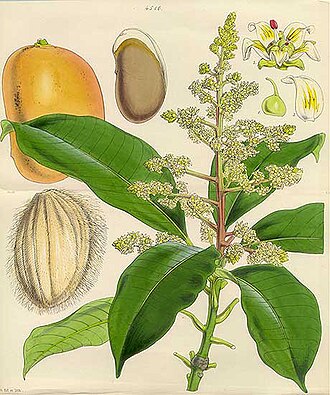
图:Walter Hood Fitch (1817-1892) del. et lith. Description by J… · Public domain · Wikimedia Commons
生命之树 › 真核生物 › 植物 › 绿色植物 › 链型植物 › 无患子目 › 漆树科 › 杧果属
芒果种
Mangifera indica
芒果树 也作檬果树、杧果树,是芒果属的一种植物,果实为芒果,原产南亚东北部和中南半岛,在梵语中叫作āmra,音译为“庵罗”,性喜高温、干燥的天气,营养生长期(根、茎、叶)最适合温度为24-30℃,气温降到18℃以下时生长缓慢,10℃以下停止生长,生殖生长期(花、果)需较高温度,以排水良好且含腐植质的砂质土壤最适宜,pH值5.5-7.5为佳。后引种改良,已遍及世界多国,其中十大芒果产地,以产量排名如下:印度、墨西哥、巴基斯坦、泰国、中国大陆、印尼、菲律宾、海地、刚果、台湾。
摘自维基百科「芒果树」,CC BY-SA 4.0
- 学名
- Mangifera indica
- 分类等级
- 种
- 上级类群
- 杧果属
- 大类
- 被子植物
- 命名
- 卡尔·林奈,1753 年
- 中文别名
- 檬果、杧果、密望、望果、马蒙、莽果
- 保护状况(IUCN)
- 数据缺乏
- 用途
- 植树造林、水果、药用植物、蔬菜、染料植物、堡垒之夜 大逃杀
- 数据库
- NCBI 分类 · GBIF · IUCN 红色名录
百科正文
形态特征
常绿大乔木,野生或粗放式植栽植株通常高达15至18米,树龄长,精致化栽种经过嫁接修剪,树高保持在两米至三米间,以利人站立地上就可以完全采收与修剪整枝;树皮鳞片状脱落;叶聚生枝顶,革质,长圆形,长披针形,圆锥花序生枝顶,每一花序有数百以至数千朵以上小花,淡黄色,分两性与雌性两种花,丽蝇是其最重要的授粉昆虫,花谢后结核果。果实大,歪卵形,微压扁,长可达20厘米。成熟果黄色,果肉嫩,香甜。
以上内容摘自维基百科「芒果树」,按 CC BY-SA 4.0 使用,去掉了参考文献、外部链接等尾部小节,公式改写成了纯文本。全文、配图和出处见原文。
英文维基百科补充中文条目比较短,下面是英文条目「Mangifera indica」的原文
Mangifera indica, commonly known as the mango tree after its fruit, is an evergreen species of flowering plant in the family Anacardiaceae. It is a large fruit tree, capable of growing to a height and width of 30 m (100 ft). There are two distinct genetic populations in modern mangoes – the "Indian type" and the "Southeast Asian type".
Description
Mangifera indica is a large green tree, valued mainly for its fruits, both green and ripe. Approximately 500–1000 varieties have been identified, named, or reported, primarily in India. It can grow up to 15–30 metres (50–100 feet) tall with a similar crown width and a trunk circumference of more than 3.7 m (12 ft). The leaves are simple, shiny and dark green. The trees take 2–4 years from planting time to first harvest, and can have a productive life of over 50 years.
Yellow-white fragrant flowers appear at the end of winter through the beginning of spring, varying with location. Both male and female flowers are borne on the same tree. Climatic conditions have a significant influence on the time of flowering. In India, flowering starts in December in the south, in January in Bengal, in February in eastern Uttar Pradesh and Bihar, and in February–March in northern India. The duration of flowering is 20–25 days for the Dasheri variety, while panicle emergence occurs in early December and flower opening is completed by February. The Neelum variety produces two crops a year in Kanyakumari, Tamil Nadu, but it flowers only once in North Indian conditions.
The mango is an irregular, egg-shaped fruit which is a fleshy drupe. Mangos are typically 8–12 centimetres (3–5 inches) long and greenish yellow in color. The fruits can be round, oval, heart, or kidney shaped. Mango fruits are green when they are unripe. The interior flesh is bright orange and soft with a large, flat pit in the middle. Mangos are mature in April and May. Raw mangos can be used in the making of pickles and chutneys. Ripe mangos are a popular fruit throughout the world. The skin and pulp account for 85% of the mango's weight, and the remaining 15% comes from the stone (seed).
Chemistry
Mangiferin (a pharmacologically active hydroxylated xanthone C-glycoside) is extracted from mango at high concentrations from the young leaves (172 g/kg), bark (107 g/kg), roots and from old leaves (94 g/kg). Allergenic urushiols are present in the fruit peel.
Taxonomy
Mangoes are believed to have originated from the region between northwestern Myanmar, Bangladesh, eastern and northeastern India. M. indica were domesticated separately in India and Southeast Asia over centuries, resulting in two distinct genetic populations in modern mangoes – the "Indian type" and the "Southeast Asian type".
The species was first described by Linnaeus in 1753. The scientific name Mangifera indica can be translated as "a mango-bearing plant of India".
Distribution and habitat
Since their domestication in southeastern Asia, mangoes have been introduced to other warm regions of the world. Generally, mango trees can withstand a minimum temperature of 17 °F (−8 °C).
Its broader native range extends from Pakistan to Malesia in subtropical and tropical climates with its origin point being around Western Indo-Burma.
The tree grows best in well-drained sandy loam; it does not grow well in heavy wet soils. The optimal pH of the soil should be between 5.2 and 7.5.
Toxicity
Urushiols in the fruit peel can trigger contact dermatitis in sensitised individuals. This reaction is more likely to occur in people who have been exposed to other plants from the family Anacardiaceae, such as poison oak and poison ivy, which are widespread in the United States.
The wood is known to produce phenolic substances that can cause contact dermatitis.
Uses
The tree is better known for its fruit than for its timber. However, mango trees can be converted to lumber once their fruit-bearing lifespan has finished. The wood is susceptible to damage from fungi and insects. The wood is used for musical instruments such as ukuleles, plywood and low-cost furniture.
The bark is used to produce a yellow dye.
Culture
The mango is the national fruit of India, Pakistan, and the Philippines, and is the national tree of Bangladesh.
The Indian mango is exported from India to the United States, where it has high demand.
以上内容摘自英文维基百科「Mangifera indica」,按 CC BY-SA 4.0 使用,去掉了参考文献、外部链接等尾部小节,公式改写成了纯文本。全文、配图和出处见原文。