格物
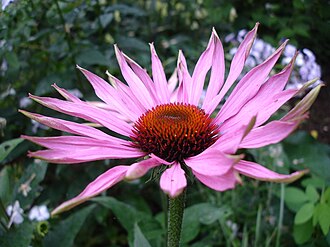
图:Ulf Eliasson · CC BY 2.5 · Wikimedia Commons
- 学名
- Echinacea
- 分类等级
- 属
- 上级类群
- 向日葵族
- 大类
- 被子植物
- 命名
- Conrad Moench
- 数据库
- NCBI 分类 · GBIF
下级类群(2)
百科正文
紫锥花主要分布于北美及欧洲,它含有菊苣酸、多糖体及烷酰胺(alkylamide)等成分,是一种免疫兴奋剂,能提升淋巴球的活性,增加肿瘤坏死因子(TNF)的释出,与促进干扰素的生成。
有消毒抗菌、抗病毒作用,可促进人体免疫系统,适合用于被病毒感染初期,预防或治疗感冒及促进伤口愈合。对治疗过敏、疝气和其他传染性疾病有帮助,也是印第安人治虫蛇咬伤的良药。紫锥菊茶和酊剂在流感季节特别受欢迎。
由于紫锥花的花粉具有丰富的营养,许多商家会把紫锥花粉制成各式各样的健康食品,甚至是奶粉。其萃取物目前已为医学界广泛使用。
相关
紫锥花运动是中华民国行政院所发起的一项反毒运动,希望借由紫锥花抗毒的意象,呼吁青少年成为解毒青年,自己能拒绝毒品也能规劝亲友拒绝毒品,由校园推向社会,由国内推向国际。
以上内容摘自维基百科「紫錐花屬」,按 CC BY-SA 4.0 使用,去掉了参考文献、外部链接等尾部小节,公式改写成了纯文本。全文、配图和出处见原文。
英文维基百科补充中文条目比较短,下面是英文条目「Echinacea」的原文
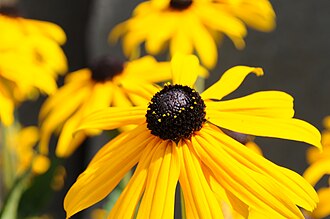
Echinacea [ek-in-NAY-shee-a] is a genus of herbaceous flowering plants in the daisy family. It has ten species, which are commonly called coneflowers. They are native only in eastern and central North America, where they grow in wet to dry prairies and open wooded areas. They have large, showy heads of composite flowers, blooming in summer. The generic name is derived from the Greek word ἐχῖνος (ekhinos), meaning "hedgehog", due to the spiny central disk. These flowering plants and their parts have different uses. Some species are cultivated in gardens for their showy flowers. Two of the species, E. tennesseensis and E. laevigata, were formerly listed in the United States as endangered species; E. tennesseensis has been delisted due to recovery and E. laevigata is now listed as threatened.
Echinacea has a long history of use in traditional medicine by Indigenous peoples for treating infections, pain, and wounds, and it later gained popularity in Western herbal remedies, especially for colds. However, modern research shows weak or inconclusive evidence for its effectiveness, with concerns about product variability and potential side effects. Regulatory authorities have not approved Echinacea products for any medical use.
Description
Echinacea species are herbaceous, drought-tolerant perennial plants growing up to 140 cm (4 ft 7 in) in height. They grow from taproots, except E. purpurea, which grows from a short caudex with fibrous roots. They have erect stems that in most species are unbranched. Both the basal and cauline (stem) leaves are arranged alternately. The leaves are normally hairy with a rough texture, having uniseriate trichomes (1–4 rings of cells), but sometimes they lack hairs. The basal leaves and the lower stem leaves have petioles, and as the leaves progress up the stem the petioles often decrease in length. The leaf blades in different species may have one, three, or five nerves.
Taxonomy
The first Echinacea species were named by European explorers after seeing them in the forests of southeastern North America during the 18th century. The genus Echinacea was then formally described by Linnaeus in 1753, and this specimen as one of five species of Rudbeckia, Rudbeckia purpurea. Conrad Moench subsequently reclassified it in 1794 as the separate but related genus, Echinacea, with the single species Echinacea purpurea, so that the botanical authority is given as (L.) Moench. In 1818, Nuttall, using the original name, described a variety of Rudbeckia purpurea, which he named Rudbeckia purpurea var serotina.
Distribution and habitat
Echinacea is restricted to North America, east of the Rocky Mountains, and in the Atlantic drainage area, predominantly the Great Plains and central United States and adjacent areas of Canada. The genus range is from Saskatchewan in the north to almost the Gulf of Mexico in Louisiana and Texas in the south, and from the Ohio oak savannas, glades of Tennessee and the Carolinas in the east, to the Rocky Mountain foothills in the west.
Conservation
Natural populations of Echinacea are threatened by over-harvesting of wild specimens for the herbal product trade, modification of their habitats by humans, and a decrease in the number of pollinators. Major reductions in the size of populations of E. laevigata and E. tennesseensis have led to their classification as endangered species. Insects and other modes of pollen distribution can be detrimental to conservation efforts. E. tennesseensis had recovered sufficiently by 2011 that it was removed from the list.
Cultivation
Many species of Echinacea are cultivated for commercial use, while others, notably E. purpurea, E. angustifolia, and E. pallida, are grown as ornamental plants in gardens. Many cultivars exist, and many of them are asexually propagated to keep them true to type.
Uses
Echinacea has long been used as a traditional medicine.
History
Echinacea angustifolia was widely used by the North American Indigenous peoples as folk medicine, with archaeological evidence dating back to the 18th century. Traditional use included external application (insect bites, burns, wounds), chewing of roots (throat and tooth infections) and internal use (cough, pain, snake bites, stomach cramps). Some Plains tribes used Echinacea for cold symptoms. The Kiowa used it for coughs and sore throats, the Cheyenne for sore throats, the Pawnee for headaches, and many tribes, including the Lakota, used it as a pain medication.
以上节选摘自英文维基百科「Echinacea」,按 CC BY-SA 4.0 使用,去掉了参考文献、外部链接等尾部小节,公式改写成了纯文本。篇幅所限,较长的小节只摘了开头一部分,有的小节没有收;全文、配图和出处见原文。