 格物
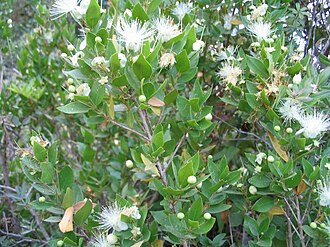
图:Public domain · Wikimedia Commons
- 学名
- Myrtus
- 分类等级
- 属
- 上级类群
- 桃金娘科
- 大类
- 被子植物
- 命名
- 卡尔·林奈,1753 年
- 中文别名
- 银香梅属
- 数据库
- NCBI 分类 · GBIF
下级类群(1)
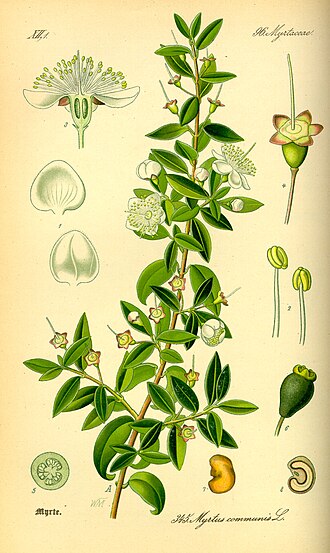
- 香桃木 Myrtus communis 种
百科正文
在希腊神话中,香桃木被尊为爱神阿芙洛狄蒂的圣花。由此而来,希腊古时的新娘们都喜欢佩戴香桃木花叶编织的婚冠。
以上内容摘自维基百科「香桃木属」,按 CC BY-SA 4.0 使用,去掉了参考文献、外部链接等尾部小节,公式改写成了纯文本。全文、配图和出处见原文。
英文维基百科补充中文条目比较短,下面是英文条目「Myrtus」的原文
Myrtus (commonly called myrtle) is a genus of flowering plants in the family Myrtaceae. It was first described by Swedish botanist Linnaeus in 1753. Myrtle was described much earlier in Leviticus, as part of the feast and observance of Sukkot. It has long been used as a medicinal herb in traditional practices.
Over 600 names have been proposed in the genus, but nearly all have either been moved to other genera or been regarded as synonyms. Two species are currently accepted:
Myrtus communis L. – Common myrtle; native to the Mediterranean region in southern Europe
Myrtus nivellei Batt. & Trab. – Saharan myrtle; native to the Saharan mountains of northern Africa
Description
Common myrtle
Myrtus communis, the "common myrtle", is native across the Mediterranean region, Macaronesia, western Asia, and the Indian subcontinent. It is also cultivated.
The plant is an evergreen shrub or small tree, growing to 5 metres (16 ft) tall. The leaf is entire, 3–5 cm long, with a fragrant essential oil.
The star-like flower has five petals and sepals, and numerous stamens. Petals usually are white. The flower is pollinated by insects.
The fruit is a round berry containing several seeds, most commonly blue-black in colour. A variety with yellow-amber berries is also present. The seeds are dispersed by birds that eat the berries.
Saharan myrtle
Myrtus nivellei, the Saharan myrtle, (Tuareg language: tefeltest), is endemic to the mountains of the central Sahara Desert. It is found in a restricted range in the Tassili n'Ajjer Mountains in southern Algeria, and the Tibesti Mountains in northern Chad.
It occurs in small areas of sparse relict woodland at montane elevations above the central Saharan desert plains.
Fossil record
Two hundred and fifty fossil seeds of †Myrtus palaeocommunis have been described from middle Miocene strata of the Fasterholt area near Silkeborg in Central Jutland, Denmark.
Uses
Gardening
Myrtus communis is widely cultivated as an ornamental plant for use as a shrub in gardens and parks. It is often used as a hedge plant, with its small leaves shearing cleanly.
When trimmed less frequently, it has numerous flowers in late summer. It requires a long hot summer to produce its flowers, and protection from winter frosts.
The species and the subspecies M. communis subsp. tarentina have gained the Royal Horticultural Society's Award of Garden Merit.
Culinary
Myrtus communis is used in the islands of Sardinia and Corsica to produce an aromatic liqueur called Mirto by macerating it in alcohol. Mirto is one of the most typical drinks of Sardinia and comes in two varieties: mirto rosso (red) produced by macerating the berries, and mirto bianco (white) produced from the less common yellow berries and sometimes the leaves.
Many Mediterranean pork dishes include myrtle berries, and roasted piglet is often stuffed with myrtle sprigs in the belly cavity, to impart an aromatic flavour to the meat.
Garden history
Rome
Because of its elegance of habit, appealing odour, and amenity to clipping by the topiarius, as much as for sacred associations, the myrtle was an indispensable feature of Roman gardens. As a reminder of home, it will have been introduced wherever Roman elites were settled, even in areas of the Mediterranean Basin where it was not already endemic: "the Romans... must surely have attempted to establish a shrub so closely associated with their mythology and tradition," observes Alice Coats. In Gaul and Britannia it will not have proved hardy.
England
In England it was reintroduced in the 16th century, traditionally with the return from Spain in 1585 of Sir Walter Raleigh, who also brought with him the first orange trees seen in England. Myrtus communis will have needed similar protection from winter cold and wet.
Related plants
Many other related plants native to South America, New Zealand and elsewhere, previously classified in a wider interpretation of the genus Myrtus, are now species within other genera, including: Eugenia, Lophomyrtus, Luma, Rhodomyrtus, Syzygium, Ugni, and at least a dozen other genera.
The name "myrtle" is also used in common names (vernacular names) of unrelated plants in several other genera, such as: "Crepe myrtle" (Lagerstroemia species and hybrids, Lythraceae); "Wax myrtle" (Morella species, Myricaceae); and "Creeping myrtle" (Vinca species, Apocynaceae).
以上节选摘自英文维基百科「Myrtus」,按 CC BY-SA 4.0 使用,去掉了参考文献、外部链接等尾部小节,公式改写成了纯文本。篇幅所限,较长的小节只摘了开头一部分,有的小节没有收;全文、配图和出处见原文。