 格物
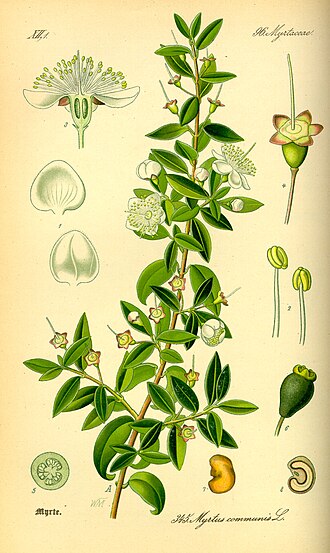
图:Public domain · Wikimedia Commons
- 学名
- Myrtus communis
- 分类等级
- 种
- 英文名
- common myrtle
- 上级类群
- 香桃木属
- 大类
- 被子植物
- 命名
- 卡尔·林奈,1753 年
- 保护状况(IUCN)
- 无危物种
- 用途
- 药用植物
- 数据库
- NCBI 分类 · GBIF · IUCN 红色名录
百科正文
英文维基百科补充中文条目比较短,下面是英文条目「Myrtus communis」的原文
Myrtus communis, the common myrtle or true myrtle, is an Old World species of flowering plant in the myrtle family, Myrtaceae. It forms an evergreen shrub.
Description
The plant is an evergreen shrub or small tree, growing to 5 metres (16 feet) tall. The leaves are 2–5 centimetres (1–2 in) long, with a fragrant essential oil.
The flowers are white or tinged with pink, with five petals and many stamens that protrude from the flower. The fruit is an edible berry that is blue-black when ripe.
Distribution and habitat
The species is native to southern Europe, North Africa, Western Asia, Macaronesia, and the Indian subcontinent.
Cultivation
This species and the more compact M. communis subsp. tarentina have won the Royal Horticultural Society's Award of Garden Merit. They are hardy but prefer a sheltered position in full sun.
The plant can be propagated with seeds stratified for 3 months. Also, one can use a cutting with a short heel (small part of the bark), keeping it in moistened rooting mix.
Uses
The essential oils derived from this plant have anti-proliferative and anti-quorum sensing properties, helping against food spoilage. The berries are also macerated in alcohol to make Mirto liqueur.
以上内容摘自英文维基百科「Myrtus communis」,按 CC BY-SA 4.0 使用,去掉了参考文献、外部链接等尾部小节,公式改写成了纯文本。全文、配图和出处见原文。