 格物
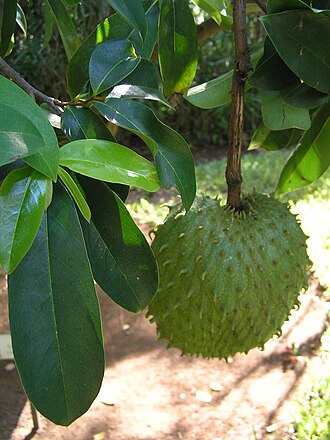
图:Damien Boilley from suburbs of Paris, France · CC BY 2.0 · Wikimedia Commons
- 学名
- Annona muricata
- 分类等级
- 种
- 上级类群
- 番荔枝属
- 大类
- 被子植物
- 命名
- 卡尔·林奈,1753 年
- 中文别名
- 刺番荔枝、红毛榴莲
- 保护状况(IUCN)
- 无危物种
- 用途
- 植树造林、果实、木材、饲料、食物、药用植物
- 数据库
- NCBI 分类 · GBIF · IUCN 红色名录
百科正文
原产于美洲热带地区,现广泛引种于世界各地。中国大陆产区为海南、云南、广西等气温较高地区。
以上内容摘自维基百科「刺果番荔枝」,按 CC BY-SA 4.0 使用,去掉了参考文献、外部链接等尾部小节,公式改写成了纯文本。全文、配图和出处见原文。
英文维基百科补充中文条目比较短,下面是英文条目「Soursop」的原文
Soursop (also called graviola, guyabano, and in Hispanic America guanábana) is the fruit of Annona muricata, a broadleaf, flowering, evergreen tree. It is native to the tropical Americas and is widely propagated. It is in the same genus, Annona, as cherimoya and is in the Annonaceae family.
The soursop is adapted to areas of high humidity and relatively warm winters; temperatures below 5 °C (41 °F) will cause damage to leaves and small branches, and temperatures below 3 °C (37 °F) can be fatal. The fruit becomes dry and is no longer good for concentrate.
With an aroma similar to pineapple, the flavor of the fruit has been described as a combination of strawberries and apple with sour citrus flavor notes, contrasting with an underlying thick creamy texture reminiscent of banana.
Soursop is widely promoted (sometimes as graviola) as an alternative cancer treatment, but there is not enough reliable medical evidence that it is effective for treating cancer or any disease.
Soursop leaves, skin, flesh, and seeds contain annonacin, a compound under preliminary research for its potential neurotoxicity.
Annona muricata
Annona muricata is a species of the genus Annona of the custard apple tree family, Annonaceae, which has edible fruit. The fruit is usually called soursop due to its slightly acidic taste when ripe. Annona muricata is native to Mexico and Central America but is now widely cultivated – and in some areas, becoming invasive – in tropical and subtropical climates throughout the world, such as India.
Botanical description
Annona muricata is a small, upright, evergreen tree that can grow to about 10 m (33 ft) tall.
Its young branches are hairy. The leaves are oblong to oval, 8 to 16 cm (3.1 to 6.3 in) long and 3 to 7 cm (1.2 to 2.8 in) wide. They are a glossy dark green with no hairs above, and paler and minutely hairy to no hairs below. The leaf stalks are 4 to 13 mm (0.16 to 0.51 in) long and without hairs.
Flower stalks (peduncles) are 2 to 5 mm (0.079 to 0.197 in) long and woody. They appear opposite from the leaves or as an extra from near the leaf stalk, each with one or two flowers, occasionally a third.
Distribution
Annona muricata is tolerant of poor soil and prefers lowland areas between the altitudes of 0 to 1,200 m (3,900 ft). The exact origin is unknown; it is native to the tropical regions of the continental Americas and is widely propagated. It is an introduced species on all temperate continents, especially in subtropical regions.
Cultivation
The plant is grown for its 10–35 cm (3.9–13.8 in) long, prickly, green fruit, which can weigh up to 10 kg (22 lb), making it the largest Annona fruit, though not as large as the related junglesop Anonidium mannii. Away from its native area, some limited production occurs as far north as southern Florida within USDA Zone 10; however, these are mostly garden plantings for local consumption. It is also grown in parts of China and Southeast Asia and is abundant on the Island of Mauritius. The main suppliers of the fruit are Mexico followed by Peru, Brazil, Ecuador, Guatemala, and Haiti.
Uses
Culinary
The flesh of the fruit consists of an edible, white pulp, some fiber, and a core of indigestible black seeds. The pulp is also used to make fruit nectar, smoothies, fruit juice drinks, as well as candies, sorbets, and ice cream flavorings.
Nutrition
Raw soursop is 81% water, 17% carbohydrates, 1% protein, and has negligible fat (see table). In a reference amount of 100 g (3.5 oz), the raw fruit supplies 276 kilojoules (66 kilocalories) of food energy, and contains only vitamin C as a significant amount (23%) of the Daily Value, with no other micronutrients in appreciable amounts (table).
Phytochemicals
The neurotoxin annonacin is contained in the fruit, seeds, and leaves of soursop. The leaves of Annona muricata contain annonamine, which is an aporphine-class alkaloid containing a quaternary ammonium group. The plant also contains lichexanthone, a compound in the xanthone class.
Neurotoxicity
The Memorial Sloan-Kettering Cancer Center cautions, "alkaloids extracted from graviola may cause neuronal dysfunction". Annonacin has been shown in laboratory research to be neurotoxic. In 2010, the French food safety agency concluded that "it is not possible to confirm that the observed cases of atypical Parkinson syndrome... are linked to the consumption of Annona muricata".
以上节选摘自英文维基百科「Soursop」,按 CC BY-SA 4.0 使用,去掉了参考文献、外部链接等尾部小节,公式改写成了纯文本。篇幅所限,较长的小节只摘了开头一部分,有的小节没有收;全文、配图和出处见原文。