 格物
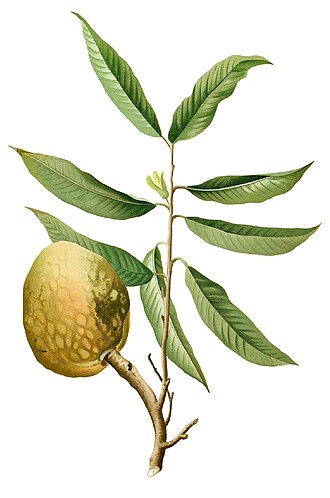
图:Francisco Manuel Blanco (O.S.A.) · Public domain · Wikimedia Commons
- 学名
- Annona reticulata
- 分类等级
- 种
- 上级类群
- 番荔枝属
- 大类
- 被子植物
- 命名
- 卡尔·林奈,1753 年
- 中文别名
- 牛心梨、牛心果
- 保护状况(IUCN)
- 无危物种
- 用途
- 植树造林、果实、药用植物、食物、饲料
- 数据库
- NCBI 分类 · GBIF · IUCN 红色名录
百科正文
该种原产于热带美洲,原生分布范围自墨西哥延伸至南美洲北部,现已被引种至亚洲、非洲、大洋洲及其他热带地区;台湾、福建、广东、广西和云南等地有栽培。
植株通常高约6—10米。果实为近球形或心形的聚合果,直径约5—12.5厘米,表面无毛并具有网纹;成熟时通常呈暗黄色、黄红色或褐色。果肉呈乳脂状,可食用,通常味甜,但不同栽培品种的风味和质地有所差异。
其种加词“reticulata”意为“网纹的”或“网状的”。
以上内容摘自维基百科「牛心番荔枝」,按 CC BY-SA 4.0 使用,去掉了参考文献、外部链接等尾部小节,公式改写成了纯文本。全文、配图和出处见原文。
英文维基百科补充中文条目比较短,下面是英文条目「Annona reticulata」的原文
Annona reticulata is a small deciduous or semi-evergreen tree in the plant family Annonaceae. It is best known for its fruit, called custard apple, a common name shared with fruits of several other species in the same genus: A. cherimola and A. squamosa. Other English common names include ox heart and bullock's heart. The fruit is sweet and useful in preparation of desserts, but is generally less popular for eating than that of A. cherimola.
Description
It is a small deciduous or semi-evergreen tree reaching 8–10 metres (26–33 ft) tall with an open, irregular crown.
The slender leaves are hairless, straight and pointed at the apex (in some varieties wrinkled), 10–20 cm (4–8 in) long and 2–7 cm (1–3 in) wide. The yellow-green flowers are generally in clusters of three or four 2–3 cm (3⁄4–1+1⁄4 in) diameter, with three long outer petals and three very small inner ones. Its pollen is shed as permanent tetrads.
The fruits vary in shape, heart-shaped, spherical, oblong or irregular. The size ranges from 7–12 cm (3–4+1⁄2 in), depending on the cultivar. When ripe, the exterior of the fruit is brown or yellowish, with red highlights and a varying degree of reticulation, depending again on the variety. The flesh, which is white and pink with numerous black seeds, varies from juicy and very aromatic to hard with a repulsive taste.
Distribution and habitat
Annona reticulata is native to the West Indies (Caribbean and Central America). Annona reticulata is now pantropical. It grows from sea level to elevations of 1,500 metres (5,000 ft) in areas of Central America that have alternating wet and dry seasons. It is cultivated and naturalized in many tropical places including Southeast Asia, Taiwan, South Asia, Australia, and Africa. In India, the species has migrated from initial cultivation into the wild.
Climate
Although the tree grows optimally in tropic conditions, it is also found in subtropical regions. It requires humid conditions (medium to high rainfall). Compared to the other Annona, it is less drought tolerant. The annual temperature necessary ranges from 17 to 27 °C (63 to 81 °F). It tolerates light night frosts to −2 °C (28 °F). A. reticulata grows on many soil types with pH ranging from 5 to 8. It does not tolerate waterlogging or when the water table is too high.
Cultivation
Seeds can be propagated. Other techniques for cultivation are grafting and budding. The tree produces 45 kg of fruits per year. In Asia, the season lasts from July to September, and in the Caribbean, it runs from February to April. Annona reticulata can take 2-3 years from planting time to harvest.
Uses
Food
Custard apple can be eaten raw, out of hand as a fresh fruit. It is not as popular as the sugar apple or the cherimoya. It can also be prepared as juices, ice-cream or puddings. In India, it is cooked into a sauce.
Propagation
A. reticulata may be grown in home gardens, even though it may not be as popular as the sugar apple (A. squamosa). It has value as rootstock for superior Annona species, such as the sugar apple, especially under humid conditions. It is also a genetic resource for hybridization.
Other
The leaves and the branches can be used for tanning as they contain blue pigments. Wrappers, ornaments and hats can be made from the inner bark. The wood is soft and can be used to make utensils, even though, it is weak and of bad quality.
Nutrition
In a 100-gram reference amount, custard apple supplies 423 kilojoules (101 kilocalories) of food energy, 23% of the Daily Value (DV) of vitamin C and 17% DV of vitamin B6, with no other micronutrients in significant amounts (table). Raw custard apple is 72% water, 25% carbohydrates, 2% protein, and 1% fat (table).
Risk and impact
Annona reticulata is known to be an invasive plant. A PIER risk assessment gave a score of 11 for the Annona reticulata. It negatively impacts the population cultivating the crop as all parts of the tree (except the fruit) are toxic, possibly causing problems for human health.
Diseases and pests
The diseases that can spread to Annona reticulata include the Anthracnose, the leaf spot, the diplodia rot and the black canker. The spiral nematode, the stunt nematode and the mealybug can also infect the plant
Aroma and phytochemicals
The fragrant aroma of A. reticulata results from some 180 compounds, including the volatile compounds, alpha-pinene, myrcene, and limonene, among others. The plant is rich in tannins.
Traditional medicine
Various traditional medicine uses have been reported over centuries for its dried fruits, bark, or leaves. In Jamaica and Panama, custard apple was used in traditional medicine as a decoction of the leaves, green fruit and bark.
以上节选摘自英文维基百科「Annona reticulata」,按 CC BY-SA 4.0 使用,去掉了参考文献、外部链接等尾部小节,公式改写成了纯文本。篇幅所限,较长的小节只摘了开头一部分,有的小节没有收;全文、配图和出处见原文。