 格物
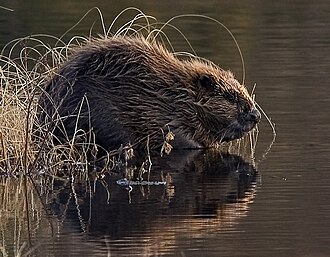
图:Per Harald Olsen · CC BY-SA 3.0 · Wikimedia Commons
- 学名
- Castor fiber
- 分类等级
- 种
- 上级类群
- 河狸属
- 大类
- 哺乳动物
- 命名
- 卡尔·林奈,1758 年
- 中文别名
- 河狸
- 保护状况(IUCN)
- 无危物种
- 栖息地
- 森林
- 数据库
- NCBI 分类 · GBIF · IUCN 红色名录
百科正文
欧亚河狸是体型最大的啮齿动物之一,体重一般在11–30 kg之间,平均体重18 kg。
从河狸干燥会阴腺体取得的香水称为河狸香。
以上内容摘自维基百科「欧亚河狸」,按 CC BY-SA 4.0 使用,去掉了参考文献、外部链接等尾部小节,公式改写成了纯文本。全文、配图和出处见原文。
英文维基百科补充中文条目比较短,下面是英文条目「Eurasian beaver」的原文
The Eurasian beaver (Castor fiber) or European beaver is a species of beaver widespread across Eurasia, with a rapidly increasing population of 1.5 million in 2020. The Eurasian beaver was hunted to near-extinction for both its fur and castoreum, with only about 1,200 beavers in eight relict populations from France to Mongolia in the early 20th century. It has since been reintroduced into much of its former range and now lives from Western, Southern, Central and Eastern Europe, Scandinavia, Russia through China and Mongolia, with about half the population in Russia. It is listed as least concern on the IUCN Red List.
Taxonomy
Castor fiber was the scientific name used by Carl Linnaeus in 1758, who described the beaver in his work Systema Naturae. Between 1792 and 1997, several Eurasian beaver zoological specimens were described and proposed as subspecies, including:
- C. f. albus and C. f. solitarius by Robert Kerr in 1792
- C. f. fulvus and C. f. variegatus by Johann Matthäus Bechstein in 1801
- C. f. galliae by Étienne Geoffroy Saint-Hilaire in 1803
- C. f. flavus, C. f. varius and C. f. niger by Anselme Gaëtan Desmarest in 1822
- C. f. gallicus Johann Baptist Fischer in 1829
- C. f. proprius by Gustaf Johan Billberg in 1833
- C. f. albicus, C. f. balticus and C. f. vistulanus by Paul Matschie in 1907
Description
The Eurasian beaver's fur colour varies between regions. Light, chestnut-rust is the dominant colour in Belarus. In Russia's Sozh River basin, it is predominantly blackish brown, while in the Voronezh Nature Reserve beavers are both brown and blackish-brown.
The Eurasian beaver is one of the largest living rodent species and the largest rodent native to Eurasia. Its head-to-body length is 80–100 cm (31–39 in) with a 25–50 cm (9.8–19.7 in) long tail length. It weighs around 11–30 kg (24–66 lb). By the average weights known, it appears to be the world's second heaviest rodent after the capybara, and is slightly larger and heavier than the North American beaver.
Distribution and habitat
The Eurasian beaver is recovering from near extinction, after depredation by humans for its fur and for castoreum, a secretion of its scent gland believed to have medicinal properties. The estimated population was only 1,200 by the early 20th century. In many European countries, the Eurasian beaver became extirpated, but reintroduction and protection programmes led to gradual recovery so that by 2020, the population was at least 1.5 million. It likely survived east of the Ural Mountains from a 19th-century population as low as 300 animals.
Behaviour and ecology
The Eurasian beaver is a keystone species, as it helps to support the ecosystem which it inhabits. It creates wetlands, which provide habitat for European water vole, Eurasian otter and Eurasian water shrew. By coppicing waterside trees and shrubs it facilitates their regrowth as dense shrubs, thus providing cover for birds and other animals. Beavers build dams that trap sediment, improve water quality, recharge groundwater tables and increase cover and forage for trout and salmon. Also, abundance and diversity of vespertilionid bats increase, apparently because of gaps created in forests, making it easier for bats to navigate.
Fossil record
Fossils found in the Spanish region around Atapuerca show that the Eurasian beaver was present in the Early Pleistocene but not in the Middle Pleistocene despite apparently favourable environmental conditions. It reappeared in the region during the Late Pleistocene and Holocene.
Conservation
The Eurasian beaver Castor fiber was once widespread in Europe and Asia but by the beginning of the 20th century both the numbers and range of the species had been drastically diminished, mainly due to hunting. At this time, the global population was estimated to be around 1,200 individuals, living in eight separate sub-populations. Conservation of the Eurasian beaver began in 1923 in the Soviet Union, with the establishment of the Voronezh Nature Reserve. From 1934 to 1977, approximately 3,000 Eurasian beavers from Voronezh were reintroduced to 52 regions from Poland to Mongolia.
以上节选摘自英文维基百科「Eurasian beaver」,按 CC BY-SA 4.0 使用,去掉了参考文献、外部链接等尾部小节,公式改写成了纯文本。篇幅所限,较长的小节只摘了开头一部分,有的小节没有收;全文、配图和出处见原文。